




Pofile
Nelson Chibuikem Emmanuel (Nelson the Carpenter) || The Young Nigerian Redefining Carpentry and Interior Design

Nelson Chibuikem Emmanuel, popularly known as Nelson the Carpenter is turning carpentry into a modern furniture and interior-design business with CarpenterWay, building a stylish showroom, training others and proving that vocational skills can scale.

Nelson the Carpenter
In a country where many young people dream of office jobs and corporate titles, Nelson Chibuikem Emmanuel, popularly known as Nelson the Carpenter has chosen a different path. One that celebrates skill, craftsmanship and creativity. With passion as his compass and hard work as his tool, Nelson Chibuikem Emmanuel has steadily carved out a name for himself as one of Nigeria’s most inspiring young entrepreneurs in carpentry and interior design.
Through his brand, CarpenterWay Nigeria, Nelson Chibuikem Emmanuel is not just building furniture, he’s building a movement that gives dignity back to skilled work. From humble beginnings in Anambra State, he has turned what many once considered a “blue-collar” trade into a respected, profitable and innovative enterprise. His story speaks to the power of vision, consistency and belief in the beauty of one’s craft.
Nelson’s journey is one that resonates deeply with today’s generation of young Nigerian carpenters, artisans and entrepreneurs. At a time when the country is calling for youth empowerment and skill-based innovation, his rise represents a new narrative that one can be both creative and successful without conforming to traditional career paths.
This article takes a close look at Nelson Chibuikem Emmanuel a.k.a. Nelson the Carpenter’s life, his entrepreneurial journey, his impact on the Nigerian carpentry and interior design industry, and what makes him a shining example of excellence, humility and purpose-driven success.
Early Life and Education of Nelson Chibuikem Emmanuel (Nelson the Carpenter)
Nelson hails from Anambra State in Nigeria where he was born and raised. Media coverage describes Nelson Chibuikem Emmanuel as born and raised in Anambra State.
While the exact town of origin and his family background are not widely published, one report states that he is a graduate of Nnamdi Azikiwe University in Awka.
According to an interview he granted some time ago, the spark for his journey into carpentry occurred during an extended strike by the Academic Staff Union of Universities (ASUU) while he was in 300-level at the university. With classes suspended, he decided to use the time to learn carpentry. He describes this as the moment he discovered the potentials in carpentry.
Nelson Chibuikem Emmanuel admits that he did not start with a strong passion for carpentry. According to him, he preferred indoor work or using a laptop. However, by gaining experience from watching how furniture was made and how spaces were transformed, his interest in the skill grew.
Nelson the Carpenter started with raw wood-work, gradually moving into interior-decoration and furniture fitting, realizing that carpentry and interior design are intertwined. According to him, wood-work should come first, and then, you learn that interior decor is part of it.
Nelson Chibuikem Emmanuel’s story is a demonstration that formal schooling wasn’t the only entry point into his success, rather, hands-on learning, apprenticeship and self-driven practice helped him lay his foundation.
From Workshop Beginnings to A Public Brand
Nelson the Carpenter’s journey began in a modest workshop rather than a polished studio. In 2017, while he was a 300‑level student at Nnamdi Azikiwe University in Awka, he found himself caught up in one of the recurring strikes by the Academic Staff Union of Universities (ASUU). With classes halted for months, he decided to use the downtime to learn carpentry, even though at that point, he admitted he would rather have been working on a laptop than wielding a saw.
What began as an experiment turned into a passion. He started with basic wood‑work, recognizing early on that furniture making and interior décor are closely connected. According to Nelson Chibuikem Emmanuel, the early days were full of self‑doubt but also full of learning, watching YouTube videos late into the night, and turning his “soft boy” image into hands‑on craft.
Over time, his little workshop evolved into a brand – CarpenterWay. He positioned himself not just as a craftsman but as the creative director of a furniture and interior‑design business. Local press describes him as the founder and CEO of the firm based in Awka, serving households, offices and real‑estate developers.
One of the turning points came when he announced his involvement in large‑scale interior projects. In July 2024, he told one newspaper that he had handled an interior job worth over ₦200 million, and that his edge came from being both a trained carpenter and an interior designer which give him the hands‑on credibility they said many in his industry do not have.
As CarpenterWay expanded, Nelson emphasized digital media, original designs and a blend of craft and aesthetics. In one interview, he explained that the brand’s ambition was to become a household name, and to move beyond mere furniture making to full interior conceptualization and delivery.
Today, Nelson the Carpenter is visible not just as a carpenter but as an entrepreneur, brand‑builder and voice for vocational skills. His transformation from workshop apprentice to public brand exemplifies how skilled trades, when combined with design sensibility and business acumen, can become something greater.
The ₦200 Million Project
One of the milestones that brought Nelson the Carpenter into the spotlight was his public statement about handling interior projects valued at over ₦200 million. In interviews with local media, he explained that his unique advantage comes from combining his carpentry skills with interior design expertise. Nelson described how his education and hands-on experience allowed him to manage large-scale projects efficiently, giving him an edge over others in the industry.
Regional publications such as InlandTown also highlighted this achievement, emphasizing that Nelson had moved from small-scale workshop jobs to managing substantial contracts that positioned him as one of Anambra’s notable young entrepreneurs. He credited this growth to his dedication, creative approach and attention to detail which have become hallmarks of the CarpenterWay brand.
This headline figure not only captured media attention but also solidified Nelson the Carpenter’s reputation as a serious player in the Nigerian furniture and interior design industry. It marked a clear transition from a humble workshop apprentice to the leader of a recognizable brand delivering high-quality, large-scale projects across Anambra State.
Showroom, Projects and The CarpenterWay Experience
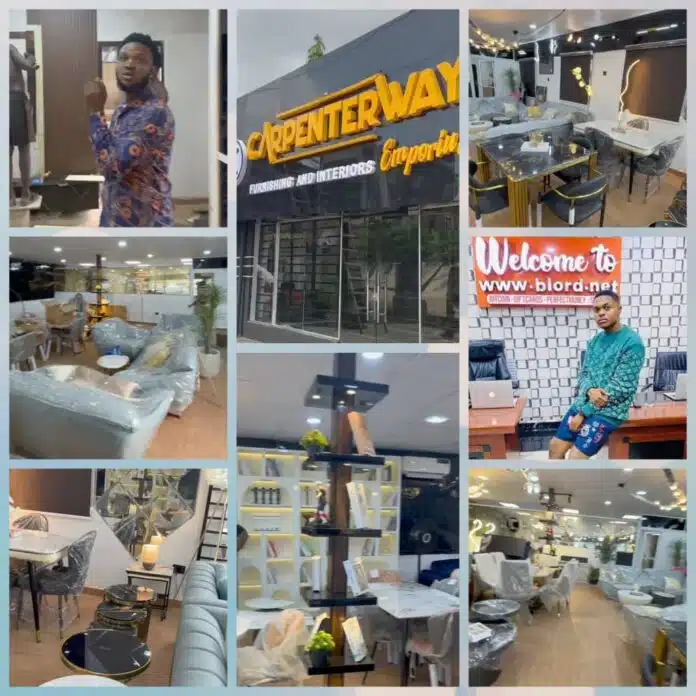
CarpenterWay Showroom
When you mention Nelson the Carpenter, one of the most visible markers of his progress is the showroom and project execution under his brand, CarpenterWay. What started as a workshop has matured into a physical retail‑and‑display space, major interior design jobs and an immersive brand experience that blends craftsmanship with modern design.
The Showroom
Located on Igweze Street, near Paxi Christi Plaza in Awka, Anambra State, the showroom branded CarpenterWay Emporium serves as the face‑to‑face business front of his enterprise. According to a December 2024 feature, Nelson unveiled the showroom as not just a showroom, but an immersive space where art meets functionality, and described how it was designed to cater to a wide array of furniture and décor tastes. The article noted that this launch was a milestone in establishing CarpenterWay as more than a small‑scale carpenter‑workshop, but a full‑fledged interior design and furnishing brand.
The Project List and Client Reach
As part of the CarpenterWay experience, major clients and large‑scale projects began to feature more prominently. The same December 2024 article reported that a prominent Anambra entrepreneur, Linus Williams Ifejika, popularly known as BLord commissioned Nelson for major projects after seeing his work online. This kind of endorsement helps to signal that the brand is reaching clients beyond individual homeowners, potentially into corporate or high‑net‑worth channels.
Another regional profile mentioned that CarpenterWay handles jobs for individuals, hotels, offices and estates, proving the range from home‑furnishing jobs to larger interior‑fit‑out assignments.
The Brand Experience
Nelson the Carpenter has emphasized that his brand, CarpenterWay is about more than woodwork. According to him, it’s about design, function and lifestyle. In interviews, he has spoken about using CGI/3D modelling, experimenting with design inspirations he found online, and then modifying them into bespoke pieces for clients.
This approach allows clients visiting the showroom to explore both finished pieces and design concepts, making the showroom a gateway into the brand’s value proposition: crafted for you, made with skill and vision.
The showroom and project dimension of CarpenterWay mark an important evolution in the story of Nelson Chibuikem Emmanuel – from local carpentry work to a visible brand with showroom presence, formalized client offering and a design‑led business model.
Training, Academy Ambitions and Youth Empowerment
For Nelson the Carpenter, training and youth empowerment are not after‑thoughts, they’re central to his vision for the future. In interviews, Nelson Chibuikem Emmanuel has consistently urged young Nigerians to value skilled craft and to reject the idea that white‑collar work is the only path to success. According to him, there is dignity in labour, and instead of jumping into fraud, one should use that same brain one wants to use to scam people to learn skills, improve one’s skills and earn an honest living.
His brand – CarpenterWay increasingly frames training as part of its model. Nelson has trained and mentored dozens of young carpenters and interior designers through informal apprenticeships and hands‑on workshops. He emphasizes recruiting young people into his workshop and giving them the chance to learn both the artisan side (wood‑work, joinery) and the design side (interior decorating, fit‑out planning). As he commented in a July 2024 interview: “I recruit my fellow young people and it makes jobs really smooth, fast and innovative.”
Beyond his own workshop, the broader environment in Anambra State shows a growing ecosystem for vocational training which strongly aligns with Nelson’s message. For example, the 1Youth2Skills Solution (1Y2SS) programme launched by the government of Anambra State aims to empower thousands of youths with entrepreneurial and vocational skills.
By speaking about young Nigerians learning carpentry, interior fit‑out and furniture work, Nelson positions himself and his brand – CarpenterWay as part of that broader shift in “skills first” thinking.
Nelson the Carpenter uses his platforms to challenge stigma around trades and to elevate vocational work. He has said that many young people see trades as unattractive. “Soft boys” prefer laptops or air‑conditioned offices, he implied, but turning those hands‑on skills into a business is a viable path.
Through this training focus and his public advocacy, he aims to empower youth with marketable craft skills and build a local talent pipeline for the interior‑design/carpentry ecosystem in Anambra and beyond. As CarpenterWay expands, the training and mentorship angle gives the brand longer‑term depth, not just a showpiece workshop.
Recognition and Local Lists

The story of Nelson Chibuikem Emmanuel, also known as Nelson the Carpenter includes several noteworthy recognitions and listings that have elevated his profile beyond the workshop. These recognitions reflect his fast‑rising status in Anambra State’s entrepreneurship scene and help explain why his brand, CarpenterWay is progressively gaining visibility.
In July 2022, Nelson was featured among the “Anambra 30 Under 35 Entrepreneurs to Watch” by a regional business‑media outlet. The listing highlighted him as the young man behind CarpenterWay, one of Anambra’s fastest growing furnishing and interior‑decorating enterprises, and described him as arguably the richest young carpenter in Anambra State.”
In mid‑2023, a local publication noted that Nelson, as founder and creative director of CarpenterWay was set to receive the “Creative Entrepreneur of the Year” award at the prestigious Anambra Man of the Year awards. The piece described how he had managed to catch the attention of enthusiasts through outstanding talent in furniture and interior decoration.
More recently, Nelson was ranked Number 2 on the list of “20 Anambra Outstanding Young Entrepreneurs in 2025” compiled by a local online magazine. The list positions him as a standout among his peers in the region, and attributes his placement to his transition from craft into a scalable enterprise that supplies furnishing, fit‑outs and interior services. The article stated that Nelson the Carpenter has turned what many view as a blue‑collar trade into a multi‑million‑naira enterprise that blends creativity, craftsmanship and innovation.
These recognitions serve several purposes. They build external validation for Nelson the Carpenter’s work, attract potential clients who value award‑winning service, and support his public message of transforming skill‑based trades into respected business ventures.
What CarpenterWay Sells

CarpenterWay Emporium
When you explore the offerings of Nelson the Carpenter and his brand, CarpenterWay, what stands out most is a seamless blend of craftsmanship, design and accessibility. From his early days as a wood‑worker to running one of Anambra’s emerging interior‑design brands, Nelson has clearly articulated what his business sells – stylish furniture, innovative interior‑fit‑out solutions and an inclusive client experience.
In a September 2022 interview, Nelson said that the company began with wood‑work, and gradually moved into interior décor because interior decor and carpentry are intertwined and you can’t talk about one without involving the other. He emphasized that his designs started from internet inspirations and evolved into original pieces. He maintains that what CarpenterWay does is CGI/3D representations, showing the shift from simple workshop jobs to a more design‑driven model.
Moreover, at his December 2024 showroom launch, one media outlet described the space as an immersive space where art meets functionality, designed with versatility in mind, and offering clients a unique opportunity to explore a wide array of furniture and interior decor options that blend both elegance and modernity. This emphasizes the style Koch factor – elegant, modern, versatile which helps explain why clients who want more than off‑the‑shelf pieces are drawn to CarpenterWay.
Nelson has stressed that CarpenterWay is not only for the elite. In the interview cited above, he said:
“I started as a student … then, my target was students … till this moment, we have services for students and they remain pocket‑friendly.”
That means that the brand tries to serve a broad market: students, middle‑income earners and higher‑end clients. The ability to tailor services from budget‑friendly to premium helps expand appeal and strengthens market penetration.
CarpenterWay has built its appeal on giving clients a showroom to visit, explore finished pieces and select custom‑works based on personal taste. According to the 2024 showroom article, clients could walk into the CarpenterWay Emporium in Awka and experience design pieces, choose finishes and see how the workshop approach translates into high‑end interior solutions.
Additionally, Nelson’s narrative emphasizes his dual role as craftsman and interior designer. That means that the client gets someone who not only designs but also understands the wood‑work, joinery and finishing – a fact he often mentions to distinguish himself from interior‑design firms that may outsource craftsmanship.
In the 2024 Shiloh Media article he said: “My education and artisan skills give me an edge … interior designers often only direct or supervise projects. When necessary I step in to ensure the job is done correctly, which speeds up the process.”
What CarpenterWay Offers
- Bespoke furniture pieces and interior‑fit‑out services that cover entire home furnishing.
- Services for different budget levels – starting from student clients to full‑scale fit‑outs.
- Use of design technology (CGI/3D) to generate original design ideas and adapt them for clients.
- A showroom presence that allows clients to switch from concept to material selection and finished piece in one location, aiding decision‑making and brand visibility.
Why Clients Choose CarpenterWay
Clients work with Nelson the Carpenter and CarpenterWay because of three overlapping factors: skill, style and accessibility.
- Skill: Nelson’s background in carpentry gives him credibility. He knows the craft from workshop level up.
- Style: The brand projects modern, elegant furniture and interiors rather than basic workshop fare.
- Accessibility: By offering services to students and middle‑income earners, the brand reaches a wider market beyond luxury only.
CarpenterWay sells more than wood and furniture. It sells the idea that local craftsmanship can meet modern interior design standards, that a workshop can become a branded showroom and that clients at multiple budget levels can access tailored, stylish furnishings.
For Nelson the Carpenter, this is not just business, it’s a statement that carpentry combined with design offers a pathway to scale, creativity and wide client appeal in Nigeria’s interior‑design industry.
In Closing …
Nelson Chibuikem Emmanuel, famously known as Nelson the Carpenter is a young entrepreneur making headlines with high-value interior projects. His journey from a university student experimenting with carpentry during an ASUU strike to the founder of CarpenterWay exemplifies the power of vision, skill and persistence.
Through his brand, he has transformed carpentry from a modest workshop trade into a respected, design-driven business that appeals to a wide spectrum of clients. Beyond creating stylish furniture and interiors, Nelson has positioned himself as a mentor and advocate for youth empowerment, encouraging young Nigerians to embrace skilled trades as viable, dignified and profitable career paths.
Nelson the Carpenter’s story is a testament to the broader narrative of modern Nigerian entrepreneurship which proves that innovation can flourish anywhere, traditional trades can be elevated through creativity and education, and young people can redefine success on their own terms. His brand, CarpenterWay embodies not just quality craftsmanship but also the potential of vocational skills to inspire, empower and transform.
In the bigger picture, Nelson’s journey highlights that with dedication, adaptability and a commitment to learning, young Nigerians can carve out opportunities, turn passions into impactful businesses and leave a lasting mark on their industries and society at large.
References
- https://www.odogwublog.com/asuu-strike-made-me-discover-the-potentials-in-carpentry-richest-young-carpenter-in-anambra-nelson-emmanuel/
- https://anambrapeople.com.ng/2022/07/02/anambra-30-under-35-entrepreneurs-to-watch/
- https://nnewicity.com/20-anambra-outstanding-young-entrepreneurs-in-2025/
- https://www.latestnigeriannews.com/p/1996893/how-asuu-strike-made-me-the-richest-young-carpenter-in-anambra-pictures.html
- https://independent.ng/how-i-handle-n200m-project-26-year-old-anambra-carpenter/
- https://www.inlandtown.com/26-year-old-anambra-carpenter-manages-200-million-naira-project/
- https://247ureports.com/2024/12/26-year-old-anambra-carpenter-builds-most-stylish-showroom-in-awka-gets-massive-contracts-from-b-lord/
- https://connect.sheltamart.com/directory/carpenterway-emporium/
- https://www.nairaland.com/8287035/26-year-old-anambra-carpenter-builds-most