Art
Nnena Kalu: British-Nigerian Artist Who Made History by Winning the 2025 Turner Prize

On 9 December 2025, at Cartwright Hall Art Gallery in Bradford, history was made in British contemporary art. Nnena Kalu was announced as the winner of the 2025 Turner Prize, becoming the first artist with a learning disability ever to win the award. The moment marked not just a personal triumph, but a structural shift in how the art world understands talent, communication, and artistic legitimacy.
The Turner Prize, founded in 1984 and named after J.M.W. Turner, carries a £25,000 cash award for the winner, with shortlisted artists each receiving £10,000. Over the decades, it has crowned figures such as Damien Hirst, Anish Kapoor, Gillian Wearing, Steve McQueen, and Lubaina Himid. Nnena Kalu’s inclusion in this lineage signals a powerful expansion of who is considered central to contemporary art history.
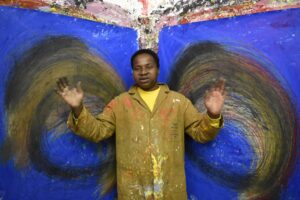
Nnena Kalu showcasing her Artwork
Early Life and Identity
Nnena Kalu was born in 1966 in Glasgow, Scotland, to parents of Nigerian origin. She grew up in the UK and later settled in South London, where she continues to live and work. From an early age, Kalu was diagnosed with a learning disability and is also autistic, with limited verbal communication. These conditions shaped her interaction with the world, but they did not limit her capacity for expression.
Unlike many contemporary artists, Kalu did not attend art school or receive formal academic training. Her artistic development began outside traditional institutions, emerging instead through supported creative spaces designed for people with learning disabilities.
Entering Art Practice (1980s–1990s)
Kalu began making art in the mid-1980s while attending day centres in London, including Hill House Day Centre in Tooting. At these centres, she was introduced to basic materials such as paper, pens, fabric, and tape. What distinguished her early on was her intense focus, repetition, and physical engagement with materials.
In 1999, Kalu joined ActionSpace, a London-based arts organisation that supports artists with learning disabilities. This relationship proved crucial. Through ActionSpace, she gained long-term studio access, continuity of practice, and professional advocacy. Unlike many short-term programmes, ActionSpace allowed Kalu to develop her work slowly and independently, without pressure to conform to commercial or academic expectations.
Developing a Distinct Visual Language
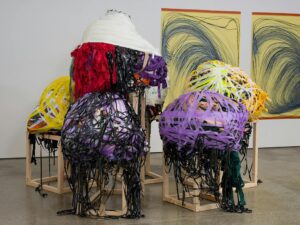
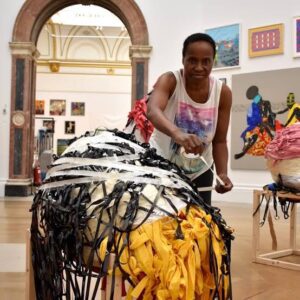
By the early 2000s, Kalu had begun developing the artistic language she is now known for. Her work centred on wrapping, binding, layering, and repetition, using found and everyday materials such as:
- Fabric offcuts
- Rope and string
- Parcel tape and masking tape
- VHS tape
- Plastic bags and cling film
- Cardboard and paper
Her sculptures often take the form of dense, cocoon-like structures, suspended from ceilings or stretched across walls. These works are usually brightly coloured and physically assertive, filling space rather than quietly occupying it.
Alongside sculpture, she produces large abstract drawings, characterised by looping, swirling lines made through repetitive hand movements. These drawings are often created in pairs or series, reinforcing rhythm and continuity rather than singular composition.
Her process is intuitive and physical rather than conceptual in the academic sense. Meaning emerges through gesture, endurance, and material accumulation, not explanation.
Early Exhibitions and Growing Recognition
For many years, Kalu’s work was exhibited mainly in supported art contexts. However, this began to change in the 2010s.
- In 2016, her work was shown internationally in Belgium alongside established contemporary artists.
- In 2018, she participated in Glasgow International, a major biennial contemporary art event.
- Her work was gradually included in museum-level exhibitions across the UK and Europe, marking a transition from marginal visibility to institutional recognition.
Importantly, her work was acquired by public collections, including the Arts Council Collection, a key marker of institutional validation in the UK art system.
Nnena Kalu Studio
Commercial Breakthrough (2024)
A major turning point came in 2024, when Kalu had her first commercial gallery exhibition at Arcadia Missa in London. This was significant not only because it introduced her work to collectors, but because it placed her firmly within the contemporary art market, an arena that had long excluded artists with learning disabilities.
The exhibition was critically well received, with commentators noting the strength, scale, and confidence of her sculptural installations.
Nnena Kalu Studio
Major Institutional Exhibition (2025)
In early 2025, Kalu presented her first major institutional solo exhibition titled Creations of Care at Kunsthall Stavanger in Norway. The exhibition showcased large-scale sculptures and drawings, emphasising the physicality and repetition central to her practice.
This exhibition played a key role in establishing her as an artist of international relevance ahead of the Turner Prize announcement.
The Works That Won the Turner Prize
Kalu was shortlisted for the 2025 Turner Prize based on two major bodies of work:
First, “Hanging Sculpture 1–10”, commissioned for Manifesta 15 in Barcelona, held in a former power station. The work consisted of ten large hanging sculptures made from fabric, tape, rope, and plastic, suspended in space to create an immersive environment.
Second, her contribution titled “Conversations”, shown at the Walker Art Gallery in Liverpool, featuring large abstract drawings filled with energetic, repetitive lines.
These works demonstrated her mastery of scale, rhythm, colour, and spatial awareness, qualities specifically cited by the Turner Prize jury.
The Turner Prize Ceremony
The 2025 Turner Prize ceremony took place on 9 December 2025 in Bradford, the UK’s City of Culture for 2025. The jury was chaired by Alex Farquharson, Director of Tate Britain.
Click here to read more about the 2025 Turner Prize
When Kalu was announced as the winner, the jury described her victory as a “watershed moment”, emphasising that her work was selected on artistic merit, not symbolic inclusion.
Kalu did not deliver a spoken acceptance speech. Instead, members of her support team spoke on her behalf, acknowledging the discrimination she has faced and the significance of her achievement. She wore a badge reading “Idol, Legend, Winner, Whatever.”
Why the Win Is Historically Important
Nnena Kalu’s Turner Prize win is historic for several reasons:
- She is the first artist with a learning disability to win the prize since its founding in 1984.
- She is among a small number of Black women to receive the award.
- She won the prize at 59 years old, challenging age-related assumptions about artistic relevance.
- Her practice operates outside verbal explanation, questioning long-standing art-world gatekeeping norms.
Her success exposes how deeply communication, education, and class biases have shaped recognition in contemporary art.
Debates and Critical Response
As expected, her win generated debate. Some critics questioned whether identity politics played a role. Others responded that such criticism ignores decades of structural exclusion that prevented artists like Kalu from being seen in the first place.
What is undisputed is that her work is now firmly positioned within museum, institutional, and historical frameworks of contemporary art.
Legacy and Ongoing Impact
Following her Turner Prize win, interest in Kalu’s work has increased significantly, with new exhibitions planned and wider international attention. Her influence extends beyond galleries, serving as a reference point for conversations around disability, neurodiversity, access, and artistic value.
Nnena Kalu’s career demonstrates that art does not require eloquence, theory, or explanation to be powerful. Her work proves that creativity can exist entirely on its own terms and still reshape history.
In 2025, the Turner Prize did not simply reward an artist.
It acknowledged a reality it had long overlooked.
Read About Uzoart’s “An Owambe Exhibition” in Lagos: Culture, Controversy, and Homecoming