


Arts and Creativity
20 Nigerians in Guinness World Records

“20 Nigerians in Guinness World Records” celebrates the extraordinary Nigerians who have achieved world recognition for their unique and inspiring feats across cooking, sports, music, art, and history. Explore their stories and achievements.

Nigeria is a country full of talent, creativity, and determination. Across cities, towns, and communities, Nigerians continue to achieve remarkable feats that capture global attention. Many of these outstanding accomplishments have been recognized among Nigerians in Guinness World Records to showcase skill, endurance, and innovation on the world stage.
From chefs who cook tirelessly for days to athletes who push the limits of physical strength, Nigerians in Guinness World Records represent the extraordinary potential of the nation. Artists have painted massive canvases, photographers have created record-breaking photo books, and musicians have brought Nigerian sounds to international audiences. Each achievement tells a story of dedication, hard work, and a drive to make history.
In this article, we explore the inspiring stories of 20 Nigerians in Guinness World Records, from historical milestones to modern-day triumphs. Their journeys highlight how passion and perseverance can turn dreams into world-recognized achievements as proof that Nigeria’s talent knows no bounds.
What It Mean to Be in the Guinness World Records
Being listed among in the Guinness World Records means more than earning a certificate or a mention in a book. It means one has achieved something that is verified as the best or most extreme of its kind in the world under strict international standards.
The Guinness World Records brand began in 1955 as a British reference book to settle pub debates about extraordinary feats, and it has since grown into the world’s leading authority on record‑breaking achievements. Today, the organization maintains a database of tens of thousands of verified records that span human performance, creativity, endurance, science, and nature itself.
To be recognized officially, a record attempt must meet specific objective criteria. The achievement has to be measurable, meaning there must be a clear unit of measurement such as time, weight, length, count, or area.
It must also be breakable so that others can challenge it in the future. The record title should be standardizable, which means there are defined rules and conditions that anyone attempting the record must follow. Most importantly, the feat has to be verifiable through evidence that proves it truly happened under the set conditions.
For example, if a record involves physical measurement, like weight or number of items, the methods used must be consistent and recognized so it can be compared fairly with other attempts. This evidence can include detailed log books, witness statements, expert measurements, and video documentation to show the entire attempt from start to finish. Independent witnesses or qualified professionals are often required to confirm that the guidelines were followed accurately
Not all ideas qualify for recognition. Guinness World Records rejects titles that rely on subjective judgments like beauty or kindness because they cannot be objectively measured. It also avoids records that cannot be fairly repeated, are not universally understood, or could cause harm or danger to participants or observers.
Once all evidence is reviewed and the achievement is confirmed, the record is officially logged, and the individual or group is given a certificate that recognizes their place in history. A record holder’s name is added to the global database, and the achievement becomes part of a legacy that inspires people worldwide to push the boundaries of what is considered possible.
Celebrating Nigerians in Guinness World Records

Nigeria is a country full of talent, creativity, and determination. Over the years, many Nigerians have not just excelled locally, they have reached global recognition by entering the Guinness World Records. These individuals and groups represent the best of Nigerian skill, endurance, and innovation, proving that extraordinary achievements can come from every corner of the country.
Nigerians in Guinness World Records span a wide range of fields. Some have tested the limits of human endurance, like chefs cooking for days without rest. Others have shown unparalleled creativity, from painting massive canvases to creating record-breaking photo books.
Athletes have pushed their physical limits, while musicians and entertainers have shared Nigerian culture with the world. Even historical figures have made their mark, all showing that Nigerians have long contributed unique achievements to global records.
Each achievement tells a story of determination, hard work, and vision. These accomplishments inspire young people across Nigeria and the diaspora as they prove that with perseverance, ambition, and skill, it is possible to stand out on the world stage.
From historical milestones to modern feats, celebrating these record holders is a way of recognizing the global impact of Nigerian talent.
Nigerians in Guinness World Records – Food and Cooking Records
Hilda Baci (Longest Cooking Marathon and Largest Jollof Rice)
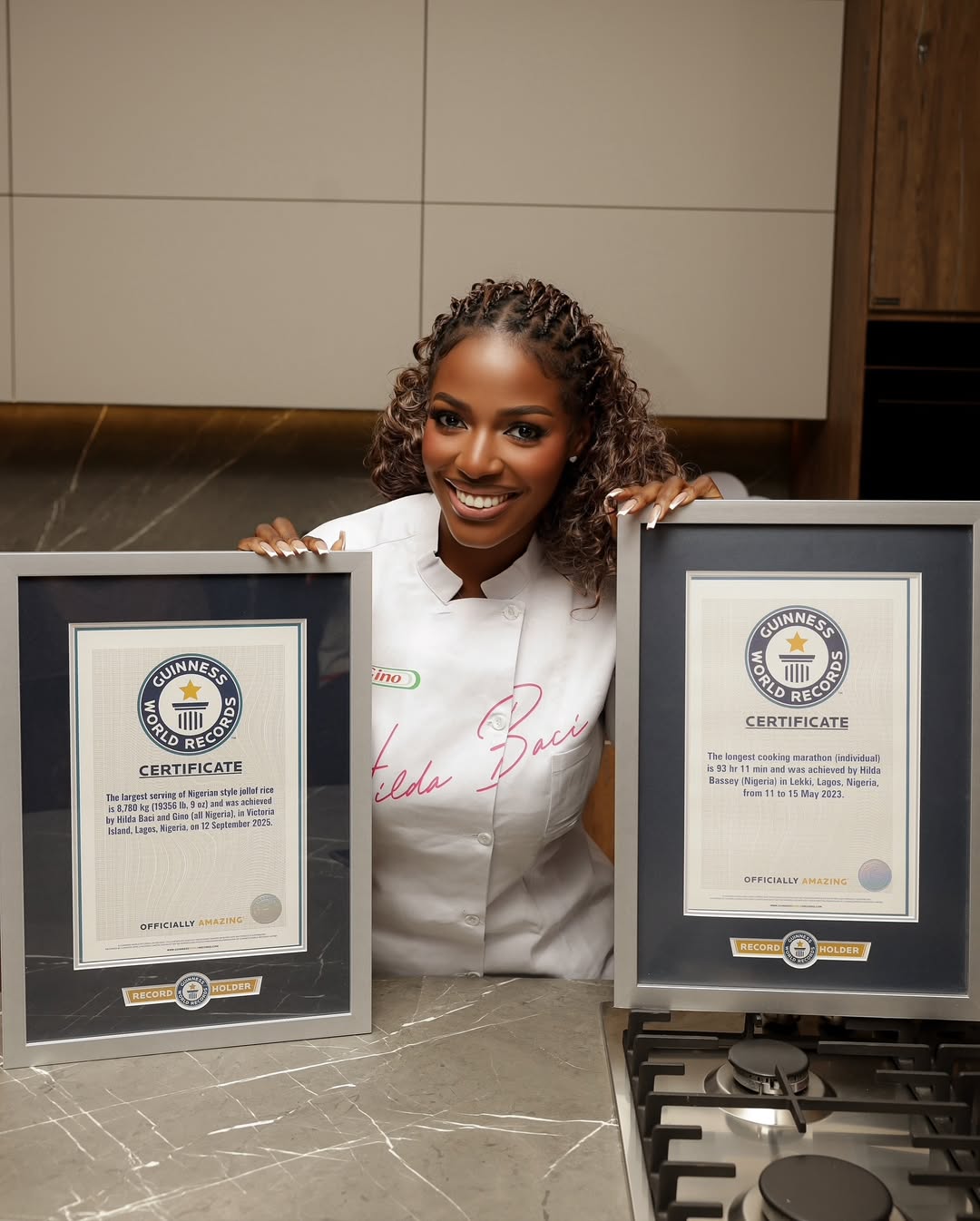
Nigeria has a rich culinary heritage, and its chefs have gained global recognition by entering the Guinness World Records. Among the most celebrated Nigerians in Guinness World Records for food and cooking is Hilda Effiong Bassey, popularly known as Hilda Baci. Hilda is a renowned Nigerian chef, restaurateur, and culinary entrepreneur from Akwa Ibom State who has captured international attention for her extraordinary feats in cooking.
In May 2023, Hilda Baci set the Guinness World Record for the longest cooking marathon by an individual, cooking continuously for 93 hours and 11 minutes in Lagos, Nigeria. Her marathon cooking session was verified by official Guinness World Records representatives who monitored her adherence to strict rules regarding breaks, safety, and continuous cooking.
This achievement showcased not only her culinary expertise but also incredible stamina, discipline, and perseverance which earned her a notable place among Nigerians in Guinness World Records.
Hilda Baci went on to set another world record in 2025 for cooking the largest pot of jollof rice, an astounding 8,780 kilograms of the beloved West African dish. The event took place in Lagos and involved meticulous measurement and verification by Guinness officials. The feat not only celebrated her personal achievement but also highlighted Nigeria’s vibrant culinary culture to a global audience.
Hilda’s accomplishments reflect the growing presence of Nigerians in Guinness World Records within the culinary industry and demonstrate how Nigerian chefs are pushing boundaries, innovating, and inspiring both national and international audiences. Her achievements encourage young Nigerian chefs and food enthusiasts to pursue ambitious goals and aim for global recognition.
Through feats like Hilda Baci’s which earned her a prominent spot among Nigerians in Guinness World Records, she has showed that the country’s culinary talent is world-class, capable of setting records that celebrate both endurance and cultural heritage.
Nigerians in Guinness World Records – Sports and Fitness Achievements
Bose Omolayo and Paul Kehinde (Para Powerlifting)
Nigeria’s dominance in para powerlifting is highlighted by Bose Omolayo and Paul Kehinde, two athletes who have made their mark globally.
Bose Omolayo set a Guinness World Record in 2021 for the heaviest para power lift by a female in the –79 kg category. She lifted 144 kilograms at the World Para Powerlifting Championships in Tbilisi, Georgia. This achievement not only demonstrated her strength but also her dedication to pushing the limits of human performance which earned her a distinguished place among Nigerians in Guinness World Records.
Paul Kehinde holds the male record in the –65 kg category, lifting an impressive 221 kilograms at the Fazza World Cup in Dubai in 2018.
Both athletes exemplify how Nigerians excel in sports that require not only physical power but also mental focus, precision, and perseverance. Their records inspire upcoming Nigerian athletes to aim for excellence on the global stage.
Gbenga Ezekiel (Skipping Records)
Another remarkable athlete among Nigerians in Guinness World Records is Gbenga Ezekiel, recognized for his extraordinary rope skipping skills. He holds records for the most skips in one minute on one leg and the most double-under skips in one minute on one leg.
These feats require incredible coordination, stamina, and concentration. It was a demonstration of the fact that Nigerian athletes are setting global standards not just in mainstream sports but also in unique disciplines that test precision and endurance.
Chukwuebuka Ezugha and Victor Richard Kipo (Soccer Skills Records)
Nigerians have also set Guinness World Records in football-related skills. Chukwuebuka Ezugha and Victor Richard Kipo hold the record for the most consecutive soccer passes using only the soles of the feet. Their precise ball control and coordination reflect the skillful techniques for which Nigerian footballers are renowned. This achievement is a testament to the creativity and technical ability of Nigerians in Guinness World Records.
Chinonso Miracle Eche and Vincent Okezie (Freestyle Football Records)
Freestyle football has also seen remarkable contributions from Nigeria. Chinonso Miracle Eche set a record for performing freestyle football touches while balancing the ball on his head to showcase agility and control.
Similarly, Vincent Okezie achieved a Guinness World Record for consecutive ‘around the world’ football tricks that embodied precision, rhythm, and endurance. Both athletes highlight the versatility of Nigerian talent, which is why they are placing them among Nigerians in Guinness World Records who inspire young athletes nationwide.
These examples of Nigerians in Guinness World Records in sports and fitness reveal Nigeria’s strength, versatility, and creativity. From para powerlifting to freestyle football and rope skipping, Nigerian athletes continue to push boundaries as proof that global recognition is achievable through talent, discipline, and determination.
Nigerians in Guinness World Records – Music and Entertainment Records
Nigeria has long been a powerhouse in music and entertainment, and many of its artists have earned international recognition by entering the Guinness World Records. These achievements highlight Nigeria’s creativity, cultural influence, and the global appeal of its entertainment industry.
Wizkid (First Nigerian Featured on a Billion-Streams Track)
Wizkid (Ayo Balogun) is one of the most prominent Nigerians in Guinness World Records in music. He gained worldwide recognition when the song “One Dance”, featuring Drake and Kyla reached 1 billion streams on Spotify.
Wizkid’s contribution to this global hit made him the first Nigerian artist to be part of a billion-stream track. This achievement demonstrates how Nigerian artists are breaking barriers and reaching audiences far beyond Africa.
Rema (First Artist to Reach No.1 on MENA Official Chart)
Rising star Rema (Divine Ikubor) is another standout among Nigerians in Guinness World Records. He became the first artist to top the Billboard Middle East and North Africa (MENA) chart with his hit song “Calm Down”.
This achievement underscores the global appeal of Afrobeats and highlights Nigeria’s growing influence in international music markets. Rema’s recognition shows that Nigerian talent continues to gain global acclaim and inspire other young artists in the country.
Burna Boy (Fastest Nigerian to Achieve Spotify Milestone)
Global superstar Burna Boy is also celebrated among Nigerians in Guinness World Records. He set records for being the fastest Nigerian artist to achieve millions of streams on Spotify for multiple songs simultaneously.
His recognition portrays the speed at which Nigerian music is dominating global platforms and emphasizes the country’s growing cultural footprint worldwide.
Nigerians in Guinness World Records – Chess and Intellectual Endurance
Tunde Onakoya (Longest Chess Marathon)
One of the most inspiring examples of Nigerians in Guinness World Records comes from the world of chess where intellect, endurance, and purpose converge. Tunde Onakoya, a Nigerian chess master and founder of Chess in Slums Africa holds the official Guinness World Record for the longest chess marathon.
This achievement highlights not only an extraordinary mental feat but also how a Nigerian has used a world‑record challenge to support a greater social mission.
Tunde Onakoya, born in Nigeria in 1994 grew up playing chess in his hometown of Ikorodu and later turned his passion into a platform for social change. Through his nonprofit Chess in Slums Africa, he teaches the game to underprivileged children in Lagos and beyond as a way of using chess as a tool for education and empowerment.
In April 2025, Onakoya officially broke the Guinness World Record for the longest chess marathon by playing continuously alongside American chess player Shawn Martinez in Times Square, New York City. The duo achieved 64 hours of back‑to‑back play to top the previous record of 61 hours, 3 minutes, and 34 seconds. The marathon involved playing multiple games against each other without extended breaks, with only short rest periods allowed under Guinness guidelines.
This record attempt drew global attention not just for its determination and skill but also for the cause behind it. Onakoya used the marathon to raise support for education initiatives, especially for children in underserved communities across Africa. The event was deeply symbolic of how Nigerians in Guinness World Records are not only setting benchmarks in endurance and cognition but are also leveraging these achievements to draw attention to issues that matter.
Onakoya’s record came after a previous marathon attempt in 2024 when he played a 60‑hour chess marathon that surpassed the prior benchmark of 56 hours and 9 minutes set in 2018 by Norwegian players. While that earlier marathon was widely covered and lauded, the 2025 attempt was the one that received official Guinness World Records certification.
The feat of playing chess for nearly three days straight requires intense mental focus, physical stamina, and strategic endurance. It is a clear demonstration that intellectual challenges, like physical ones can be measured and celebrated on the world stage. Onakoya’s success places him firmly among the Nigerians in Guinness World Records and shows that Nigerian excellence shines just as brightly in minds as it does in muscles or creativity.
Nigerians in Guinness World Records – Arts and Creative Records
Nigeria has a rich tradition of artistic excellence, and several Nigerians have made history by entering the Guinness World Records for creative achievements. These records highlight imagination, skill, and dedication, placing Nigerian talent on a global stage.
Kanyeyachukwu Tagbo-Okeke (Largest Individual Art Canvas)
One of the most remarkable Nigerians in Guinness World Records in the arts is Kanyeyachukwu Tagbo-Okeke, a young artist with autism. In 2025, he set the record for the largest individual art canvas by creating a piece titled “Impossibility is a Myth” that measured over 12,300 square metres, roughly the size of two football fields. The project which held in Abuja on World Autism Acceptance Day promoted both awareness of autism and recognition of Nigerian creativity on a global platform.
Tagbo-Okeke’s achievement shows that Nigerians in Guinness World Records are not limited to conventional fields but extend to imaginative and socially impactful expressions of talent. His record has inspired artists and advocates alike and shows that art can be both a personal triumph and a tool for societal change.
Bayo Omoboriowo (Largest Photo Book)
Another prominent figure in the creative sphere is Bayo Omoboriowo, a renowned Nigerian photographer and visual storyteller. Omoboriowo set the Guinness World Record for the largest photo book in 2021. The book spans over 60 square metres and captures Nigeria’s cultural, historical, and social narratives.
This accomplishment highlights the capacity of Nigerians in Guinness World Records to innovate in arts and photography. By mixing cultural storytelling with record-breaking scale, Omoboriowo has positioned Nigeria as a leader in global creative achievements.
Chinedu Eze (Largest Mosaic Artwork)
In addition, Nigerian artist Chinedu Eze broke a Guinness World Record for creating the largest mosaic artwork composed entirely of recycled materials. The piece which was displayed in Lagos in 2024 covered 3,500 square metres and involved collaboration with over 100 volunteers. This innovative approach reveals how Nigerian artists combine creativity with sustainability to earn international acclaim and joining the ranks of Nigerians in Guinness World Records.
Nigerians in Guinness World Records – Historical Guinness World Records
Nigeria’s impact on the Guinness World Records is not limited to modern achievements. Several historical milestones highlight the country’s long-standing contribution to global records and showcase leadership, intellect, and exceptional talent. These figures remain important symbols of Nigerian excellence.
Keagborekuzi I (Youngest Monarch in the World)
One of the most notable historical records held by Nigerians in Guinness World Records is that of Keagborekuzi I, born Benjamin Ikenchukwu Keagborekuzi Gbenoba. In 1979, he became the youngest crowned monarch in the world at just two years old by ascending the throne of Agbor Kingdom in Delta State. His recognition was officially documented in the 1980 edition of Guinness World Records, marking him as a significant figure in Nigeria’s cultural history.
Keagborekuzi I’s record symbolizes the rich traditions of Nigerian kingdoms and the global recognition of unique cultural milestones. His ascension at such a young age remains a historical achievement that continues to inspire fascination worldwide.
Stephen Keshi (First African to Win AFCON as Player and Coach)
Another historical achievement among Nigerians in Guinness World Records is held by the late Stephen Keshi affectionately known as Big Boss. Keshi made history as the first African to win the Africa Cup of Nations (AFCON) both as a player and as a coach.
He played a crucial role in Nigeria’s victory at the 1994 AFCON as a player and later led the national team to triumph as coach in 2013. Guinness World Records officially recognizes this dual accomplishment as a unique milestone in football history. Keshi’s legacy demonstrates the power of leadership, dedication, and Nigerian talent on both continental and global stages.
Other Notable Nigerian World Records
Beyond sports, music, arts, and historical achievements, several Nigerians have made their mark in unique and diverse fields to further cement Nigeria’s presence on the global stage. These individuals are celebrated for creativity, endurance, and innovation, and they continue to inspire young Nigerians to pursue ambitious goals.
Chukwuebuka Ezugha and Victor Richard Kipo (Football Skill Records)
Chukwuebuka Ezugha and Victor Richard Kipo hold the Guinness World Record for the most consecutive soccer passes using only the soles of the feet. This achievement required immense focus, precision, and coordination. Their record highlights how Nigerian talent extends beyond traditional team sports into creative skill-based challenges, thus making them part of the celebrated list of Nigerians in Guinness World Records.
Chinonso Miracle Eche (Freestyle Football Balancing)
Another remarkable example of Nigerian skill is Chinonso Miracle Eche who set a Guinness World Record for performing freestyle football touches while balancing the ball on his head. This record required incredible balance, coordination, and endurance, showcasing Nigeria’s growing global reputation in unique sports and performance-based records.
Vincent Okezie (Consecutive Football Tricks)
Vincent Okezie is recognized for setting a Guinness World Record for consecutive ‘around the world’ football tricks. His achievement combines dexterity, timing, and consistency that demonstrate the innovative ways Nigerians are making their mark internationally. These skill-based feats further contribute to Nigeria’s expanding list of Nigerians in Guinness World Records.
Impact of These Achievements
The accomplishments of Nigerians in Guinness World Records extend far beyond individual recognition. Each record, whether in sports, arts, music, or intellectual endurance reflects the resilience, creativity, and talent that Nigerians bring to the global stage. These achievements serve as a source of national pride and inspiration, and motivate the younger generations to pursue excellence in their chosen fields.
Every record set by a Nigerian provides a tangible example that hard work, dedication, and innovation can lead to global recognition. From Hilda Baci’s cooking marathons to Tunde Onakoya’s chess marathon, these feats show young Nigerians that even ambitious, seemingly impossible goals can be achieved. Schools, communities, and youth programmes often highlight these accomplishments to encourage children to aim high and cultivate skills that could one day earn them a place among Nigerians in Guinness World Records.
These records also showcase Nigeria’s cultural, intellectual, and athletic capabilities to the world. Achievements in music, like Wizkid’s billion-stream record, or in arts, like Kanyeyachukwu Tagbo-Okeke’s largest art canvas prove that Nigerian creativity is not just local but globally competitive. By consistently appearing in Guinness World Records, Nigerians are helping to redefine global perceptions of the country, positioning Nigeria as a hub of talent and innovation.
Many Nigerians who have set records also use their achievements to give back to society. Tunde Onakoya, for example leveraged his chess marathon to promote education for underprivileged children. Kanyeyachukwu Tagbo-Okeke’s artwork raised awareness about autism. These examples illustrate that Nigerians in Guinness World Records are not only breaking records for personal glory but also using their platforms to inspire positive social change.
The recognition of Nigerians in the Guinness World Records fosters a sense of collective pride. It highlights the diverse capabilities of Nigerians, whether in intellectual pursuits, artistic creativity, sports, or culinary arts. Each record reinforces the message that Nigeria is home to individuals capable of extraordinary achievements, enhancing national identity and cultural pride.
Overall, the impact of these achievements is multifaceted – they inspire future generations, showcase Nigerian talent globally, encourage social innovation, and strengthen national pride. Collectively, Nigerians in Guinness World Records represent not just individual excellence, but the enduring potential and resilience of a nation determined to leave its mark on the world stage.
In Conclusion …
The achievements of Nigerians in Guinness World Records mirror the extraordinary talent, determination, and creativity that define the nation. From historical milestones to modern feats in sports, music, culinary arts, intellectual endurance, and visual creativity, Nigerians continue to leave a lasting mark on the global stage. Each record tells a story of perseverance, innovation, and the drive to excel against all odds.
These accomplishments inspire future generations to dream bigger and aim higher. They reveal that with dedication, discipline, and vision, Nigerians can compete and succeed internationally and set benchmarks that are recognized worldwide. Whether it is Hilda Baci’s marathon cooking, Wizkid’s billion-stream milestone, or Tunde Onakoya’s chess marathon, each achievement serves as proof that Nigerian excellence transcends borders.
Moreover, these records contribute to national pride, cultural recognition, and social impact. Many record holders use their platforms to raise awareness, inspire communities, and promote positive change, thus reinforcing the idea that world-class success can be a force for good.
In essence, Nigerians in Guinness World Records are not only individuals achieving remarkable feats, they are symbols of what Nigeria represents, namely, talent, resilience, and a relentless pursuit of excellence. Their stories encourage all Nigerians to believe in their potential as a way of showing that greatness is achievable in any field with hard work and ambition.’
References
- https://apnews.com/article/nigeria-guinness-world-records-rice-chef-9908b36f3c485fa0d4d4685c0c9427fc
- https://www.pulse.ng/story/nigerians-in-guinness-book-of-world-records-2024072611250249947
- https://www.top10.com.ng/2025/09/10-guinness-world-records-held-by.html
- https://www.vanguardngr.com/2024/04/nigerians-whove-recently-won-the-guinness-world-record/
- https://streamdorm.com/2753/2025/nigerians-who-have-broken-guinness-world-records/
- https://dnbstories.com/2025/10/all-nigerians-with-guinness-world-records-to-date.html
- https://gistcore.com.ng/2025/09/13/10-nigerians-who-have-broken-guinness-world-records/
- https://tribuneonlineng.com/10-nigerians-who-have-broken-guinness-world-records/
You might want to check this out …