


Igbo Culture & Heritage
Igbo Culture in Diaspora: The Struggles of Raising Culturally-Aware Children Abroad

“Igbo culture in diaspora: …” highlights the struggles of raising children who are aware of their culture abroad, with focus on language loss, identity conflict, and how parents preserve cultural heritage in foreign environments.
It often starts in ordinary moments. A parent calls out in Igbo from the kitchen. The child hears, understands, but answers in English without thinking. No drama, no resistance. Just habit. The conversation moves on. But something small shifts in that exchange.
This is one of the quiet realities inside many homes as it concerns Igbo culture in diaspora.
Raising children who are aware of their Igbo heritage abroad is not only about providing care or education. It is also about what language survives in the house, what identity feels familiar to a child, and what slowly fades without anyone really deciding it should.
For many families, this situation did not begin with migration by choice alone. Large waves of movement, especially after the Nigerian Civil War placed Igbo families in different parts of the world. Over time, those families grew, and a new generation began to form its understanding of home in places where Igbo is not the surrounding language.
That is where the tension sits. Between what parents carry from home and what children absorb where they are growing up. Between intention and environment. Between memory and daily reality.
This article looks closely at that space, the lived experience of Igbo culture in diaspora where raising children becomes less about preserving culture in theory and more about negotiating it in everyday life.
Understanding Igbo Culture in Diaspora
To really make sense of the struggles involved in raising Igbo children abroad, it helps to first understand what Igbo culture in diaspora actually looks like in everyday life.
It is not a fixed version of culture that stays the same once people leave Nigeria. Instead, Igbo culture in diaspora is what happens when Igbo people carry their language, values, and identity into new countries and try to keep them alive in different conditions. In that process, culture does not disappear. It adjusts. It gets translated into new routines, new environments, and sometimes, new compromises.
Studies on migrant communities consistently show this pattern. For Igbo families in particular, cultural identity is often preserved through everyday practices such as naming children, maintaining family traditions, and staying connected through community networks. A study published in Genealogy (MDPI) highlights that Igbo names in diaspora are not just labels. They often carry meaning tied to family history, migration experiences, and a sense of belonging that stretches across generations.
That detail matters. It shows that Igbo culture in diaspora is not something passive or forgotten. Even far from home, it continues to exist in active, visible ways, even if quietly. But there is another side to it.
The way culture is expressed does not remain the same. Children growing up outside Nigeria are not learning Igbo culture in one setting alone. They are learning it at home, they also learn from school systems, friends, television, social media, and the wider society around them. All of these influences come together to form a second layer of identity.
This is where things become more complex. Because the child is not choosing between cultures in a clear way. They are living both at the same time, often without fully noticing where one begins and the other ends.
The Language Struggle
One of the earliest and most visible challenges within Igbo culture in diaspora is language. It shows up quietly, usually inside the home, in the simplest conversations.
A parent speaks Igbo out of habit. The child understands every word but responds in English. Not out of defiance but because English is the language that feels natural in school, with friends, and in most parts of daily life. Over time, that pattern becomes normal. The switch happens without anyone formally deciding it. This is how language shift begins in many diaspora homes.
In most cases, it is the parents who set the ground for the language struggle by not encouraging the use of the language at home.
Research on migrant families shows that this kind of change is common across generations. When a community lives in a dominant English-speaking environment, children often move from full fluency in the heritage language to partial understanding, and eventually to limited or passive use. The mother tongue becomes something they can recognize but not confidently speak.
In the case of Igbo culture in diaspora, this shift is often shaped by everyday reality. Parents are busy, children are in English-speaking schools, and the surrounding environment reinforces English at every turn. Even when parents try to be intentional, consistency can be difficult to maintain over time.
A study in sociolinguistics on language maintenance in migrant communities explains that heritage languages are most at risk when they are not used beyond symbolic moments. That means when a language is only spoken occasionally, during greetings or special visits, it gradually loses its place as a working language in the home.
But language is more than communication. It carries memory, tone, and cultural meaning. When it weakens, parts of that cultural connection also become harder to pass on.
This is why the language struggle sits at the centre of Igbo culture in diaspora. It is not just about whether a child can speak Igbo. It is about how much of the culture remains accessible to them in a way that feels natural, not forced or distant.
Identity Struggles

For many children growing up within Igbo culture in diaspora, the question of identity does not always come in words. It often shows up in small moments, quietly, and sometimes unexpectedly.
At home, they are reminded of where their parents come from, the language they are expected to understand, and the values they are taught to respect. Outside the home, everything shifts. School, friendships, and social life operate in a different cultural rhythm. Over time, the child learns to move between both worlds, often without stopping to fully explain the difference. This is where identity begins to feel layered rather than simple.
Research on migrant and second-generation children consistently shows that identity is not fixed in diaspora settings. Instead, it becomes something shaped by environment, experience, and belonging in different spaces. Children of immigrants often grow up navigating more than one cultural reference point at the same time which can create moments of uncertainty, especially during adolescence.
With Igbo culture in diaspora, this experience can be subtler than it appears. A child may not reject their heritage but they may not fully know how to place it within their everyday life. At home, they are Nigerian or Igbo. Outside, they are often identified by the country they live in. Between those two labels, there is a space that does not always feel clearly defined.
Studies on identity formation among diaspora youth describe this as a dual sense of belonging. It is not necessarily a conflict between cultures. It is rather a negotiation between different ways of seeing oneself. Some children grow into this balance naturally over time. Others struggle with it, especially when cultural connection feels distant or inconsistent.
With Igbo culture in diaspora, this becomes more noticeable when children begin to ask simple but important questions. Where do I truly belong? What part of me defines who I am? These questions may not always be spoken out loud but they often shape how identity develops over time.
Parenting in Diaspora
For many families living within Igbo culture in diaspora, parenting is not a single-track experience. It often feels like standing between two systems that do not always speak the same language, even when both are part of daily life.
At home, many Igbo parents carry expectations shaped by tradition. Respect for elders, careful communication, discipline, and a strong sense of family responsibility are not just values. They are part of how life is structured. Outside the home, however, children are growing in environments where independence is encouraged early where expression is more open, and where authority is often approached differently. Neither side is necessarily wrong. The challenge is that they do not always align in practice.
This is where parenting in Igbo culture in diaspora becomes complex. A parent may try to teach values in the way they learned them, but the child is also learning different behavioural norms from school, peers, and society. What feels like respect in one setting may feel like restriction in another. What feels like freedom in one context may feel like lack of guidance in the other.
Research on families from Igbo culture in diaspora consistently shows that this kind of cultural balancing is one of the most demanding aspects of raising children abroad. Parents are not only raising children; they are also interpreting two different cultural expectations at the same time and trying to decide how to merge them in a way that still feels meaningful at home.
In many Igbo households, this pressure is emotional as much as it is practical. There is often a quiet concern that cultural values may weaken over time, especially as children become more influenced by the environment they grow up in. At the same time, parents also understand that their children cannot be fully separated from that environment.
So parenting becomes less about strict cultural preservation and more about negotiation. Choosing what to hold firmly, what to explain differently, and what to let evolve naturally.
Within Igbo culture in diaspora, this balancing act is ongoing. It does not come with clear rules or fixed outcomes. It is lived daily, in conversations, decisions, corrections, and small compromises that shape how culture is passed from one generation to the next.
How Parents Try to Preserve Culture Abroad
Within the homes of people of Igbo culture in diaspora, preservation is rarely loud or formal. It usually happens in small, repeated actions inside the home and community, often without much attention drawn to it.
One of the most consistent ways parents try to hold on to the Igbo culture in diaspora is through language at home. Many Igbo parents make a deliberate effort to speak Igbo with their children, even when the response comes in English. For them, the goal is not always perfect fluency. It is continuity. The idea that the language is still present in the home, still heard, still familiar.
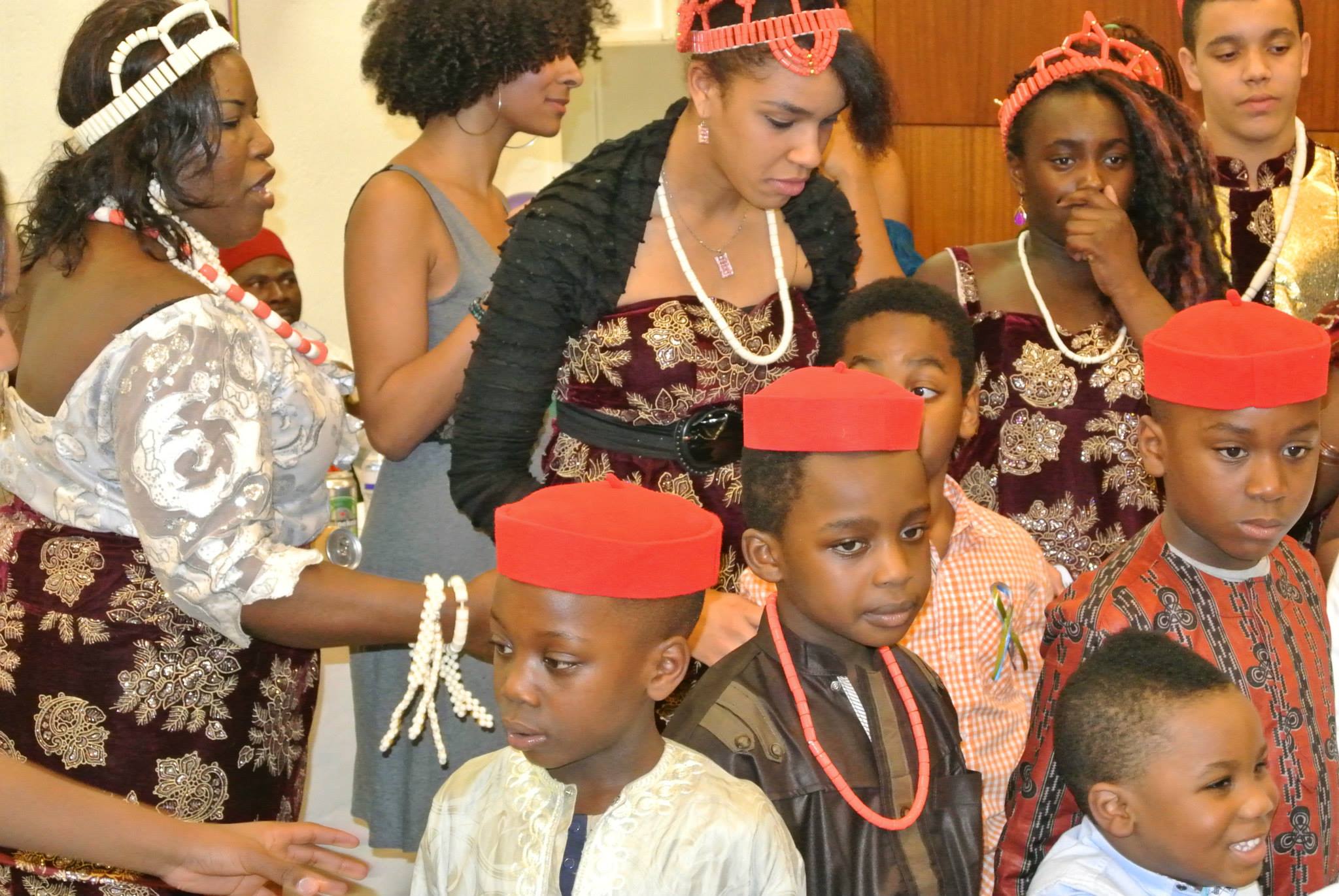
Another strong point of the preservation of the Igbo culture in diaspora is naming. Igbo names are not chosen randomly. They often carry meaning, memory, prayer, or family history. In diaspora settings, these names become even more important. They serve as a constant link between the child and their heritage, even when daily life feels far removed from Nigeria. Research on Igbo naming practices in diaspora communities supports this. It shows that names often function as identity markers that carry cultural meaning across generations.
Community also plays a key role. Many families from the Igbo culture in diaspora join cultural associations or local Igbo groups where they connect with others who share the same background. These gatherings create space for shared language, storytelling, and social bonding. They also help children to see that their culture is not only something experienced at home but something shared by others as well.
Cultural events are another important layer. Celebrations such as the New Yam Festival are often recreated in diaspora communities. While the setting may be different, the meaning remains the same. It is a way of reconnecting with tradition, even in a new environment. The festival itself, widely known in Igbo tradition represents gratitude, harvest, and community unity, and it continues to be observed in various forms outside Nigeria.
Across all these efforts, there is a clear pattern. Parents are not trying to recreate Nigeria exactly as it is. Instead, they are trying to keep Igbo culture in diaspora alive in ways that can exist within their current environment. It is a careful balance between memory and adaptation, between what was inherited and what can still be passed on.
Culture Is Not Lost, It Is Changing
One of the most important truths about Igbo culture in diaspora is that it does not simply disappear when families move abroad. It changes, sometimes slowly, sometimes quickly, but it rarely stops existing.
In many diaspora homes, culture no longer appears in its original form all the time. Instead, it shows up in selected practices, repeated habits, and modified traditions that fit into a different environment. A child may not experience village life in Nigeria, but they may still hear Igbo stories at home. They may not attend traditional ceremonies in their original setting, but they may take part in adapted versions organized by community groups abroad.
This is how cultural continuity often works in migration settings. It is not a full transfer of the past into the present. It is a process of adjustment where certain parts remain active while others evolve to fit new conditions.
Research on diaspora communities supports this idea. Studies on migrant cultural identity show that heritage cultures are often maintained through adaptation rather than complete replication. What is preserved tends to be what can survive within the social and environmental realities of the host country.
In the case of Igbo culture in diaspora, this can be seen in how traditions are practiced differently across generations. Parents may hold on strongly to customs they grew up with while children experience those same customs in more flexible or simplified forms. Over time, this creates variations in how culture is understood and expressed within the same family.
Language, celebrations, and social values may all appear slightly different from what they were in Nigeria but they still carry meaning. The difference is in form, not in complete disappearance.
This is why it is more accurate to see Igbo culture in diaspora as something that evolves rather than something that is lost. It continues to exist through people, even when it is no longer expressed in exactly the same way as before.
Practical Ways to Reduce the Struggles
The challenges within Igbo culture in diaspora are real but they are not fixed. Many families find that small, consistent actions make a meaningful difference over time. The goal is not perfection. It is steady connection between children and their cultural roots.
One of the most effective steps is making Igbo language part of everyday home life. Even if children respond in English, continued exposure matters. Short conversations, simple greetings, and repeated phrases help the language remain familiar. Over time, familiarity builds comfort, and comfort can grow into participation.
Storytelling is another practical approach. Instead of teaching culture as a set of rules, many parents pass it through stories. These stories may include family history, moral lessons, or explanations of customs. This way, children begin to understand not just what is done but why it is done.
Names also play a quiet but powerful role. Explaining the meaning behind Igbo names helps children to connect identity with intention. When a child understands that their name carries history, prayer, or family memory, it becomes more than just a label. It becomes part of how they see themselves.
Cultural routines also help to reduce distance. This can include preparing traditional meals, observing cultural festivals, or marking important family events in ways that connect back to Igbo heritage. One widely recognized example is participation in celebrations such as the New Yam Festival which is often recreated in diaspora communities to maintain cultural continuity.
Visits to Nigeria, when possible also make a strong impact. Experiencing the environment where the culture originates gives children a real-world connection that cannot always be recreated abroad. Even short visits can help them understand context in a deeper way.
Most importantly, many families find that encouragement works better than pressure. When children feel forced, they may resist. But when they are invited into culture through positive experiences, they are more likely to stay connected in their own way.
Reducing the struggles in Igbo culture in diaspora is not about eliminating differences between generations. It is about building enough connection so that those differences do not turn into complete disconnection.
Conclusion …
What becomes clear with Igbo culture in diaspora is that nothing about it is static. Not the language, not the identity, and not the way families pass culture from one generation to the next.
What many parents describe as a struggle is often a daily negotiation between what they grew up with and what their children are growing into. In that space, culture is not simply preserved or lost. It moves with people. It adjusts to new environments. It finds new ways to exist, even when the setting is unfamiliar.
The experiences of raising children in Igbo culture in diaspora show that identity is not built in one place or one language alone. It is shaped over time, through home conversations, school environments, friendships, and the quiet influence of both worlds overlapping.
At the centre of it all is not a disappearance of culture but a change in how it is lived.
This is why Igbo culture in diaspora is better understood as something in motion. It carries history, adapts to present realities, and continues into the future in forms that may look different but still hold meaning.
For many families, the goal is no longer to replicate culture exactly as it exists in Nigeria. It is to keep a meaningful connection alive, even if that connection looks different from one generation to the next.
References
- https://www.mdpi.com/2313-5778/10/1/7
- https://www.researchgate.net/publication/Language_Maintenance_and_Shift_in_Diaspora_Communities
- https://www.britannica.com/event/Nigerian-Civil-War
- https://www.unesco.org/en/cultural-diversity
- https://www.britannica.com/science/sociolinguistics
You may want to check this out …