




Igbo Food Culture
Ofe Oha (Oha Soup): A Legendary Heritage of Igbo Food Culture and Tradition

Ofe Oha is a traditional Igbo soup made from Oha leaves (Pterocarpus mildbraedii). Explore its cultural meaning, preparation, history, and role in Igbo food heritage and identity.

Ofe Oha is one of those meals you often know from childhood, even before you understand its name or where it comes from. In many Igbo homes, it is the kind of soup you meet on a normal day and also on special days, usually when someone important is around or when the house feels a bit fuller than usual.
It is made with Oha leaves from the Pterocarpus mildbraedii tree, cooked into a smooth, thick soup that carries a taste many people easily recognize once they have had it before. But beyond how it tastes, Ofe Oha (Oha Soup) is part of everyday Igbo food culture. It shows up in family kitchens, shared plates, and those quiet moments around food where people talk, eat, and stay a little longer than planned.
For many people, it is not just about cooking a traditional soup. It is about a way of eating that has been passed down over time where ingredients, methods, and even the order of cooking are learned by watching and repeating, not by reading recipes.
This article looks at Ofe Oha beyond the pot. It explores its place in Igbo food tradition, the role of the Oha leaf, and why this soup still matters in homes today, even as cooking habits continue to change.
Understanding Ofe Oha as a Traditional Igbo Soup
Ofe Oha (Oha soup) is a traditional Igbo soup made from fresh Oha leaves, locally known as Oha nkụ in some communities and scientifically identified as Pterocarpus mildbraedii. It is one of the well-known soups in southeastern Nigeria, especially among the Igbo people where it is valued both as everyday food and as a special dish for visitors and family gatherings.
At its simplest, Ofe Oha is a leaf-based soup thickened with cocoyam paste or other local thickeners, cooked with palm oil, meat or fish, crayfish, and seasoning. The Oha leaves are usually added at the final stage of cooking. They are often hand-torn rather than chopped, a small detail that helps to preserve their soft texture, colour and natural taste.
What makes Ofe Oha stand out is not complexity, but balance. The soup is smooth, mildly earthy, and rich without being heavy. It pairs well with staple swallows like pounded yam, fufu, or garri, which are common across Igbo households.
In Igbo food culture, Oha soup is more than a recipe. It sits among respected traditional soups that carry local identity and memory. It is commonly prepared in homes across southeastern Nigeria and is often associated with hospitality. When Ofe Oha is served, it usually signals care for the people at the table.
Over time, it has remained one of the most recognized expressions of Igbo traditional cuisine by keeping its place in both rural kitchens and urban homes.
The Oha Leaf (Pterocarpus mildbraedii)
The signature vegetable of Ofe Oha is the Oha leaf itself. Without it, the soup loses its identity. The leaf comes from a tall forest tree known scientifically as Pterocarpus mildbraedii, a species found in parts of West and Central Africa, including Nigeria. In Igbo communities, it is simply called “Oha,” and it has long been valued as both food and a familiar part of local plant life.
The Oha tree is not a cultivated crop in the same way as common vegetables. In many places, it grows naturally in forests or is left standing in family compounds and farmlands. The leaves are harvested carefully, often by hand, because they are soft and can be easily damaged. This careful harvesting practice is part of why the leaf is still treated with a certain level of respect in many households.
In cooking, Oha leaves are known for their tender texture. Unlike some leafy vegetables that become bitter or tough when heated for long, Oha retains a smooth, pleasant feel in soup. This is one reason it is added late during cooking, so it holds its character in the final dish.
Beyond the kitchen, the Oha leaf also appears in traditional knowledge systems around food and wellness. Studies on indigenous West African plants note that Pterocarpus mildbraedii is consumed as a vegetable and contains nutrients such as vitamins, minerals, and natural plant compounds that support general nutrition. This scientific recognition aligns with long-standing local use where the leaf has been part of everyday meals for generations.
In Igbo cuisine, the Oha leaf is not treated as an ordinary ingredient. It is part of a wider food tradition where plants are understood through experience, season, and use. Its presence in Ofe Oha is what gives the soup its identity, and links the dish directly to the land, the forest, and the knowledge passed through families over time.
Cultural Significance of Ofe Oha in Igbo Society
In Igbo society, Ofe Oha is not just a meal served at the table. It is part of how people show care, welcome others, and keep family ties active through everyday life. The soup carries meaning that goes beyond its ingredients, and this is why it continues to hold a respected place in many homes across southeastern Nigeria.
One of the clearest roles of Ofe Oha is in hospitality. When visitors arrive, especially in traditional homes, food is an important part of how they are received. Serving Oha soup is often seen as a thoughtful gesture. It suggests that the guest is valued enough to be offered something familiar, well-prepared, and rooted in local tradition.
The soup also appears in family settings where people come together after time apart. It is commonly prepared during weekends, reunions, and quiet family gatherings. In these moments, the food becomes part of the conversation itself. People share stories while eating, and the meal helps to create a relaxed space where connection feels natural.
In many Igbo households, Ofe Oha (Oha Soup) also carries a sense of identity. For people living outside their hometowns, cooking or eating it can bring back memories of home. It is one of those dishes that easily connects individuals to their roots without needing explanation. The taste alone often carries that reminder.
There is also a cultural rhythm to how the soup is treated. It is not always an everyday dish in all homes, which gives it a slightly special place on the menu. Because of this, its appearance at the table often feels intentional, like a small celebration even on a normal day.
Across Igboland, food is closely tied to community life, and Ofe Oha fits into that system naturally. It reflects how meals are shared, how knowledge is passed through cooking, and how simple ingredients can carry layers of cultural meaning without needing to be spoken aloud.
The Traditional Preparation of Ofe Oha

The preparation of Ofe Oha follows a familiar pattern in many Igbo homes, and while small differences exist from one family to another, the core method remains largely the same. It is a cooking process shaped by experience, not strict measurement, and most people learn it by watching older family members in the kitchen.
The first step is preparing the ingredients. The main component is fresh Oha leaves, harvested from the Pterocarpus mildbraedii tree. These leaves are usually washed gently and torn by hand rather than cut with a knife. This practice helps to preserve their soft texture and keeps them from becoming bruised during cooking.
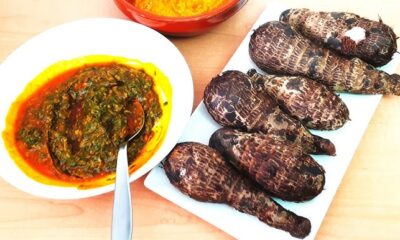
Next comes the thickener. Cocoyam is the most common base used in traditional preparation. The cocoyam is boiled until soft, peeled, and then pounded or blended into a smooth paste. In some communities, other local thickeners like achi or ofor may also be used, depending on preference and availability.
The cooking begins with the soup base. Meat, fish, or both are seasoned and boiled, most times, with dried fish or stockfish to build a rich stock. Palm oil is then added to give the soup its characteristic colour and depth of flavour. In some communities like Nnewi, they use akwu syrup (palm nut syrup) in place of palm oil.
Once the base is well prepared, the cocoyam paste is introduced gradually. It is stirred carefully to avoid lumps, and the soup is allowed to simmer until it thickens to a smooth consistency. This stage is important because it determines the final texture of the dish. At this stage too, ogiri is added and grinded uziza seed are added for the signature aroma.
The uziza and Oha leaves are added last. This timing is intentional. Adding them too early can affect their texture and colour. When added at the final stage, the leaves retain their softness and blend gently into the soup without losing their natural character.
After a short simmer, the soup is ready. The final result is a smooth, richly flavoured dish that pairs well with pounded yam, fufu, or garri. In many homes, the cooking process is not just about following steps. It is part of a rhythm that has been passed down over time where taste, observation, and memory guide how the soup comes together.
Ofe Oha and Igbo Food Philosophy
In Igbo culture, food is rarely treated as something separate from daily life or identity. It is part of how people understand health, community, and tradition. Within this wider way of thinking, Ofe Oha holds a clear place as a dish that carries both nourishment and cultural meaning without needing special explanation.
One key idea in Igbo food philosophy is balance. Meals are expected to bring together different elements in a way that feels complete. Ofe Oha (Oha Soup) fits this pattern well. It combines leafy vegetables, protein from meat or fish, natural thickener from cocoyam, and palm oil in a single pot. The result is a meal that is filling, but also rooted in locally available ingredients.
Another important aspect is the connection between food and shared experience. In many Igbo homes, cooking is not only about feeding individuals. It is about preparing something that people can eat together. Ofe Oha is often served in a communal setting where a single dish is shared, and conversation naturally follows the meal. In this sense, eating becomes part of social life rather than a separate activity.
Igbo food philosophy also values knowledge passed through practice. Recipes are rarely written down in traditional settings. Instead, cooking skills are learned by observation, repetition, and guidance from older family members. Ofe Oha reflects this clearly. Many people first learn how to prepare it by standing beside a parent or grandparent in the kitchen, not from a written recipe.
There is also a quiet respect for natural ingredients. Indigenous vegetables like the Oha leaf are used based on what grows locally and what is in season. This approach keeps food closely tied to the environment. It also explains why Ofe Oha remains linked to rural and home-based cooking traditions, even as modern diets change in urban areas.
Taken together, these ideas show that Ofe Oha is not just a single dish. It fits into a wider food culture where meals carry meaning, cooking is a form of learning, and eating is part of how relationships are maintained in everyday life.
Modern Changes and Urban Adaptation of Ofe Oha
Like many traditional Nigerian dishes, Ofe Oha has gradually adjusted to changes in lifestyle, location, and food access. While the core identity of the soup remains the same, the way it is sourced, prepared, and served has shifted, especially in urban areas where time, convenience, and ingredient availability play a bigger role.
In many cities, fresh Oha leaves are not always easy to find. Because of this, people now rely on frozen, dried, or pre-packaged versions of the leaves. These alternatives make it possible to prepare Ofe Oha (Oha Soup) outside its natural growing regions, even though some cooks still prefer fresh leaves for their texture and taste.
Cooking methods have also adapted to modern kitchens. Traditional pounding of cocoyam is often replaced with blenders or food processors. This reduces preparation time and makes the cooking process easier for busy households. Despite the change in tools, the goal remains the same – to achieve a smooth, well-thickened soup base.
In urban settings, Ofe Oha is also influenced by time constraints. Where extended cooking once fit into daily routines, many families now prepare it within shorter periods. This has led to more simplified versions of the recipe, without removing its essential ingredients or flavour profile.
Another noticeable change is how the soup is consumed outside the home. Restaurants and food vendors in Nigerian cities now include Ofe Oha on their menus, introducing it to the younger generations and non-Igbo customers. In these settings, it becomes part of a broader Nigerian food experience rather than strictly a home-cooked meal.
Even with these adaptations, the cultural importance of Ofe Oha remains steady. It continues to appear in family gatherings, celebrations, and moments when people want a familiar taste of home. The methods may change, but the place of Ofe Oha in Igbo food culture stays intact, moving naturally with the realities of modern life while holding on to its traditional roots.
Economic and Agricultural Importance of Oha Leaf

Beyond its role in the kitchen, the Oha leaf also carries real economic and agricultural value in many parts of southeastern Nigeria. While it is often discussed mainly as a soup ingredient, its journey from farm or forest to market helps to support small-scale trade and household income in local communities.
The Oha leaf comes from the tree Pterocarpus mildbraedii which grows naturally in forested areas and is sometimes preserved in farmlands or family compounds. In rural settings, harvesting the leaves provides a seasonal source of food and income. Families who have access to mature trees can gather leaves for both home use and local sale.
In many local markets, especially in Igbo-speaking regions, fresh Oha leaves are sold alongside other indigenous vegetables. This trade is often handled by small-scale vendors, many of whom are women. For these traders, Oha is part of a wider system of daily food commerce that helps to support household needs.
The demand for Ofe Oha in homes and restaurants keeps the leaf in steady circulation. Even when availability fluctuates due to season or location, buyers continue to look for it because of its strong cultural and culinary importance. This demand helps to sustain its place in local agricultural activity.
In recent years, there has also been growing interest in indigenous vegetables as part of broader discussions around food security and local farming systems. Studies on traditional African leafy vegetables, including Pterocarpus mildbraedii, highlight their nutritional value and role in supporting diversified diets. This has increased attention to crops like Oha beyond cultural cooking alone.
At the same time, challenges remain. The Oha tree is not widely cultivated in large commercial farms, which limits large-scale production. In some areas, environmental changes and reduced forest cover also affect availability. As a result, supply can vary, depending on season and location.
Even with these challenges, the Oha leaf continues to hold its place in both local agriculture and everyday food trade. Its steady demand ensures that it remains part of rural livelihoods and market activity, thus linking cultural food traditions like Ofe Oha to the economic life of the communities that sustain it.
Preserving Ofe Oha as a Living Cultural Heritage
The place of Ofe Oha in Igbo food culture has remained strong over time. However, like many traditional practices, it now sits at a point where conscious effort is needed to keep it alive. It is no longer enough that people simply know the soup. The way it is prepared, shared, and passed on is becoming just as important as the meal itself.
One of the clearest ways to preserve Ofe Oha (Oha Soup) is through everyday home cooking. In many families, traditional recipes are still learned informally, often by watching parents or older relatives prepare meals. This form of learning remains one of the strongest ways cultural food knowledge is transmitted. When children are included in cooking, they are more likely to understand not only the steps, but also the meaning behind the food.
Education also plays a role. Schools and cultural programmes can help to document indigenous foods and teach students about their origins. When dishes like Ofe Oha are included in discussions about culture and heritage, they move beyond the home and become part of a shared historical understanding.
Another important step is documentation. Writing down recipes, cooking methods, and the cultural context of traditional foods helps to preserve them for future generations. While oral tradition has kept Igbo cuisine alive for centuries, written and digital records now offer an added layer of protection against loss.
There is also growing importance in supporting local agriculture. Since Oha leaves come from a specific tree species, encouraging the planting and protection of Pterocarpus mildbraedii helps to ensure that the main ingredient of the soup remains available. Without the leaf, the dish cannot exist in its true form.
Urban lifestyles continue to change how people cook and eat, but that does not remove the value of traditional meals. Instead, it creates space for adaptation. Frozen leaves, simplified recipes, and restaurant versions all show that Ofe Oha can adjust without losing its identity.
Preserving this dish is not only about keeping a recipe alive. It is about maintaining a connection between food, memory, and identity. When Ofe Oha is cooked and shared, it carries more than flavour. It carries a history that continues to live through each generation that chooses to prepare it.
Conclusion …
Ofe Oha is not just another traditional soup in Igbo cuisine. It is part of a wider cultural memory that continues to live in homes, family kitchens, and shared meals. From the Oha leaf itself to the way the soup is carefully prepared and served, every part carries a sense of practice that has been passed along through generations.
What makes Ofe Oha (Oha Soup) stand out is not only its taste, it is also the place it holds in everyday life. It appears in moments of hospitality, in family gatherings, and in quiet meals that bring people together without much planning. Over time, it has remained steady, even as cooking habits, cities, and lifestyles have changed.
At its heart, Ofe Oha connects food with identity. It links people to the land where the Oha tree grows, to the kitchens where the recipe is learned by watching, and to the shared tables where stories are told. It is one of those dishes that carries meaning without needing to explain itself.
As Igbo food culture continues to adapt in modern times, Ofe Oha remains a reminder that tradition is not only preserved in stories or books, it is also in what people continue to cook, serve, and share.
References
- BusinessDay Nigeria. (2025). Ofe Oha: Proudly Nigerian superfood that can gain global recognition. https://businessday.ng/life/article/ofe-oha-proudly-nigerian-superfood-that-can-gain-un-cultural-status/
- Wikipedia contributors. (n.d.). Oha soup. In Wikipedia, The Free Encyclopedia. https://en.wikipedia.org/wiki/Oha_soup
- Wikipedia contributors. (n.d.). Pterocarpus mildbraedii. In Wikipedia, The Free Encyclopedia. https://en.wikipedia.org/wiki/Pterocarpus_mildbraedii
- Public Health Nigeria. (n.d.). Oha leaf health benefits and side effects. https://www.publichealth.com.ng/oha-leaf-health-benefits-and-side-effects/
- Guardian Nigeria. (n.d.). How to make Oha soup. https://guardian.ng/life/food/how-to-make-oha-soup/
- Encyclopaedia Britannica. (n.d.). Pterocarpus. https://www.britannica.com/plant/Pterocarpus
You might want to check this out …
- https://nnewicity.com/top-15-igbo-foods-you-must-try/
- https://nnewicity.com/igbo-food-culture-dishes-staple-foods-meaning/
- https://nnewicity.com/ogiri-the-culinary-treasure-in-igbo-cuisine/









