African History
Assin Manso Ancestral Slave River || The “River of No Return”

Assin Manso ancestral slave river is a powerful West African site of memory where captives took their “last bath.” This article traces the history of Assin Manso, the Memorial Wall of Return, the 1998 reburials, how the site is preserved and visited today, and actress Gabrielle Union’s recent, emotional reflections after visiting the river.
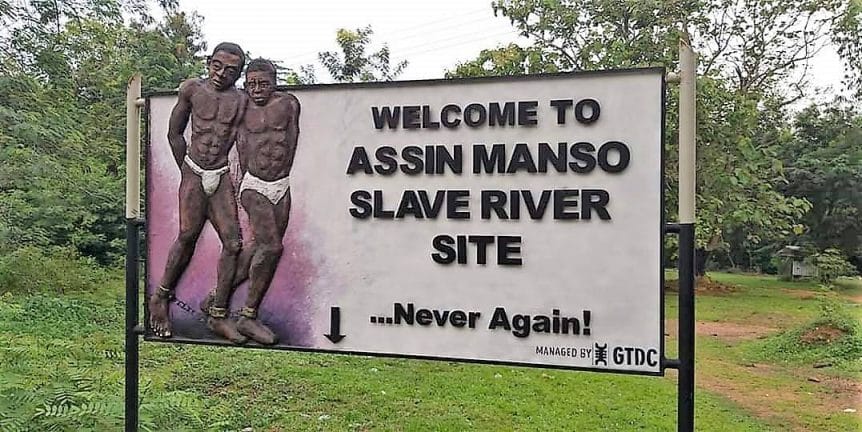
Nestled in Ghana’s Central Region lies the Assin Manso Ancestral Slave River, one of the most haunting and historically significant landmarks of the trans-Atlantic slave trade. Also known as the “River of No Return,” this tranquil river once served as the final bathing place i.e. the “last bath” for enslaved Africans before they were marched to the coastal forts of Cape Coast and Elmina and shipped across the Atlantic.
Today, the site stands as both a memorial and a sacred space for reflection, remembrance, and healing. Visitors from around the world, including American, Gabrielle Union, whose recent emotional visit drew global attention come to walk the same path their ancestors once did, to touch the waters that witnessed centuries of pain, and to reclaim a shared story of resilience.
In this article, we explore the deep history, cultural meaning, and enduring spirit of the Assin Manso ancestral slave river, uncovering why it continues to stir hearts and inspire generations seeking to reconnect with their roots.
A Brief History of Assin Manso Ancestral Slave River

The Assin Manso Ancestral Slave River holds a central place in the painful yet vital history of the trans-Atlantic slave trade. Located about 40 kilometers along the Cape Coast–Kumasi highway in Ghana’s Central Region, Assin Manso was once a bustling market town that served as a major transit point for enslaved Africans captured from various parts of West Africa. Before being sold to European traders at the coastal forts of Cape Coast and Elmina, captives were gathered at Assin Manso for rest, inspection, and preparation for sale.
It was here, along the banks of the Donkor Nsuo, literally meaning “Slave River” that the captives took their “last bath”. They were bathed, oiled, and fed after grueling marches that stretched for hundreds of miles from the northern and inland regions. This “last bath” symbolized their final moments on African soil before being marched to the coast and shipped across the Atlantic. A journey from which many would never return.
Over time, the Assin Manso Ancestral Slave River evolved from a site of unimaginable human suffering into one of deep remembrance and reconciliation. In 1998, it gained international recognition when the remains of two formerly enslaved Africans, one from the United States and another from Jamaica were ceremonially reinterred here.
That symbolic act transformed Assin Manso into a sacred site of memory, connecting descendants of the African diaspora to their ancestral homeland and marking it as one of Ghana’s most powerful heritage destinations.
The “Last Bath”: Meaning and Practice
At the heart of the Assin Manso Ancestral Slave River lies one of the most haunting and symbolic rituals of the trans-Atlantic slave trade, the “last bath.” This practice took place at the Donkor Nsuo, meaning “Slave River,” where thousands of captured Africans were brought after long, brutal treks from the northern and inland regions of Ghana and beyond.
At this river, the captives were bathed, scrubbed, and oiled, not as an act of care or dignity, but as a grim preparation for sale. Slave merchants sought to make them appear strong and healthy before they were marched to the coastal forts of Cape Coast and Elmina for shipment across the Atlantic. For many, this bath marked their final contact with African soil. Once they left the banks of the river, they were bound for a journey into the unknown, hence the name “River of No Return.”
Today, the Assin Manso Ancestral Slave River stands as a powerful reminder of this dark ritual. Visitors who walk barefoot along the same path and touch the calm waters often describe the experience as deeply emotional and transformative.
The river’s silence tells the story of endurance and loss. A story that continues to echo across centuries. Through remembrance and reflection, the “last bath” has evolved from a symbol of dehumanization into one of resilience, reconnection, and the enduring spirit of the African people.
The Site Today

Today, the Assin Manso Ancestral Slave River has transformed from a place of unimaginable suffering into a sacred space of remembrance, healing, and reconnection. What was once a slave market and holding point is now a peaceful memorial site that welcomes thousands of visitors each year – descendants of the African diaspora, students, historians, and travelers seeking to honour the past and reconnect with their roots.
At the crux of the site is the Memorial Wall of Return, a striking monument where visitors inscribe their names, messages, and countries of origin. Each inscription symbolizes a spiritual homecoming. A way for people of African descent scattered across the world to reclaim their identity and affirm their belonging. The wall has become a living record of return, carrying stories of pain, pride, and perseverance.
The Ancestral Graveyard lies nearby. A solemn space that holds the reinterred remains of two formerly enslaved Africans from the United States and from Jamaica, respectively. Their symbolic return to Ghana in 1998 marked a turning point in how the world remembers the slave trade, transforming the Assin Manso Ancestral Slave River into a global heritage site of reflection and reconciliation.
Visitors can also walk the path to the river, guided by local historians who narrate the events that unfolded there centuries ago. The path, lined with memorial sculptures and trees, leads to the quiet waters of the Donkor Nsuo. The same river where enslaved Africans once took their “last bath.” Standing at its edge today, one feels both the sorrow of loss and the strength of remembrance.
Through its memorials, graves, and the Wall of Return, the Assin Manso Ancestral Slave River continues to tell a story the world must never forget. A story of humanity’s capacity for cruelty, and our shared responsibility to remember, honour, and heal.
Historical and Emotional Relevance of Assin Manso
More than a historic landmark, the Assin Manso Ancestral Slave River is a living testimony to one of humanity’s darkest chapters and Africa’s enduring strength. Historically, it served as one of the most significant transit points during the trans-Atlantic slave trade – the last place enslaved Africans touched their homeland before being shipped away.
For historians and cultural preservationists, Assin Manso is a crucial link in understanding the complex web of trade, exploitation, and resistance that defined that era.
But beyond history books, the site carries deep emotional and spiritual weight. For descendants of enslaved Africans, standing by the river’s edge is often an overwhelming experience. A symbolic reunion with ancestors who were torn from their roots. Many visitors describe a profound sense of peace, sorrow, and pride as they walk through the grounds, touch the waters, or write their names on the Wall of Return. It is a place where silence speaks, where the whispers of the past echo through the rustle of trees and the steady flow of the river.
Assin Manso also matters because it bridges the gap between history and healing. It invites Africa and its diaspora to confront the pain of the past while celebrating the resilience, creativity, and cultural survival of those who endured. Each visit rekindles awareness of the shared heritage that binds people of African descent worldwide, turning remembrance into renewal.
In a world where many historical injustices are often forgotten or distorted, the Assin Manso Ancestral Slave River stands as a beacon of truth. A reminder that healing begins with remembering, and that from centuries of oppression can emerge a unified call for dignity, identity, and hope.
The 1998 Reburials: A Symbolic Return and Sacred Ritual
In 1998, the Assin Manso Ancestral Slave River became the centre of a deeply symbolic and emotional event: the reburial of two enslaved Africans whose remains were returned from the diaspora. One came from the United States and the other from Jamaica. Their journey home was not just a physical act of repatriation but a spiritual homecoming that carried the hopes, grief, and resilience of millions of descendants of enslaved Africans around the world.
The ceremony, known as the “Emancipation Day Reburial,” was organized as part of Ghana’s effort to reconnect with the African diaspora and honour the memory of those who never made it back. The coffins arrived in Ghana draped in national flags, accompanied by solemn traditional rites, prayers, and songs. Thousands of people gathered – locals, government officials, and visitors from across the globe to witness what was both a burial and a rebirth.
At Assin Manso, the remains were carried to the Ancestral Graveyard, near the very river where countless Africans took their last bath before being marched to the coast. There, amid tears and drumming, the ancestors were finally laid to rest on their homeland. The air was thick with emotion as libations were poured, and elders invoked the spirits of the departed. The act symbolized closure, reconciliation, and return. A long-delayed journey home for those who had been denied the right to die among their own.
The 1998 reburials transformed the Assin Manso Ancestral Slave River from a site of tragedy into one of remembrance and healing. Each year since then, commemorative events and pilgrimages have been held there during Ghana’s Emancipation Day celebrations, attracting people of African descent from across the world. For them, the ritual is not just about honouring the dead, it is about reclaiming identity, acknowledging history, and continuing the unbroken bond between Africa and its scattered children.
How the Assin Manso Ancestral Slave River Is Experienced Today
Today, the Assin Manso Ancestral Slave River is not merely a historical attraction, it is a powerful site of heritage tourism, cultural education, and spiritual pilgrimage. Managed as both a memorial and educational centre, the site offers visitors an opportunity to connect deeply with history through guided storytelling, exhibits, and immersive experiences that bring the past to life.
Upon arrival, visitors are greeted by local historians and curators who narrate the harrowing journey enslaved Africans endured. They explain how the captives were marched hundreds of kilometers barefoot, chained, and exhausted, until they reached the Donkor Nsuo, where they took their “last bath.” Through these narratives, the site becomes more than a collection of monuments. It becomes a living classroom where memory and history meet.
The visitor experience typically includes a walk along the slave route, a stop at the Wall of Return, a visit to the Ancestral Graveyard, and a moment of reflection by the river itself. Along the path, art installations and memorial sculptures depict scenes of captivity and resistance, helping visitors grasp the emotional gravity of the site.
Assin Manso also plays a major role in Ghana’s heritage tourism and diaspora engagement programmes. It features prominently in events such as the Pan-African Festival of Emancipation and The Year of Return (2019) initiatives that invite people of African descent worldwide to reconnect with their ancestral homeland. For many, visiting Assin Manso is a deeply spiritual act. A pilgrimage that restores a sense of identity and belonging lost through centuries of displacement.
Beyond its emotional resonance, the Assin Manso Ancestral Slave River serves as a space for learning and dialogue. Educational tours for students, cultural exchange programmes and academic research projects are frequently hosted there, ensuring that the lessons of the past continue to inspire awareness and unity in the present.
This way, Assin Manso is not just preserved as a historical site, it is interpreted as a living memory, one that bridges continents, generations, and souls through truth, remembrance, and hope.
Gabrielle Union’s Visit and Her Reflections

When American actress and activist, Gabrielle Union visited the Assin Manso Ancestral Slave River this October 2025, her journey was far more than a celebrity stop. It was a pilgrimage of remembrance and reconnection. Standing at the banks of the Donkor Nsuo, Union joined a long line of people of African descent who have made their way back to this sacred site to honour the memories of their ancestors who were taken away through the trans-Atlantic slave trade.
Accompanied by family and cultural guides, Union toured the memorial grounds, walked along the historic slave route, and paused for reflection at the Ancestral Graveyard and the Wall of Return. Her visit was marked by deep emotion as she paid homage to the men, women, and children who endured unimaginable suffering, yet, carried within them the spirit of survival that still defines African and Black identity today.
In her reflections shared on social media, Union described the experience as “humbling, heartbreaking, and healing.” She spoke about feeling the weight of history and the power of remembrance, noting that the visit reminded her of the strength, resilience, and dignity of her ancestors. She urged others, especially, members of the African diaspora to make the journey, if they can, to “walk the path, touch the water, and listen to the whispers of those who came before us.”
Union’s visit counts because it amplifies global awareness of the historical and emotional importance of the Assin Manso Ancestral Slave River. Her presence and her willingness to share the experience helps a wider audience to connect with Africa’s role in world history, beyond the textbooks and museums. It bridges the gap between the continent and its diaspora, showing that remembrance can be both painful and empowering.
For Ghanaians, Union’s visit reaffirms the country’s ongoing efforts to preserve and promote heritage tourism and diaspora reconnection through initiatives like The Year of Return and Beyond the Return. For the global Black community, it underscores a universal truth that to remember is to reclaim.
In the stillness of Assin Manso, Gabrielle Union joined a timeless conversation that continues to call all people of African descent to look back with reverence, and forward with pride and purpose.
Local Memory and Scholarly Perspectives
The story of the Assin Manso Ancestral Slave River is not told by monuments alone, it lives on through the voices of the local people and the insights of Ghanaian scholars who have dedicated themselves to preserving its truth. For the residents of Assin Manso, the site is more than a historical attraction. It represents a sacred ground woven into their identity, culture, and oral history.
Elders in the community often recount stories passed down through generations of the long, tragic processions of captives who arrived weary and broken, and of the silence that followed once they vanished toward the coast. These local narratives give life and texture to what official history books sometimes overlook, that is, the human side of the slave trade, seen and remembered through African eyes. Many describe the river as a place of spirits, where the cries of ancestors are still felt in the rustling trees and flowing waters.
Ghanaian scholars and historians, such as Professor Akosua Adoma Perbi and Dr. Emmanuel Akyeampong, have written extensively on the role of Assin Manso within the larger context of the trans-Atlantic slave trade. Their research highlights how the site served as a major hub connecting interior slave markets to the coastal castles of Cape Coast and Elmina. Through archaeology, oral history, and cultural anthropology, they have helped piece together the lived experiences of those who passed through the Donkor Nsuo, offering a more holistic, African-centered understanding of history.
Local and academic efforts have also converged to turn Assin Manso into a centre of remembrance and learning. Schools frequently organize excursions there, while universities host seminars and exhibitions exploring the spiritual, economic, and political dimensions of slavery. These efforts ensure that the site is not just preserved but continuously interpreted for new generations.
Through these voices from Ghana, the Assin Manso Ancestral Slave River stands as a reminder that history is not frozen in time, rather, it breathes through the people who remember, research, and retell it. Their testimonies bridge the gap between memory and scholarship, ensuring that the lessons of Assin Manso remain alive, powerful, and relevant to both Africa and the wider world.’
Interpreting a Painful Past
Like many heritage sites connected to slavery, the Assin Manso Ancestral Slave River carries layers of history that are complex, emotional, and sometimes debated. While there is a broad agreement on its central role as a resting and bathing point for enslaved Africans before their forced march to the coast, historians and cultural custodians continue to engage in discussions about how best to interpret and present that history responsibly.
One key challenge lies in balancing fact and feeling. For many visitors, especially, those from the African diaspora, Assin Manso is not merely a historical site but a spiritual homecoming. The river is often described in sacred terms, a place where the souls of the departed still linger. Scholars and curators therefore face the delicate task of preserving the emotional sanctity of the site while ensuring that the historical narrative remains evidence-based and nuanced.
There are also broader academic debates about how to situate Assin Manso within the trans-Atlantic slave trade’s vast network. Some researchers argue that while the site played a significant regional role, it should not be viewed in isolation from other major routes and depots across West Africa. Others emphasize its symbolic power as a focal point for remembrance where historical reality meets collective healing.
To address these tensions, Ghana’s heritage authorities have prioritized inclusive and respectful interpretation. Guided tours now combine verified historical facts with oral histories from local elders, allowing multiple perspectives to coexist. This approach recognizes that memory itself is a form of truth that carries emotional depth beyond written archives.
Ultimately, the conversation around the Assin Manso Ancestral Slave River reflects a broader truth about confronting the past, the fact that remembrance is never simple. It demands honesty, empathy, and humility. The goal is not to sanitize history, but to tell it with compassion and accuracy, ensuring that both the pain and the perseverance of those who passed through Assin Manso are never forgotten.
The Wider Significance

The story of the Assin Manso Ancestral Slave River extends far beyond Ghana’s borders. It is a site where history, memory, and healing converge. A place that speaks not only to Africans but to the global community. For centuries, the trans-Atlantic slave trade tore millions of people from their homelands, erasing names, families, and languages. Today, Assin Manso stands as one of the few places where that painful rupture is symbolically mended.
For people of African descent around the world, visiting the river is often described as a journey of return. A reconnection with ancestors whose strength and spirit endured across generations. Standing at the banks of the Donkor Nsuo, many find a profound sense of peace and belonging, as if the waters themselves invite them to reclaim what was lost. This act of remembrance transforms pain into power, turning a site of bondage into one of liberation and identity.
The Assin Manso Ancestral Slave River also holds significance for Ghana and Africa at large. It underscores the continent’s commitment to confronting the traumas of its past with honesty and dignity. Through national initiatives such as Emancipation Day, The Year of Return (2019), and Beyond the Return, Ghana continues to open its arms to the diaspora, encouraging people of African descent to visit, invest, and reconnect with their ancestral homeland.
But perhaps, the greatest power of Assin Manso lies in its message of healing through remembrance. By acknowledging the suffering of the enslaved and honoring their resilience, the site helps bridge divides of time, geography, and identity. It calls on humanity to remember that the history of slavery is not only African history but also human history, and its lessons belong to everyone.
In this sense, Assin Manso is more than a memorial. It is a mirror reflecting both our shared pain and our shared potential. It reminds the world that healing begins with truth, that return is possible even after centuries, and that memory, when carried with reverence can lead to freedom, unity, and renewal.
Closing Reflection…
The River That Still Speaks
The Assin Manso Ancestral Slave River is not just a place marked on Ghana’s map. Beyond that, it is a living monument of memory, a river that still speaks across centuries. Its calm waters tell stories of unimaginable sorrow and unbroken spirit; of those who were stripped of freedom, yet, carried the flame of resilience that burns in their descendants today.
From the haunting ritual of the “last bath” to the solemn 1998 reburials and the ongoing pilgrimages of people from all over the world, Assin Manso continues to evolve from a site of tragedy into one of healing, identity, and rebirth. Each visit, whether by locals, scholars, or global figures like Gabrielle Union reinforces its power as a bridge between past and present, between Africa and its diaspora, between grief and hope.
To stand at Assin Manso is to confront history with open eyes and an open heart. It compels us to remember the cost of inhumanity while celebrating the triumph of endurance. It reminds us that even the deepest wounds can guide us toward renewal, if we choose remembrance over forgetting, and unity over silence.
In the end, the Assin Manso Ancestral Slave River flows not only through Ghana but through the collective consciousness of the world. It is a river of truth and return. A reminder that though countless lives were taken away by force, the connection between Africa and her children remains unbroken, eternal, and alive in every ripple that moves through its sacred waters.
References
- https://visitghana.com/assin-manso-ancestral-slave-river-site/
- https://en.wikipedia.org/wiki/Assin_Manso_Slave_River_Site
- https://www.beyondthereturn.com/assin-manso-slave-river/
- https://hobletsonthego.com/where-weve-been/africa/ghana/assin-manso-slave-river-site/
- https://www.theghanareport.com/gabrielle-union-recounts-spiritual-and-cleansing-moment-during-ghana-visit/
You might want to check this out…