

Anambra News
From Onitsha to Silicon Valley: Nigerian Girls Build Fake Drug App

Nigeria has long struggled with the menace of counterfeit drugs, a hidden crisis that claims thousands of lives each year. From malaria tablets that contain little more than chalk to antibiotics that fail when patients need them most, fake medicines remain a major public health threat across Africa. For many families, a simple trip to the pharmacy can mean the difference between life and death.
But in 2018, hope came from an unexpected place, a classroom in Onitsha, Anambra State. Five teenage girls from Regina Pacis Secondary School, Vivian Okoye, Jessica Osita, Promise Nnalue, Adaeze Onuigbo, and Nwabuaku Ossai decided to take action. They built a mobile application called FD-Detector, designed to help people identify counterfeit medicines before it is too late.

Regina Pacis Onitsha students presenting FD-Detector app in Silicon Valley
What started as a school project quickly became a global success story. Their app did not just win admiration, it carried them all the way to Silicon Valley in California, where they made history as the first African team to win gold at the Technovation Challenge.
The Problem of Fake Drugs in Nigeria and Africa
Fake drugs are not just an inconvenience, they are deadly. The World Health Organization once reported that substandard and counterfeit medicines kill hundreds of thousands of people globally every year. In sub-Saharan Africa, the issue is worse because health systems are weaker and regulation is more difficult to enforce.
Nigeria has been battling these for decades. Malaria, which is one of the biggest killers in the country, is often targeted by counterfeiters because malaria drugs are in high demand. Imagine a patient who buys what looks like genuine anti-malaria medicine. The packaging is perfect, the price seems normal, but the drug is fake. Instead of curing the illness, the person gets worse and may eventually die.
The economic cost is equally huge. Families spend scarce resources buying useless medicine. The trust in pharmacies and hospitals reduces. Even genuine pharmaceutical companies lose money because fake versions of their products circulate everywhere.
Efforts by the Nigerian government and the National Agency for Food and Drug Administration and Control (NAFDAC) have helped, but the problem is far from solved. Fake drug producers are often ahead with new tricks. That is why new solutions, especially technological ones, are urgently needed. This was the gap that the teenage girls from Onitsha decided to address.
Meet the Regina Pacis Girls
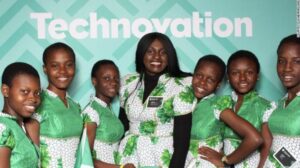
Save-a-Soul team with mentor after winning Technovation Challenge
Regina Pacis Secondary School sits on Awka Road in Onitsha, one of Nigeria’s busiest commercial cities. The school is known for discipline and academic excellence, but in 2018 it became famous for something more – innovation.
The “Save-a-Soul” team, as the girls called themselves, was made up of five bright minds:
- Vivian Okoye
- Jessica Osita
- Promise Nnalue
- Adaeze Onuigbo
- Nwabuaku Ossai
Guiding them was their mentor, Uchenna Onwuamaegbu-Ugwu, a passionate advocate for STEM education for girls in Nigeria. She introduced them to the Technovation Challenge, a global competition that encourages young girls to solve community problems using technology.
While brainstorming for the challenge, the girls kept coming back to one painful issue, the menace of fake drugs. For Jessica, it was personal. For all of them, it was urgent. That was how the seed of FD-Detector was planted.
Birth of the FD-Detector App
Turning an idea into reality was not easy. Most of the girls had little or no background in coding before the competition. They had to learn programming basics, understand how mobile apps work, and think about design, all within a few months.
They decided to build FD-Detector, short for Fake Drug Detector. The app was designed to help ordinary people check if a medicine is genuine before using it. The main feature was simple, by scanning the barcode on the drug package, the app could confirm whether the medicine was real or fake. It also allowed users to check expiry dates and report suspicious products.
To build it, the girls used MIT App Inventor, an open-source platform that makes it easier for beginners to design apps. They spent long hours after school, learning, testing, and correcting errors. Sometimes the app would crash; other times the scanner refused to work. But each challenge only pushed them to work harder.
For them, the project was more than just a school assignment. It was about saving lives. Every line of code was written with the hope that no more families would suffer the pain of losing loved ones to fake medicine.
From Onitsha to Silicon Valley
The Technovation Challenge is the world’s largest tech competition for girls, with thousands of teams applying from different countries every year. The Regina Pacis girls entered the junior category in 2018. They were up against teams from the United States, Spain, Turkey, Uzbekistan, and many other countries.
At first, they did not believe they could stand out on such a big stage. They came from a school in Onitsha, not from a high-tech city. But their determination and the power of their idea carried them forward. Step by step, they advanced through the rounds until they were invited to San Francisco, California, the heart of Silicon Valley for the world finals.
It was their first time leaving Nigeria. The journey itself was an adventure, but what awaited them was even bigger. Standing before judges, tech experts, and an international audience, the girls confidently presented FD-Detector. They explained the fake drug problem in Nigeria and demonstrated how their app could help solve it.
When the results were announced, the Save-a-Soul team from Onitsha had won gold in the junior category. They were the first African team to achieve this feat. From Onitsha’s classrooms to Silicon Valley’s global stage, they had shown the world that talent has no boundaries.
Impact and Recognition
The victory of the Regina Pacis girls did not end in San Francisco, it echoed across Nigeria and the world. Newspapers, television stations, and online platforms celebrated them as “The Onitsha Girls Who Conquered Silicon Valley.” For many Nigerians, it was a moment of pride and proof that the country’s youth could compete at the highest levels of global innovation.
Back home in Anambra State, the girls were received like heroes. The state government, led by Governor Willie Obiano at the time, promised to support them and explore how the app could be developed further. The National Agency for Food and Drug Administration and Control (NAFDAC), which is responsible for regulating drugs in Nigeria, also showed interest in collaborating with the team.
The recognition went beyond government. International organizations invited them to speak at conferences and share their journey. Their school, Regina Pacis Secondary School, became famous, attracting more interest in science and technology education.
Perhaps the biggest impact was inspiration. Across Nigeria, many young girls who had never considered technology before suddenly believed it was possible. If teenagers from Onitsha could build a life-saving app and win in Silicon Valley, then others could dream too. The team became role models for girls in STEM, breaking stereotypes and showing that innovation is not limited to men or to people from developed countries.
Challenges and the Road Ahead
While their story is inspiring, it also raises important questions. Building an app is one thing, making it widely used is another. For FD-Detector to truly fight fake drugs, it needs a strong database of authentic medicines, constant updates, and cooperation from pharmaceutical companies and regulators. Without this, counterfeiters can still find ways around the system.
Another challenge is sustainability. The girls were still students when they created the app. To keep improving it, they needed funding, technical support, and long-term mentorship. In Nigeria, many great ideas die because there is no structure to help young innovators move from prototype to real business or social solution.
Connectivity is also an issue. Many rural areas in Nigeria do not have reliable internet access. For FD-Detector to work everywhere, it needs to be designed in a way that even offline users can benefit.
Yet, these challenges are not reasons to give up, they are opportunities. If the government, universities, and private sector invest in projects like this, Nigeria could turn young ideas into world-class solutions. For the Regina Pacis girls, their victory was not just the end of a competition, it was the beginning of a lifelong journey in technology and leadership.
Broader Lessons
The story of the Onitsha girls is bigger than one app. It teaches several lessons about innovation and society.
First, it shows that talent is everywhere, but opportunity is not. Without the Technovation Challenge, the girls may never have discovered their potential in technology. This proves the importance of giving young people access to global platforms.
Second, it highlights the role of mentorship and education. The guidance of their mentor, Uchenna Onwuamaegbu-Ugwu, was critical. She believed in them, encouraged them, and gave them the tools to succeed. If more schools and communities invest in mentors and STEM programs, many more young innovators will rise.
Third, it is a lesson in the power of women in STEM. In many societies, especially in Africa, girls are often told that science and technology are “not for them.” The Regina Pacis team destroyed that myth. They stood before the world and proved that girls can code, build, and solve global problems.
Finally, it reminds us that local problems can lead to global solutions. The girls focused on an issue that was affecting their community—fake malaria drugs. By solving it, they caught the world’s attention. Innovation does not always have to start with complex global issues; sometimes it starts with the challenges at your doorstep.
Conclusion
From the classrooms of Regina Pacis Secondary School to the spotlight of Silicon Valley, the journey of Vivian Okoye, Jessica Osita, Promise Nnalue, Adaeze Onuigbo, and Nwabuaku Ossai is proof that young Africans have the power to change the world. With courage, curiosity, and the right support, they turned personal pain and social problems into a tool that could save lives.
Fake drugs remain a major challenge in Nigeria and Africa, but the story of FD-Detector offers hope. It shows that the fight is not only for governments and big companies but also for ordinary young people with extraordinary ideas.
As the girls continue their education and careers, the world watches with interest. Whether they build more apps, launch tech companies, or inspire others to dream, their impact is already clear. They have given a generation of Nigerian youth the confidence to believe: if you can think it, you can build it.
In the end, their story is not just about winning a competition, it is about rewriting the future. And it all started in Onitsha.
Read More: Top 10 Tourist Cities in Africa: Culture, Food, History, and Adventure