


Trending News
Nze Tobe Osigwe’s Call for 120 Years Sentence for Nnamdi Kanu || Justice for IPOB Victims

Nze Tobe Osigwe’s call for 120 years sentence for Nnamdi Kanu has sparked debate on the Nigeria social media space as he makes a case for justice for IPOB victims. Read his earlier views, and reactions from Igbo leaders and the public.
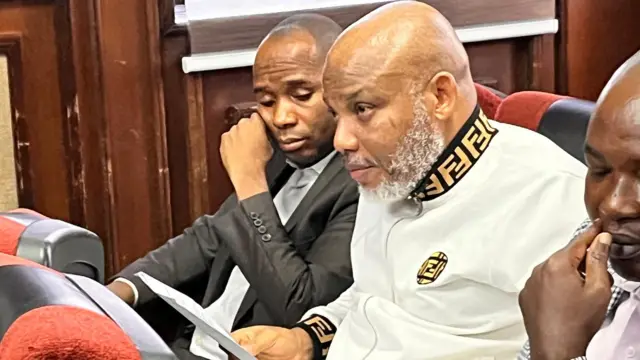
IPOB Leader – Mazi Nnamdi Kanu
Nze Tobe Osigwe’s call for 120 years sentence for Nnamdi Kanu has sent shockwaves online, igniting intense debate about justice, accountability, and the victims of IPOB’s agitation. In a strongly worded statement, Osigwe demanded that Nnamdi Kanu be sentenced to 120 years in solitary confinement, arguing that only such a severe punishment can truly deliver justice for the lives lost, communities destroyed, and businesses devastated by IPOB’s actions.
This bold stance is the latest in a series of outspoken views from Osigwe, who has consistently criticized Nnamdi Kanu and IPOB for the disruption caused in Igbo communities.
In this article, we explore Nze Tobe Osigwe’s call for 120 years sentence for Nnamdi Kanu, his reasoning, the victims he highlights, public reactions, and how his earlier critiques of Kanu shaped this dramatic demand.
Who Is Nze Tobe Osigwe?
Nze Tobe Osigwe, also known as Eze Ikolommụọ is a Nigerian cultural advocate, filmmaker, writer and practitioner of Igbo traditional religion (Odinala). As a prominent voice in Igbo spiritual and moral discourse, Nze Tobe Osigwe’s call for a 120‑year sentence for Nnamdi Kanu reflects not only his views on justice but also his deep commitment to Igbo identity, tradition and ethics.
Born into the Igbo community, Osigwe holds the traditional title of Ọzọ in Nnewi, a highly respected spiritual and social rank in Igbo society. He is often referred to by his spiritual name, Eze Ikolommụọ, highlighting his role as a cultural and ancestral consciousness teacher.
In his public and media appearances, Nze Tobe Osigwe has been very clear about the significance of tradition and education working hand in hand. In a notable interview on 90MinutesAfrica, he argued that Christianity is comparable to a “secondary school” in spiritual education, while Odinala – the Igbo traditional religion – is akin to a “tertiary institution.”
He believes that many Igbo people remain in Christianity “out of fear”, especially the fear of hell), a concept he has publicly called “a myth” used to sustain certain religious systems.
Despite his strong traditionalist stance, Osigwe is not opposed to modernity. He has stressed that Igbo elites should acquire scientific and technological education first, then integrate the ethical teachings of their ancestor’s value system into their modern lives.
As a respected traditional figure, Nze Tobe Osigwe’s call for a 120‑year sentence for Nnamdi Kanu is steeped in moral and spiritual conviction. Understanding who he is helps to shed light on why his demands carry weight in Igbo socio-cultural and religious discussions.
Nze Tobe Osigwe’s Call for 120 Years Sentence for Nnamdi Kanu Statement: The Full Text
Nze Tobe Osigwe’s call for 120 years sentence for Nnamdi Kanu is a strong, uncompromising demand made in a public post. Here is the full text of his stance:
“I do believe Nnamdi Kanu should be sentenced to one hundred and twenty years in solitary confinement.
And anyone advocating for Nnamdi Kanu to be released is a clown pretending as if there are no actual victims deserving of justice from Kanu’s macabre agitation.
Those who have died from his senseless agitation deserve justice!
Children who have been orphaned as a result of Kanu deserve justice!
Communities that were sacked and houses looted deserve justice!
Those who lost some parts on their body during enforcements of SAH deserve justice!
Communities that were forced to pay taxes to IPOB deserve justice!
Community leaders and Igwes that were executed for refusing to conform deserve justice!
Police officers who were targeted and unalived by Kanu’s IPOB deserve justice!
Ala Igbo which received the innocent bloods of her children deserve justice!
Many businesses that died as a result of IPOB agitation deserve justice!
The nation which will rebuild all the public buildings destroyed by IPOB deserve justice!
To those asking me to address what pushed Nnamdi Kanu and IPOB to take up arms, you also deserve to be sentenced.
You are really asking me to justify why a thief after stealing from me went on to burn down my house? You asking a victim of Kanu’s agitation to explain what made him to make my life miserable? Did I send Kanu on any errand that I will make a defence for him?
If Nnamdi Kanu could not put up a defence in court as to why he went berserk, why should I imagine or invent one for him?
He had his day in court to tell the world and we the victims of his agitation why he chose the dangerous path, shockingly, the arrogant swine posited he had no case to answer.
Kanu has to be sentenced to one hundred and twenty years in solitary confinement. After several years in the dungeon, that is when talks about a political release should even suffice.”
Ezeikolomuo
Igbo Consciousness Teacher
This is the full text of Nze Tobe Osigwe’s call for 120 years sentence for Nnamdi Kanu, as posted on his Facebook page. In a language that can be described as very forceful, he centres the victims of IPOB’s agitation and rejects any argument that seeks to justify or rationalize Kanu’s methods.
By demanding solitary confinement and a very long term, he signalled that he believes only sustained punishment can truly deliver justice. He also suggested that only after a long punitive period should political release even be discussed, implying distrust in quick or symbolic reconciliation.
Key Points from Nze Tobe Osigwe’s Call for 120 Years Sentence for Nnamdi Kanu
Nze Tobe Osigwe’s call for 120 years sentence for Nnamdi Kanu is not just a single statement, it contains several key points that reveal his reasoning, priorities and worldview. Taking a look at the main takeaways from his views, Osigwe explicitly calls for 120 years in solitary confinement, signalling that he believes only a very harsh penalty can serve as justice for the victims of IPOB’s agitation.
His argument prioritizes the victims of Kanu and IPOB’s actions, including the deceased, orphans, injured, displaced communities, executed traditional leaders, police officers and destroyed businesses. By listing these groups, Osigwe emphasizes that justice must respond to the tangible human and economic costs of IPOB’s agitation.
Osigwe refuses to rationalize or defend Kanu’s motives, stating that the victims should not have to explain the reasons behind their suffering. He makes it clear that the focus should remain on accountability, not political debate, asserting that any talk of political release should only arise after years of imprisonment, implying that justice must be felt through punishment before negotiation.
As an Igbo Consciousness Teacher, Osigwe frames justice in moral and cultural terms, emphasizing communal healing and ethical accountability alongside legal consequences. He calls those advocating for Kanu’s release “clowns,” arguing that ignoring the victims’ suffering shows a lack of moral and ethical responsibility. He dismisses arguments for leniency, portraying Kanu’s court behaviour and claim that he had no case to answer as arrogant and disrespectful to the victims.
Overall, Nze Tobe Osigwe’s call for 120 years sentence for Nnamdi Kanu is built on a principled, victim-first approach that blends cultural, moral and punitive considerations. The statement reflects his deep concern for the consequences of the actions of IPOB and a belief that justice must be visible, tangible and long-lasting.
Victims Highlighted in Nze Tobe Osigwe’s Call for 120 Years Sentence for Nnamdi Kanu
In Nze Tobe Osigwe’s call for 120 years sentence for Nnamdi Kanu, he places a strong emphasis on the people and communities he considers victims of IPOB’s agitation. This focus on victims underscores the moral and social rationale behind his demand. Let’s review the main groups highlighted in Nze Tobe Osigwe’s call for 120 years sentence for Nnamdi Kanu.
Deceased Individuals: Osigwe stresses that those who lost their lives due to IPOB’s activities deserve justice, framing the sentence as a response to lives cut short.
Orphaned Children: Children left without parents due to the agitation are singled out as a key reason for a harsh sentence, emphasizing the long-term impact of Kanu’s actions on families.
Displaced Communities: Communities that were sacked, houses looted, or people forcibly displaced are recognized as victims whose suffering must be acknowledged.
Injured Persons: Those who sustained serious injuries during enforcement of IPOB’s sit-at-home orders are highlighted, including individuals who lost some parts of their body.
Taxed or Coerced Communities: Osigwe notes that certain communities were allegedly forced to pay “taxes” to IPOB, an economic burden imposed on civilians under duress.
Traditional Leaders and Igwes: He draws attention to community leaders executed for resisting IPOB, framing these acts as a direct assault on traditional authority and communal governance.
Law Enforcement Officers: Police officers targeted or killed by IPOB are explicitly mentioned, reflecting the law-and-order consequences of the agitation.
Destroyed Businesses: Osigwe emphasizes the economic toll, citing businesses that “died” as a result of IPOB’s agitation.
Public Infrastructure: The destruction of public buildings and national assets is highlighted as part of the broader impact of the unrest.
By enumerating these groups, Nze Tobe Osigwe’s call for 120 years sentence for Nnamdi Kanu frames the demand as victim-centered justice, not a personal or political vendetta. It also reinforces his argument that accountability must be tangible and long-lasting, acknowledging the breadth of suffering caused by the activities of IPOB.
Public Reactions to Nze Tobe Osigwe’s Call for 120 Years Sentence for Nnamdi Kanu
Public reactions to Nze Tobe Osigwe’s call for 120 years sentence for Nnamdi Kanu have been mixed, reflecting Nigeria’s complex social, political and cultural landscape. His statement has sparked debates among traditional leaders, political observers, human rights activists and ordinary citizens.
Some Igbo cultural enthusiasts and traditionalists have supported Nze Tobe Osigwe’s call for 120 years sentence for Nnamdi Kanu, seeing it as a necessary moral stance to restore communal order and protect traditional authority.
Supporters emphasize that Nze Tobe Osigwe’s call for 120 years sentence for Nnamdi Kanu is rooted in ancestral ethics and the principles of Igbo community responsibility, reinforcing the idea that justice must serve the victims and broader society.
Groups like Ohanaeze Ndigbo, the apex Igbo socio-cultural organization have cautioned against overly punitive approaches. They argue that harsh sentences may exacerbate divisions rather than promote reconciliation. Ohanaeze leaders have stressed that political advocacy for Kanu’s release should not be conflated with moral neglect, warning that some critics may exploit the situation for personal gain.
Human rights advocates have raised concerns over procedural fairness, transparency and the appropriateness of extreme sentencing. While acknowledging victims’ suffering, they caution against mandatory ultra-long sentences without due process and judicial review.
IPOB members and sympathizers have largely rejected Nze Tobe Osigwe’s call for 120 years sentence for Nnamdi Kanu, framing it as politically motivated and ignoring broader grievances that IPOB has raised over marginalization and self-determination. They emphasize the need for transparent trials and fair hearings, asserting that justice should be balanced and impartial.
On social platforms, Nze Tobe Osigwe’s call for 120 years sentence for Nnamdi Kanu has sparked heated debate. Many users praise his victim-centered approach, while others criticize the extremity of the proposed punishment.
The discourse reflects a wider national conversation on justice, political accountability and cultural identity, highlighting how Osigwe’s statement resonates with both supporters and critics.
In essence, the reactions of the public to Nze Tobe Osigwe’s call for 120 years sentence for Nnamdi Kanu illustrates a deeply divided perception of justice. While some view it as a necessary moral and cultural corrective, others caution against excessively punitive measures and emphasize reconciliation and procedural fairness. These reactions underline the complexity of balancing victim advocacy, cultural ethics and political realities in contemporary Nigeria.
The Context of Nnamdi Kanu’s Conviction and IPOB Agitation
Nnamdi Kanu’s conviction and IPOB agitation is essential to understanding why Nze Tobe Osigwe’s call for 120 years sentence for Nnamdi Kanu resonates with some and provokes strong pushback from others.
Background on IPOB and Nnamdi Kanu
Before we delve into Nze Tobe Osigwe’s call for 120 years sentence for Nnamdi Kanu, let’s get a background information of IPOB and the man behind the formation. IPOB (Indigenous People of Biafra) is a separatist organization founded by Nnamdi Kanu. The group advocates for the self-determination of Igbo people in southeastern Nigeria. Over the years, IPOB has been accused by the Nigerian government of orchestrating sit-at-home orders in the southeast which critics argue disrupt economic life and infringe on the freedom of movement.
The Nigerian authorities classify IPOB as a proscribed and terrorist organization, citing a pattern of violent rhetoric, broadcast sermons through Radio Biafra and calls for violence.
The Conviction and Sentencing of Nnamdi Kanu
On November 20, 2025, the Federal High Court in Abuja, presided over by Justice James Omotosho, convicted Nnamdi Kanu on seven terrorism-related counts. The judge sentenced Kanu to life imprisonment on multiple counts as follows:
- Life on counts 1, 4, 5, and 6.
- 20 years on count 3.
- 5 years on count 7.
- All sentences are to run concurrently.
Justice Omotosho opted not to impose the death penalty, despite the prosecution’s request. Instead, he invoked mercy, citing a biblical principle and noting global sentiment against capital punishment. The court also declared Kanu an “international terrorist”, pointing to his broadcasts, threats against diplomatic missions and instructions to followers to carry out violent acts.
Additional orders from the court include that:
- Kanu should be held in protective custody, not the usual Kuje prison, for his own safety.
- He should have no access to digital devices, because of how he allegedly used radio and broadcasts to incite violence.
- The transmitter used for Radio Biafra was forfeited to the Federal Government.
Kanu’s legal team has indicated it will appeal the verdict.
Nze Tobe Osigwe’s call for 120 years sentence for Nnamdi Kanu must be seen against the backdrop that a court found Kanu guilty of serious terrorism-related offenses, not just political dissent.
The sit-at-home orders which the court labelled as “terrorism,” are precisely the kind of harm Osigwe refers to in his demand for long-term punishment and justice for victims.
By calling for a very harsh sentence – 120 years in solitary, Osigwe’s demand goes beyond the court’s life sentence. He appears to want not just incarceration, but a form of prolonged, visible punishment, perhaps to serve as both moral reckoning and deterrent.
His perspective also reflects the fears of those who believe that IPOB’s agitation has caused deep and lasting harm to individuals and communities – harm that, in his view, deserves more than conventional legal punishment.
Analyzing Nze Tobe Osigwe’s Call for 120 Years Sentence for Nnamdi Kanu
Understanding the reason behind Nze Tobe Osigwe’s call for 120 years sentence for Nnamdi Kanu provides insight into the reasoning behind his bold and controversial stance. His call is far from arbitrary, it is rooted firmly in moral, cultural and socio-political considerations. Here’s a detailed analysis:
Justice for Victims
Nze Tobe Osigwe’s call for 120 years sentence for Nnamdi Kanu centres on victims of IPOB’s agitation. He lists people who were killed, injured, displaced, orphaned, or economically harmed, emphasizing that justice must reflect the scale of their suffering. By calling for an extremely long sentence, Osigwe signals that short-term imprisonment is insufficient for the magnitude of harm caused.
Moral and Cultural Responsibility
As an Igbo consciousness teacher and traditionalist, Osigwe frames punishment in moral and cultural terms. He sees the long sentence as a way to restore communal order, respect ancestral values and hold a disruptive force accountable. According to Osigwe, justice in Igbo culture is both ethical and visible, ensuring that wrongdoers are held responsible in a manner the community can witness and respect.
Deterrence
Nze Tobe Osigwe’s call for 120 years sentence for Nnamdi Kanu is premised on the fact that it will serve as a deterrent to others who might consider similar actions. The punishment is designed to prevent future violence and lawlessness, particularly in communities affected by IPOB’s agitation.
Rejection of Political Justifications
Part of the reasoning behind Nze Tobe Osigwe’s call for 120 years sentence for Nnamdi Kanu stems from his refusal to entertain political explanations for Kanu’s actions. He argues that victims should not have to justify or rationalize the crimes committed against them. In his view, any attempt to contextualize or excuse Kanu’s behaviour undermines accountability and trivializes the suffering of affected communities.
Disillusionment with Legal Outcomes
Nze Tobe Osigwe’s call for 120 years sentence for Nnamdi Kanu reflects dissatisfaction with the court’s life sentence and decision not to impose the death penalty. He suggests that legal sentences alone may not be sufficient to address the moral and social dimensions of IPOB’s crimes, hence his call for an extended punitive measure that emphasizes accountability.
Symbolic Justice
Beyond punishment, Nze Tobe Osigwe’s call for 120 years sentence for Nnamdi Kanu is symbolic. By advocating for decades-long solitary confinement, Osigwe aims to send a strong message that serious societal disruption and loss of life cannot go unpunished. This symbolic justice is intended to resonate culturally, morally and politically, reinforcing the community’s values and expectations of accountability.
Overall, Nze Tobe Osigwe’s call for 120 years sentence for Nnamdi Kanu is driven by a combination of victim advocacy, moral conviction, deterrence, cultural accountability and symbolic justice. His demand illustrates the broader debate in Nigeria about how to balance legal outcomes with societal and ethical expectations, especially when dealing with politically sensitive and community-impacting crimes.
Nze Tobe Osigwe’s Earlier Views About Nnamdi Kanu Before the Sentence
His earlier views about Nnamdi Kanu before conviction provide important context for understanding why Nze Tobe Osigwe’s call for 120‑year sentence for Nnamdi Kanu was so forceful. Long before the court handed down its judgment, Osigwe had expressed strong opinions about Kanu and IPOB, highlighting concerns about their impact on Igbo communities and the nation as a whole.
Osigwe had consistently criticized IPOB’s sit-at-home orders, imposition of community taxes and threats of violence, arguing that these actions harmed ordinary citizens more than they advanced any political cause. He described the agitation as reckless and disruptive, emphasizing the loss of life, property and economic opportunities caused by Kanu’s leadership.
Even before the conviction, Osigwe refused to excuse Kanu’s actions for political or ideological reasons. He often argued that victims should not have to rationalize or justify the crimes committed against them, and that no political narrative could outweigh accountability for human suffering.
Osigwe’s critiques were framed in the context of Igbo moral and cultural values, stressing that leaders who disrupt communal peace are morally culpable. He warned that continued agitation without regard for human cost would erode trust in traditional leadership and harm the Igbo society.
These earlier views reveal that Nze Tobe Osigwe’s call for 120‑year sentence for Nnamdi Kanu was not a reaction to the verdict alone, but a continuation of a long-standing position emphasizing justice, accountability and moral responsibility.
By examining his earlier views about Nnamdi Kanu before conviction, it becomes clear that Nze Tobe Osigwe’s call for 120 years sentence for Nnamdi Kanu is consistent with his long-standing concerns about IPOB’s methods and the suffering inflicted on communities. His stance reflects a blend of cultural ethics, victim advocacy and moral accountability that has guided his public commentary over the years.
In Conclusion …
Justice, accountability and public opinion on Nze Tobe Osigwe’s call for 120 years sentence for Nnamdi Kanu highlights the broader significance of his demand in Nigeria’s socio-political and cultural landscape. Osigwe’s stance reflects a strong belief in victim-centered justice, moral responsibility and the need for accountability that transcends conventional legal outcomes.
Nze Tobe Osigwe’s call for 120 years sentence for Nnamdi Kanu has sparked widespread discussion, drawing both support and criticism. Supporters view it as a necessary moral and cultural response to the extensive harm caused by IPOB’s agitation, while critics question the extremity of the proposed punishment and stress the importance of due process. This spectrum of reactions underscores the complexity of balancing legal rulings with societal expectations, particularly in politically sensitive cases.
Ultimately, Nze Tobe Osigwe’s call for 120 years sentence for Nnamdi Kanu serves as a lens through which the nation can examine issues of justice, cultural ethics and community protection. It reminds policymakers, judicial authorities and citizens that legal outcomes alone may not address the moral and social consequences of actions that affect entire communities. Osigwe’s statement invites a broader conversation about how to reconcile accountability with fairness, ensuring that the voices of victims remain central in discussions about justice.
References
- https://biography.igbopeople.org/profession/traditional-religion-practitioner/
- https://www.facebook.com/story.php?
- https://saharareporters.com/2025/11/20/breaking-court-sentences-nnamdi-kanu-life-imprisonment-cites-international-concerns-over
- story_fbid=10236371736607499&id=1052670523&mibextid=wwXIfr&rdid=yIgiXNaz5Q9luamZ#
- https://nnewicity.com/5-major-mistakes-of-mazi-nnamdi-kanu/
- https://nnewicity.com/how-the-youngest-ozo-title-holder-in-nnewi/
- https://nnewicity.com/igbo-traditional-religion/