



African Culture and Traditions
“IGBO TRADITIONAL RELIGION IS SUPERIOR TO CHRISTIANITY” – NZE TOBE OSIGWE’S VIEWPOINT

INTRODUCTION
Igbo traditional religion did not start with Nze Tobe Osuigwe. It is as old as the Igbo tribe. But then, before we delve into Osigwe’s viewpoint, it’s important to introduce him. Nze Tobe Osigwe (also known as Ezeikolommuo) is a Nigerian filmmaker, writer, and practicing dibía who champions the revival of Igbo spiritual heritage. In interviews and public engagements, he has stepped forward, not only as an artist but as a cultural advocate and spiritual thinker.
According to media accounts, Osigwe is a Theatre Arts graduate. This academic discipline equipped him with a foundation in performance, storytelling, and cultural expression. Some sources suggest that he also studied film or theatre, also described as Theatre and Film Studies at the University of Nigeria, Nsukka. Over time, he has positioned himself as an ambassador for Igbo culture, a voice for indigenous spirituality, and a critic of what he sees as the dominance of imported religious systems.
In his public statements, Osigwe often blends artistry, theology, and activism. He speaks, not as a detached academic but as someone who claims direct practice and spiritual experience in Odinala (the Igbo indigenous religion).
In a recent interview on 90MinutesAfrica, he made bold claims where he likened Christianity to a lower level of spiritual schooling and said that the deeper spiritual truth for many Igbo lies in Odinala, which he called “higher” than Christianity.
Osigwe also insists that his call to tradition is not a rejection of modern life. He appeals to the Igbo elite and educated class to pursue science and technology first, then integrate the value systems of their ancestors into contemporary society. In his view, tradition and progress should not compete, rather, they should complement.
Given this background, Nze Tobe Osigwe’s perspective is compelling, not merely because of what he says, but because of who he represents – a creative, culturally rooted, spiritually engaged voice asking Igbo people to rethink religion, identity, and modernity from within their indigenous roots.
This article lays out Osigwe’s arguments, shows how people have reacted, and explores what the debate reveals about religion, identity, and tradition in Igbo land.

NZE TOBE OSIGWE’S ARGUMENTS IN DETAIL
In his very recent interview on 90MinutesAfrica with Rudolf Okonkwo, Osigwe posited that Christianity is a preparatory stage. He compared Christianity to a “secondary school” and Odinala to a “tertiary institution.” According to him, many people who were raised Christian, when they seek deeper spiritual understanding, often see Odinala as the next step. Nze Tobe Osuigwe argues that Igbo traditional religion is “higher than Christianity and other organized religions.”
In Osigwe’s opinion, fear is what keep many Igbos in Christianity. He contends that many people stay Christian because they are afraid of hell. According to him, hell is a myth used to suppress questioning of Christianity’s foundation.
Odinala, Osigwe says, is more about values, ethics, moral responsibility, and communal life. These are things he believes Christianity does not always deliver in the Igbo context. He emphasizes that education and science are necessary, but tradition is what supplies the ethical foundations. He claims that many Igbo elites should pursue education and technological development before fully integrating Odinala systems.
Osigwe explicitly said that Odinala should not replace science, rather, its values should coexist with modern education and technology. He cited the example of China that learned Western technology but retained their value systems. He wants Igbo tradition’s ethics to safeguard modern society.
Osigwe is careful to state that he is not calling for rejection of development or a return to analogue living. He is of the opinion that tradition should supply moral grounding while allowing modern tools and education to flourish.
REACTIONS FROM OSIGWE’S VIEWPOINTS
Nze Tobe Osigwe’s statements have produced mixed reactions. While some people share the same opinion as his, others disagree. Here are major responses that have been visible so far.
Supporting Views
Among the people supporting Osigwe’e perspectives are the cultural revivalists and lovers of tradition. Many people who care deeply about Igbo culture and heritage have embraced Osigwe’s viewpoint. According to them, Osigwe is giving voice to their feelings that Christianity, introduced during colonialism, deeply changed Igbo ways, sometimes, suppressing native beliefs and values. For them, Osigwe’s view is an affirmation of identity.
Another set of people who are agreeing with Osigwe are the Igbo Youths who are exploring spiritual alternatives.
Some younger Igbo people, especially in urban areas or diaspora, have expressed interest in learning more about Odinala after hearing views like Osigwe’s. Their validation is coming from the fact that they feel disconnected from Christian teachings or churches and are curious about indigenous religion because of its cultural and moral resonance.
Scholars of neo-traditionalism also lend credence to Osigwe’s arguments. Academic works like Faith and Friction: Christianity and Neo-Traditionalism in Igboland by Ifeanyi Chukwudebelu et al., show that there is a growing movement of neo-traditional belief, where people blend or move between Christianity and traditional Igbo spirituality. These studies, sometimes, affirm that traditional religion has been neglected or suppressed, and that people’s reactions to Christian dominance are part of a larger cultural awakening.
Opposing Views
On the critical side are Christian believers who see Osigwe’s claim as provocative or false. Some Christians have pushed back, saying that Christianity offers salvation, written doctrine, and global reach in ways Odinala does not. They argue that statements like “hell is a myth” are dangerous or misleading.
Those who warn against wholesale rejection of Christianity are among Osigwe’s critics. These are people who agree that tradition has value but argue that rejecting Christianity altogether discards the positive benefits like community, education, health missions, and international connections. They warn that claiming superiority might lead to division and intolerance.
Also in the opposing side are scholars who are pointing out possible contradictions. Some researchers highlight challenges in Odinala practices such as rituals that seem incompatible with modern law or human rights. They also argue that some claims about tradition are romanticized. In their opinion, not all traditional practices were always just or fair. They caution that cultural revival must be critical, not unreflective.
Neutral/Mixed Views
In all, there are people whose feelings toward Osigwe’s viewpoints aren’t entirely in agreement or disagreement. This set of people include those who prefer a balance. Some of them are saying yes to cultural revival and ethics from tradition, but also yes to what Christianity has done in terms of education, social welfare, moral teachings. These people are calling for an authentic Igbo Christianity. A Christianity that respects Igbo moral values, tradition, and culture. Scholarly work such as Developing an Igbo Christianity: An Analysis of Igbo and Christian Worldviews shows that many people desire a version of Christianity that is not culturally alien.
There are also Igbo individuals who feel torn between both worlds. They were raised Christian but also feel pulled towards Odinala and are wondering how to reconcile both. They, sometimes fear social rejection, family disapproval, or spiritual confusion.

RESEARCH & CULTURAL CONTEXT THAT RELATES TO OSIGWE’S VIEW
To understand why Nze Tobe Osigwe’s view has resonance, and why there is pushback, here are some relevant findings and cultural background from academic and journalistic sources:
Neo-traditionalism is growing in Igboland.
Studies, e.g. Faith and Friction: Christianity and Neo-Traditionalism in Igboland show that people are increasingly re-examining traditional Igbo religion, either to reclaim cultural identity or because they feel Christianity has not fully addressed their sense of spiritual belonging.
Cultural values weakened by modernity and Christian influence.
There is a research that shows how Christian and Western influences, urbanization, education, and modern lifestyles have altered Igbo traditional religious culture and its values, sometimes, weakening customs like communal life, respect for elders, sacred land, etc. Some proponents see this as a loss that should be restored.
Desire for inculturation.
Many Christian Igbo scholars and theologians argue for an “incultured” Christianity, one that respects Igbo worldview, uses Igbo language, values, cosmology, and symbols. This indicates there is already a bridge in some minds between Christianity and Odinala. Osigwe’s argument can be seen in light of that desire to integrate religious faith with Igbo identity.
Challenges in traditional practices.
Some studies highlight that, not all traditional practices are seen as positive. Things like ostracism, certain superstitions, or practices conflicting with modern laws or gender equality are often critiqued. This provides context for why some people respond to Osigwe with caution.
REVELATIONS FROM TOBE OSIGWE’S VIEW AND PEOPLE’S REACTIONS
From Osigwe’s viewpoints and the responses, several insights emerge. Many Igbo people feel a gap. Christian teaching does not always address moral crises, corruption, alienation, or loss of identity. This gap creates space for claims like Osigwe’s.
There is a growing confidence among proponents of Odinala to express their views publicly without hiding. The fact that this argument that Igbo traditional religion is superior to Christianity was covered by a major outlet like Sahara Reporters suggests that the conversation is no longer a whisper but is becoming mainstream.
There’s also the contention over what “superior” means in the context. Superior in moral guidance? Spiritual depth? Cultural authenticity? This goes to show that people are defining religion not only by doctrine but by lived experience, belonging, identity, values.
Osigwe’s careful positioning – valuing science, education and modernity signals that this is not a call for rejecting all that comes with Christianity, but rather for rebalancing, ensuring that Igbo traditional religion is not erased completely.
POTENTIAL IMPLICATIONS OF MORE PEOPLE ACCEPTING OSIGWE’S VIEW
In the situation where Osigwe’s argument that Igbo traditional religion is superior to Christianity gains wider acceptance in Igbo land, here are some likely outcomes:
Stronger revival of Igbo festivals, rituals, ceremonies.
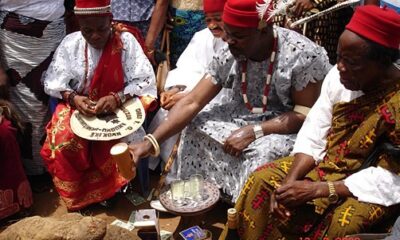
More people may begin to attend traditional rites, consult dibia and engage ancestral worship or rituals publicly.
There may be greater tension between Christian institutions and Odinala practitioners.
Because of conflicting claims e.g. about hell, truth, morality, there could be religious debate, disagreement, or even hostility.
There may also be calls for reform in Christian churches.
Churches may feel pressure to incorporate more Igbo culture, tradition, or moral values or to respond to criticisms about fear-based teaching.
There is the possibility of strengthening cultural identity.
For Igbo people who feel alienated or marginalized, a turn toward Odinala might bring back a sense of roots, belonging, and personal integrity.
There may equally be calls for legal or public recognition.
Igbo traditional religion practitioners may push for rights, recognition, freedom from discrimination, just as others practicing minority religions do.
VOICES FROM SOCIAL MEDIA
Here are some key reactions from Sahara Reporters” Facebook post of Osigwe’s views on their page:
“Christianity is the bedrock and foundation of western civilization. All the groundbreaking scientific discoveries, technological breakthrough and laws came by the influence of the Christian faith. Tell us the ones your traditional religion gave you if not the killing of fowls for sacrifice?” – Barr Omega Elisha
“Christianity is not a religion so it’s not competing with any religion. It’s a personal relationship with God through Jesus Christ His son, so it’s more than a religion” – Sola Olusola
“Christianity brings life, light and salvation. It gives peace, joy and hope. It makes rich and adds no sorrow. Traditional religion offers the exact opposite. Nobody wants to move from Light to darkness. But people are moving from darkness to Light.” – Dan Okonkwo
“Look at what Christian nations have achieved and look at what Igbo nation has achieved if you want to know which one is superior.” – Emeka Eze
“That’s not even a debate. Superior and older. The only religiøus practice that didn’t go into religiøus war to win followers or believers.” – Mazi Nnabuike Nwome
“Igbo tradition is not a religion but a spiritual way of Life.
Igbo tradition is older than Christianity.” – Onuegbu Onyekachikwu Ifemadigo
“Of course he is totally correct. Christianity, which started a little more than 2000yrs ago is for the Europeans whereas Igbo traditional religion (Odi n’ala) has been there for more than 10,000yrs ago. It’s also original to us.” – Jonas Rafeal
“We all embraced the one that works for us, no religious belief is superior to the other, I’m conservative but Christianity has shaped so many things in our world today, I’m not talking about the kind we practice in Nigeria though.” – Enemo Ekele
“Igbo traditional religion has a lot of similarities with Christianity so they are not enemies.” – Ononye Matthew.
VOICES OF SCHOLARS
It is important that we also bring in the perspectives of scholars who have reacted to similar viewpoints or from related studies on Igbo traditional religion and Christianity.
From “Faith and Friction: Christianity and Neo-Traditionalism in Igboland”, the researchers document that some Christian communities feel challenged by the resurgence of traditional religion. However, many also see opportunities that melding or respectful co-existence is possible when dialogue is open.
From “Developing an Igbo Christianity: An Analysis of Igbo and Christian Worldviews”, some scholars argue that Christian theology in Igboland needs to consider Igbo cosmology and values, so that Christianity feels less “foreign.” Some view this as a more moderate version of what proponents like Osigwe are saying.
Critical voices in academic work e.g. PhD theses looking at Igbo traditional belief systems often point out problematic practices in Igbo traditional religion and ask whether tradition can always satisfy the needs of modern society like education, equality, justice. These voices suggest that any claim of superiority should be examined carefully.
IN CONCLUSION…
Clearly, Nze Tobe Osigwe’s opinion that Igbo traditional religion is superior to Christianity has stirred debate. His arguments rest on the ideas of spiritual depth, ethical foundation, cultural authenticity, and freedom from fear. While some people resonate with these ideas, others see risks, or prefer Christian faith, or a blending of both.
In all, one thing that could be deduced from the reactions to the argument of superiority between Igbo traditional religion and Christianity is that the conversation is not just about religion. It’s about identity, culture, history. It is also about what many Igbo people believe should guide their lives today. Whether one agrees with Osigwe or not, his view has pushed into public view a question that many are already feeling, and that is: What does it mean to belong, spiritually and culturally, as an Igbo person?
And to you, our dear reader, what do you think about Nze Tobe Osigwe’s position about Igbo traditional religion being superior to Christianity? Let’s have your take.
REFERENCES
- https://saharareporters.com/2025/10/09/igbo-traditional-religion-superior-christianity-nigerian-filmmaker-osigwe
- https://www.aljazeera.com/features/2025/4/29/why-some-nigerians-are-leaving-christianity-for-african-spiritual-beliefs
- https://en.wikipedia.org/wiki/Odinani
- https://karolinum.cz/data/clanek/13304/CV_66_2_0139.pdf
- https://papers.ssrn.com/sol3/papers.cfm?abstract_id=3590960
- https://www.facebook.com/story.php?story_fbid=1369146801233499&id=100044145774265&mibextid=wwXIfr&rdid=bK0QlRzC1NlOZvAh#
You can check this out…
https://nnewicity.com/ikenga-meaning-symbolism-and-importance-in-igbo-culture/