Culture and Tradition
Ubang Tribe in Cross River: The Nigerian Community Where Men and Women Speak Different Languages

In the green hills of Obudu in Cross River State, southern Nigeria, there is a small farming community called Ubang. Life here seems ordinary at first glance. People grow yams, cassava, and maize. They gather for festivals and celebrate together. But if you stay long enough, you will notice something extraordinary. Men and women in Ubang do not speak the same language.
The difference is not about accent or tone. It is not like British and American English where the words are mostly the same with just a few changes. In Ubang, many everyday words are completely different depending on whether you are male or female. A father and his daughter can look at the same yam and call it by two completely different names. Yet they both understand each other perfectly.
The people of Ubang are proud of this uniqueness. They see it as a blessing and as part of their identity. But like many traditional languages in Nigeria, this gift is facing pressure from modern life.

Ubang Community
The People and Location
Ubang is located in Obudu Local Government Area in Cross River State. The community is made up of three villages and most families depend on farming for survival. The land is fertile, so yams, plantains, and vegetables grow in abundance. Farming is not just a way to survive, it is also tied to the traditions of the people.
Ubang is not a large community, but it is tightly knit. Everyone knows everyone. Customs and respect for elders remain strong. Like many other small communities in Nigeria, oral tradition is very important. Folktales, proverbs, and rituals are passed down from generation to generation.
In this environment, language plays a powerful role. It is not only a tool for communication. It is the key that unlocks identity. And in Ubang, language has taken a form that makes them unlike any other people in the world.
How the Two Languages Work
The men in Ubang have their own set of words. The women also have theirs. Sometimes these words overlap, but in many cases they are completely different.
For example, the word for yam in the male language is itong. In the female language, yam is irui. A man might say nki when he is talking about clothing, but a woman will call the same thing ariga. For dog, men say abu while women say akwakwe. Even the word for cup is different. Men call it nko, while women call it ogbala.
There is no fixed pattern. The words are not just slightly changed versions of each other. They are entirely different sounds. An anthropologist who studied the community once said it is “almost like two different lexicons.”
Despite these differences, there is no communication problem in Ubang. Men and women understand each other perfectly well. Children grow up hearing both sets of words. By the time they are adults, they can use their own language but also understand the other.
This makes daily life very interesting. At home, a woman might say irui while her husband responds with itong. They both laugh and continue the conversation. It is not confusing. It is natural.
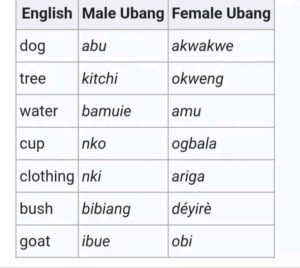
Words in Ubang language
Socialization and Language Learning
The way Ubang children learn these languages is part of what makes the system work. Every child starts life learning the female language. This is because they spend their early years mostly with their mothers, sisters, and grandmothers. A little boy in Ubang will call yam irui just like his sister.
But around the age of ten, something changes. A boy is expected to leave behind the female words and begin to use the male words. This switch is seen as a mark of maturity.
Chief Oliver Ibang, a respected leader in the community, in an interview with BBC explained it this way. He said that nobody has to force the boy. At a certain stage, the boy discovers he is not using his rightful language. When he starts speaking the men’s language, the community sees it as a sign that he is growing into manhood.
If a boy fails to make this change, he is considered abnormal. The shift is not just about words. It is about identity. It is a passage that turns a boy into a man in the eyes of the community.
Girls, on the other hand, remain with the female language throughout their lives. This balance keeps the system going.
Origins and Theories
How did such a rare language system begin? There are two main explanations.
The first is the explanation given by the Ubang people themselves. Many of them believe the difference came from God. According to their tradition, when God created Adam and Eve, they were Ubang people. God gave them two different languages. He wanted to give every ethnic group in the world two languages as well, but He stopped after creating the two for Ubang. There were not enough languages to go around, so only Ubang was left with this blessing. This story is told with pride, as proof that the community is special.
The second explanation comes from anthropology. Researcher Chi Chi Undie, who studied the community, described Ubang as a dual sex culture. In such cultures, men and women operate in separate spheres, almost like they live in different worlds that come together only when needed. The two languages reflect this separation. Each sex has its own world, and the words they use are part of that world.
However, even the anthropologist admitted that the theory is not perfect. Other Nigerian cultures also have dual sex systems where men and women have different roles, yet they do not speak different languages. This makes Ubang even more mysterious.
Cultural Identity and Pride
For the people of Ubang, the two languages are not a problem. They are a source of pride. The community believes that this difference is part of what makes them unique in the world. It is seen as a blessing and a mark of distinction.
Language is tied closely to culture in Ubang. Just as festivals and rituals remind people of their roots, the male and female languages act as a constant reminder that they belong to a people with a special heritage. To speak the correct language for your sex is to show that you are a true son or daughter of Ubang.
It is also a sign of maturity. When a boy changes from the female words to the male words, he is not only speaking differently. He is declaring that he has crossed into a new stage of life. This is why people say that language in Ubang is more than communication. It is identity, tradition, and pride.
The Challenges of Modernization
As unique as Ubang is, the future of this language system is not secure. Like many small communities in Nigeria, Ubang is facing the pressures of modernization.
Young people now grow up surrounded by English, which is the language of schools, government, and media. Nigeria’s three major languages, Hausa, Igbo, and Yoruba, are also widely spoken across the country. This means that children are exposed to other languages more than they are to their mother tongue.
In some schools in Ubang, children are even discouraged from speaking their language. Teachers punish them for using it. Some are beaten or fined for speaking in Ubang instead of English. A chief in the community once told the BBC that if a child is punished for speaking their mother tongue, that language will eventually die. His warning captures the fear that the two unique languages of Ubang could fade away if children are not allowed to use them freely.
This situation has caused worry in the community. Many children now mix English words into their speech. The pure forms of the male and female languages are slowly weakening.
Some young people also leave the village to study or work in bigger towns. When they do, they often adopt English or other dominant languages. Parents who raise their children outside Ubang sometimes fail to teach them the community languages. As a result, many children grow up knowing little or nothing about this cultural treasure.
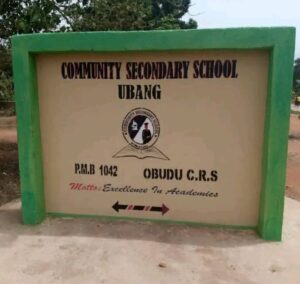
Community secondary school, Ubang
Efforts to Preserve the Languages
Despite these challenges, there are people in Ubang who are determined to keep the two languages alive. Elders, community leaders, and teachers have been calling for more action.
One dream is to build a language centre in Ubang. Such a centre would serve as a place to showcase the uniqueness of the community. It would also be a place where children could learn and practice both languages.
There are also calls for textbooks, novels, and even films in the Ubang languages. If the words are written down and taught in schools, they will have a better chance of survival. Nigeria’s National Policy on Education already says that every child should learn the language of their immediate environment. The people of Ubang believe this should be enforced in their schools.
In the interview with the BBC, Chief Oliver Ibang further explained that God gave the community this special gift of two languages, and it must not be allowed to die. His statement is often quoted because it shows how deeply the people of Ubang see their language as part of their identity and destiny.
Students also see the need for preservation. Some young people have promised that even if they move away from Ubang, they will teach their children the male or female language so the tradition does not die. This shows that there is still hope, but it will take effort and commitment.
Conclusion
The story of Ubang is more than a story about words. It is about how language shapes identity and culture. In this small farming community in Cross River State, the fact that men and women speak differently has become a symbol of uniqueness.
It is a rare phenomenon in the world, and it tells us that language is not just a tool for communication. It is a reflection of history, belief, and belonging.
Yet this treasure is under threat. Modern education and the spread of English are making it harder for young people to hold on to the male and female languages. Without effort, the system could slowly disappear.
But there is also hope. Elders and young people alike are working to preserve the languages. Some dream of a language centre that will keep Ubang alive for generations. As Chief Oliver Ibang reminded in his words to the BBC, if the languages die, then the Ubang people themselves will no longer exist.
The lesson is clear. To lose a language is to lose a part of identity. For Ubang, protecting their two languages is the same as protecting their future.
Related Topics: Sacred Monkeys of Awka: The Imoka Festival and Igbo Tradition