


Nigerian Biographies
10 Facts About Dr. Nwafor Orizu That Every Nigerian Should Know

Dr. Nwafor Orizu was a prince, educator, journalist, and political leader whose vision shaped Nigeria’s history. Discover 10 fascinating facts about his life, achievements, and enduring legacy that every Nigerian should know.

Dr. Nwafor Orizu is one of Nigeria’s most fascinating historical figures, and a man whose life bridged tradition, education, and politics in remarkable ways. Born a prince of Nnewi, he carried the responsibilities of royalty but chose a path that went far beyond titles and privilege. He became a scholar, an educationist, a journalist, and a political leader whose influence impacted the First Republic and left a lasting mark on Nigeria’s national identity.
While many remember him as the youngest President of the Nigerian Senate and briefly as Acting President, his story is far richer. He championed education because he believed it was the key to Nigeria’s progress, and he worked tirelessly to create opportunities for young Nigerians to study both at home and abroad. Through his writings, speeches, and institutions, he inspired a generation to think boldly and act responsibly.
In this article, we share 10 compelling facts about Dr. Nwafor Orizu that every Nigerian should know. These facts highlight not only his political achievements but also his intellectual pursuits, his dedication to education, and the values that guided his life.
By understanding his journey, we gain insight into the challenges and triumphs of Nigeria’s early years as an independent nation and the enduring legacy of a man who truly contributed to his country.
Fact 1: Dr. Nwafor Orizu Was Born a Prince of Nnewi
Dr. Nwafor Orizu was born on 17 July 1914 into the royal family of Nnewi, a historic town in what is today Anambra State, southeastern Nigeria. His full name at birth was Abyssinia Akweke Nwafor Orizu, and he was the son of Eze Ugbonyamba (Igwe Orizu I), the traditional ruler of Nnewi. This made him an uncle of the current traditional ruler of Nnewi, Igwe Kenneth Onyemeke Orizu III.
From the very beginning, he carried the expectations and privileges of a prince as he grew up in an environment that valued leadership, community service, and the preservation of culture.
Being a prince of Nnewi exposed him to the rich traditions and customs of his people. The royal upbringing instilled in him a strong sense of duty, not just to his family but to the wider Igbo community and, eventually, the Nigerian nation.
Even as he went abroad for education and later entered public life, he never lost the grounding that his heritage provided. His royal lineage was a framework that influenced his leadership style, his commitment to education, and his belief in the importance of service.
Growing up in Nnewi, the young Nwafor Orizu witnessed both the privileges of royalty and the challenges facing ordinary Nigerians under colonial rule. This combination of insight and responsibility influenced his lifelong mission to create opportunities for learning, leadership, and national development.
By the time he returned to Nigeria after his studies abroad, he carried with him the dual legacy of princely heritage and global education, ready to make his mark on the nation.
Being born a prince was not merely a fact about his birth, it became the starting point of a life dedicated to leadership, education, and service. That set the stage for Dr. Nwafor Orizu to become one of Nigeria’s most respected figures in politics, scholarship, and national development.
Fact 2: His Education Was Both Local and International
From the very beginning, Dr. Nwafor Orizu demonstrated a deep love for learning. Growing up as a prince, he had access to the best educational opportunities his community could offer. His early schooling took place in local institutions in Nnewi and Onitsha where he excelled in reading, writing, and the fundamentals of mathematics and social studies. Even at a young age, he showed intellectual curiosity that set him apart from his peers.
But Orizu’s educational journey did not stop at local schools. He had a vision that extended far beyond the borders of southeastern Nigeria. In 1939, he traveled to the United States, determined to gain knowledge that he could later bring back to his homeland. He enrolled at Lincoln University in Pennsylvania, an institution known for nurturing leaders and thinkers from across the African diaspora.
At Lincoln University, he immersed himself in political science and philosophy, and earned not only academic credentials but also exposure to ideas about governance, democracy, and social development. He then moved to Ohio State University where he completed his Bachelor’s degree with honours in Political Science. His academic rigour and commitment to learning earned him recognition among both faculty and students.
Never satisfied with merely completing a degree, Nwafor Orizu went on to pursue graduate studies at Columbia University in New York City, one of the world’s leading centres for public law and government studies. There, he earned a Master of Arts in Public Law and Government and laid the groundwork for his later doctoral research. These years abroad exposed him to new educational models, particularly the American approach which he later advocated as a blueprint for Nigeria’s educational development.
This combination of local grounding and international experience became a hallmark of Dr. Nwafor Orizu’s life. His early education allowed him to bridge worlds. He understood the traditions of his people but he also grasped the possibilities of global knowledge. This dual perspective would later inform his leadership in politics, his work in education, and his advocacy for the modernization of Nigeria’s schooling system.
In essence, his educational journey was more than the schools he attended. It was a preparation for service, a foundation that enabled him to think critically, lead effectively, and inspire others. By blending local roots with international learning, Dr. Nwafor Orizu became a symbol of intellectual excellence and a pioneer in bringing global ideas to Nigerian education and governance.
Fact 3: He Championed an American‑Style Education
One of the most defining aspects of Dr. Nwafor Orizu’s life was his deep belief in the power of education to transform individuals and nations. His time in the United States profoundly influenced his perspective on learning. Unlike the British colonial education system in Nigeria which emphasized rote memorization and rigid hierarchies, the American system offered a broader, more flexible approach. Nwafor Orizu came to admire this system for its emphasis on critical thinking, creativity, and holistic development.
He coined the term “horizontal education” to describe the American model, highlighting how it encouraged students to explore multiple disciplines, develop practical skills, and engage actively in the society. For him, education was not just about passing exams, it was about preparing young Nigerians to think independently, take initiative, and contribute meaningfully to their communities and the nation.
Upon returning to Nigeria, Dr. Nwafor Orizu became a vocal advocate for this American-style educational philosophy. He argued that Nigeria needed schools that encouraged curiosity and practical engagement rather than strict memorization. He emphasized the importance of broadening the curricula to include subjects like civics, social sciences, and leadership studies, alongside the traditional sciences and arts.
His advocacy was not limited to theory. Orizu worked to implement these ideas in practice. Through the schools he founded, he introduced the curricula that reflected these principles. He encouraged students to participate in debates, community service, and creative projects. He believed that these experiences were as important as academic knowledge in shaping students into well-rounded leaders rather than mere certificate holders.
Because of his passion for this approach, he earned the nickname “Orizontal” which was a playful nod to his promotion of horizontal learning. It reflected both admiration and recognition of his commitment to modernizing Nigerian education.
Through his writings, speeches, and public engagement, Dr. Nwafor Orizu inspired educators, policymakers, and students alike. He challenged conventional thinking and showed that education could be a powerful tool for national progress. Today, his advocacy for broad-based, flexible learning continues to influence educational discussions in Nigeria, even beyond his own lifetime.
Championing an American-style education was not just an idea for Dr. Nwafor Orizu, it was a mission that defined his career as an educator, influenced the schools he built, and cemented his reputation as one of Nigeria’s foremost advocates for innovative and effective learning.
Fact 4: He Founded Educational Institutions

For Dr. Nwafor Orizu, education was more than a passion. It was a lifelong mission. He believed that for Nigeria to progress, it needed schools that nurtured both intellect and character. This belief drove him to found several educational institutions that would leave a lasting mark on the country’s academic landscape.
One of his most notable achievements was the establishment of the Nigerian Secondary School in Nnewi, popularly known in Nnewi as “National” in the 1950s. This school a model for what he called broad-based education. The curriculum was designed to develop students’ analytical skills, creativity, and leadership abilities, alongside conventional academic subjects. Nwafor Orizu emphasized extracurricular activities such as debates, community service, and sports as he believed that practical engagement was as important as classroom learning.
In addition to the Nigerian Secondary School, he founded Enitona High School which further reflected his educational philosophy. Both schools served as platforms for implementing his vision of horizontal education that combined Western learning approaches with Nigerian cultural values. He encouraged students to think critically about the world around them while remaining grounded in their heritage.
Dr. Nwafor Orizu also extended his impact through the Enitona Printing Press which supported educational publishing. This facility produced textbooks, learning materials, and scholarly works as a way of ensuring that students and teachers had access to quality resources. His vision went beyond the classroom because he wanted a holistic educational ecosystem that fostered knowledge, critical thinking, and civic responsibility.
Through these institutions, Dr. Nwafor Orizu trained generations of Nigerian leaders, educators, and professionals. Many of his students later held influential positions in government, academia, and business, and carried forward the values he instilled. His schools became renowned for producing not just academically proficient graduates but well-rounded individuals ready to contribute to nation-building.
Founding educational institutions was a natural extension of Dr. Nwafor Orizu’s philosophy. He did not merely advocate for reform, he built the schools that embodied it. His work ensured that Nigerian students had access to quality education that prepared them for the challenges of both their local communities and the wider world.
Fact 5: He Was a Leading Voice for African Students in America
During his years of study in the United States, Dr. Nwafor Orizu was not your regular student. He emerged as a leading voice for African students abroad, and advocated for opportunities, scholarships, and greater recognition of African talent in international academic circles.
At a time most Africans studying overseas faced significant challenges, including racial discrimination, limited financial support, and cultural isolation, Dr. Nwafor Orizu worked tirelessly to create networks and platforms that could support their ambitions. He helped to organize African student associations and was instrumental in forming the American Council on African Education (ACAE). This organization became a lifeline for African students that connected them with scholarships, mentorship, and academic resources that were often hard to access.
Dr. Nwafor Orizu was a mentor and a guide. Many African students looked up to him for advice, encouragement, and inspiration. He shared his experiences, helped students navigate the cultural and educational challenges of studying abroad, and emphasized the importance of using their knowledge to benefit their home countries.
His advocacy highlighted a deep sense of responsibility to the continent. Dr. Nwafor Orizu believed that the education Africans received abroad should not remain abroad; that it needed to return home to influence policies, schools, and communities. He consistently encouraged students to think beyond individual achievement, and urged them to consider the broader impact of their studies on African development.
By championing African students in the United States, Dr. Nwafor Orizu strengthened the intellectual connections between Africa and the world. He helped to create a generation of educated Africans who were prepared to return home, lead, and contribute to nation-building after independence. His leadership in this area highlighted his dual vision of personal academic excellence paired with a commitment to collective progress.
Essentially, Dr. Nwafor Orizu was not only a scholar himself but a mentor and advocate for others. His efforts laid the groundwork for stronger educational exchange programmes between Africa and America and left a lasting legacy in the lives of countless African students who benefitted from his guidance, foresight, and dedication.
Fact 6: He Was a Journalist, Publisher, and Public Thinker

Beyond education and politics, Dr. Nwafor Orizu made his mark as a journalist, publisher, and public intellectual using the power of the written word to inspire ideas and influence public opinion. He understood that leadership extended beyond holding office; that it included guiding thought, inspiring action, and challenging the society to think critically.
Dr. Nwafor Orizu founded and managed The West African Examiner, a newspaper that became a platform for discussing social, political, and educational issues affecting Nigeria and Africa at large. Through this publication, he addressed topics such as national development, governance, education reform, and self-determination. His articles were often insightful, thought-provoking, and aimed at encouraging Nigerians to think beyond colonial structures and embrace a vision for an independent and progressive nation.
As a public thinker, Dr. Nwafor Orizu also wrote extensively on the philosophy of education and leadership. He believed that intellectual engagement was a key pillar of nation-building. In his essays and speeches, he argued that citizens should be both educated and ethically grounded, able to contribute positively to the society. He stressed that knowledge without action or moral responsibility was incomplete, and he consistently encouraged his audience to apply learning to real-world challenges.
His role as a publisher extended beyond newspapers. Through his educational institutions, Orizu promoted scholarly works, textbooks, and materials that reflected his belief in broad-based education. By doing so, he helped to ensure that the ideas he championed reached both students and the wider community.
The impact of Dr. Nwafor Orizu’s journalism and intellectual work was significant. He provided a voice for progressive ideas at a time Nigeria was navigating the challenges of colonialism, nationalism, and the early stages of independence. His writings inspired young Nigerians to value education, think independently, and take leadership in shaping the country’s future.
Dr. Nwafor Orizu was a scholar, politician and public intellectual who understood the power of ideas. Through journalism, publishing, and thoughtful discourse, he influenced generations, encouraged civic responsibility, and helped to lay the foundation for a society in which informed citizens could contribute meaningfully to national development.
Fact 7: He Entered Politics and Helped to Shape the Independent Nigeria
While Dr. Nwafor Orizu had already made a name for himself as an educator and intellectual, he soon realized that to have a broader impact, he needed to step into the political arena. Politics, he believed offered a platform to turn ideas into action and to help to guide the direction of a newly independent Nigeria.
Dr. Nwafor Orizu began his political journey in Eastern Nigeria by initially serving as a representative of the Onitsha Division in the regional House of Assembly. His sharp intellect, persuasive communication skills, and commitment to public service quickly set him apart. He later joined the National Council of Nigeria and the Cameroons (NCNC), one of the major political parties of the time, and became a trusted voice on matters of governance, education, and national policy.
In the federal political landscape, Dr. Nwafor Orizu rose to prominence when he was elected to the Federal House of Representatives. His reputation as a scholar and advocate for education brought a new level of seriousness and thoughtfulness to debates and legislation. He was known for his ability to balance intellectual rigour with practical solutions, and he consistently argued for policies that would benefit both local communities and the nation at large.
In 1963, his peers recognized his leadership abilities and elected him President of the Nigerian Senate. With that, he became the youngest person to hold the position in Nigeria’s history. As Senate President, Dr. Nwafor Orizu presided over critical debates during the First Republic that helped to form the legislative framework for a young nation still finding its footing after independence. He played a key role in ensuring that laws were thoughtfully considered and that governance upheld principles of fairness, justice, and development.
Throughout his political career, Dr. Nwafor Orizu remained deeply committed to education, national unity, and the promotion of ethical leadership. He viewed politics not merely as a quest for power but as a means to implement the values he had long championed which are learning, responsibility, and service. His influence extended beyond policy as he inspired colleagues, students, and citizens to believe in the possibility of a Nigeria guided by knowledge and principle.
Politics allowed Dr. Nwafor Orizu to translate his vision into tangible contributions for the nation. From the regional assembly to the federal Senate, he helped to guide the policies, debates, and leadership culture of independent Nigeria, and left a legacy that continues to be remembered as one of intelligence, integrity, and dedication to public service.
Fact 8: He Served as Acting President of Nigeria
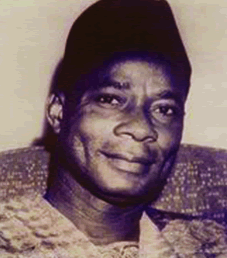
One of the most remarkable chapters in Dr. Nwafor Orizu’s life was his brief tenure as Acting President of Nigeria. In late 1965, while the President, Dr. Nnamdi Azikiwe was away on official duties abroad, being the Senate President, he constitutionally assumed the role of Acting President. This period highlighted both his political stature and his sense of responsibility to the nation.
Though his time in this position was short, it came at a critical moment in Nigeria’s history. The First Republic was navigating complex political tensions, regional divisions, and the growing pressures of post-independence governance. Dr. Nwafor Orizu approached this role with calm, intelligence, and a commitment to constitutional order. His priority was to ensure continuity in government, maintain stability, and uphold democratic principles during a period of uncertainty.
As Acting President, Dr. Nwafor Orizu did not seek personal glory or make radical policy changes. Instead, he focused on safeguarding the functions of government, supporting institutional processes, and maintaining public confidence in leadership. His conduct affirmed the principles he had long championed, namely, responsibility, integrity, and service to the nation.
This moment also underscored the historical significance of his career. While many remember him as an educator, intellectual, and Senate President, few fully appreciate that he once held the highest office in the land, albeit temporarily. It was a testament to the trust and respect he had earned among his peers and the nation at large.
Tragically, his tenure as Acting President ended with the military coup of 15 January 1966 which abruptly brought the First Republic to a close. Despite this, Dr. Nwafor Orizu’s brief presidency remains a symbolic reminder of his leadership, dedication, and the high regard in which he was held. It highlighted his ability to step into a role of immense responsibility and execute it with prudence and dignity.
Serving as Acting President of Nigeria was not just a ceremonial role for Dr. Nwafor Orizu, it was a demonstration of his unwavering commitment to his country. Even in the face of political upheaval, he remained a stabilizing figure.
Fact 9: He Faced Controversy but Continued Public Service
Even the most accomplished lives encounter challenges, and Dr. Nwafor Orizu was no exception. Throughout his career, he faced controversies that tested his integrity, resilience, and commitment to public service. One of the most notable episodes occurred in 1953 when he was charged by colonial authorities in connection with the management of scholarship funds. At the time, accusations of financial mismanagement threatened both his reputation and his work in education.
Despite the pressure, Dr. Nwafor Orizu handled the situation with dignity and patience. He maintained his commitment to education and public service while demonstrating a steadfast belief in accountability and ethical conduct. After investigations, he was later exonerated, and history would remember him not for this controversy but for the significant contributions he made to Nigeria’s intellectual and political development.
What set Dr. Nwafor Orizu apart was how he responded to adversity. Rather than withdrawing from public life, he continued to engage actively in governance and educational initiatives. In the years following his exoneration, he served in various capacities, including acting as Chairman of the Teachers’ Service Commission in the East Central State during the 1970s. He also remained a mentor, writer, and advocate for education.
His ability to navigate controversy while maintaining focus on service is a lesson in leadership and character. He showed that setbacks, even serious ones, can be opportunities for reflection, growth, and recommitment to one’s principles. This resilience strengthened his reputation as a statesman and educationist who consistently put the nation’s interests above personal gain.
Although Dr. Nwafor Orizu faced moments of scrutiny and difficulty, his response to controversy exemplified his integrity, perseverance, and dedication. He proved that true public service requires courage, consistency, and the ability to rise above challenges.
Fact 10: His Lasting Legacy for Nigeria Is Deep and Multifaceted
When reflecting on the life of Dr. Nwafor Orizu, it becomes clear that his impact on Nigeria goes far beyond any single office held or institution founded. His legacy is deep, multifaceted, and enduring as it touches education, politics, journalism, and national identity.
In education, Dr. Nwafor Orizu’s vision continues to inspire. The schools he founded set standards for broad-based learning that combined academic excellence with leadership development. His advocacy for horizontal education, inspired by his experiences in the United States transformed the way many educators approached teaching. Even today, discussions about modernizing Nigerian education often reference his pioneering ideas.
Politically, Dr. Nwafor Orizu is remembered as a principled leader. Serving as Senate President and briefly as Acting President of Nigeria, he upheld democratic values during turbulent times. He was respected not just for his intelligence but for his calm, ethical approach to governance. His commitment to public service proved that leadership is about responsibility and the greater good, a lesson that resonates strongly in contemporary Nigeria.
Dr. Nwafor Orizu’s contributions as a journalist and public intellectual also left a lasting imprint. Through publications like The West African Examiner, he influenced public discourse on education, governance, and national development. He inspired Nigerians to think critically, engage civically, and consider their role in defining the future of the country.
His legacy is also institutionalized through honours and commemorations. Nwafor Orizu College of Education in Nsugbe carries his name as a way of ensuring that generations of educators and students remain connected to his ideals. He is remembered as a visionary who bridged the worlds of tradition and modernity by combining his royal heritage in Nnewi with global knowledge to serve his nation.
Ultimately, Dr. Nwafor Orizu’s life was an evidence that true impact is multifaceted. He was a prince, a scholar, an educator, a journalist, a politician, and a mentor. His vision for Nigeria as a nation where education, ethical leadership, and civic responsibility guide progress remains relevant. His legacy continues to inspire Nigerians to pursue knowledge, uphold integrity, and serve their communities with dedication.
Dr. Nwafor Orizu did not just live in history, he influenced it. His contributions remind us that leadership and service, when grounded in principle and guided by knowledge, can leave an imprint that lasts for generations.
In Conclusion …
The life of Dr. Nwafor Orizu is a story of vision, dedication, and service. From his birth as a prince of Nnewi to his pioneering work in education, his leadership in politics, and his role as a journalist and public thinker, he left a mark on Nigeria that few can rival. Each chapter of his life, whether founding schools, advocating for African students abroad, or serving as Senate President and Acting President reveals a man committed to building a better nation through knowledge, integrity, and action.
What makes Dr. Nwafor Orizu truly remarkable is the breadth of his impact. He combined traditional heritage with global learning, intellectual rigour with practical leadership, and personal achievement with service to others. His legacy is not confined to history books, instead, it lives on in the institutions he built, the policies he influenced, and the countless Nigerians inspired by his life and ideas.
Understanding Dr. Nwafor Orizu means appreciating the possibilities of leadership guided by principle, education, and vision. His story reminds us that knowledge, courage, and dedication can impact a nation and leave a legacy that endures for generations. For every Nigerian, his life offers lessons in resilience, purpose, and the transformative power of education.
References
- https://en.wikipedia.org/wiki/Nwafor_Orizu
- https://biography.igbopeople.org/biography/prince-akweke-abyssinia-nwafor-orizu/
- https://articles.connectnigeria.com/nigerians-in-history-nwafor-orizu/
- https://nigeriareposit.nln.gov.ng/items/6af9ee90-f65c-4158-97e3-ba729c95d25d
- https://en.wikipedia.org/wiki/ACAE
- https://en.wikipedia.org/wiki/Nwafor_Orizu_College_of_Education
- https://nnewicommunity.com/tribute-to-dr-akwaeke-abyssimia-nwafor-orizu/
You might want to check this out …









