



Anambra News
Sacred Monkeys of Awka: The Imoka Festival and Igbo Tradition

In many Nigerian and African societies, certain animals and plants are treated with special respect because of the roles they played in history. They are remembered not just as part of nature but as protectors, friends, and even family. Among the Igbo people of southeastern Nigeria, these sacred bonds are still alive in different towns.
In Awka, the capital of Anambra State, the monkey holds this place of honor. For centuries, monkeys have been protected, respected, and regarded almost as human beings. Their story is tied to the survival of the community, and today, they remain symbols of Awka’s cultural identity.

White Belly Monkey
Why Monkeys Are Sacred in Awka
According to oral tradition, long ago when inter-community wars were common, Awka often faced surprise attacks from neighboring towns. At that time, monkeys living in the surrounding forests played an unexpected role in protecting the people. Whenever enemies planned to invade, the monkeys would raise alarm through loud cries and restless movements. These warnings gave the Awka warriors enough time to prepare for battle, preventing the community from being overrun.
Because of this, the monkeys were seen not just as animals but as allies. In gratitude, the people of Awka placed them under the spiritual protection of the Imoka deity, the town’s main guardian spirit. From then until now, harming or eating monkeys in Awka has been considered a serious taboo.
The Imoka Festival and the Monkey Connection
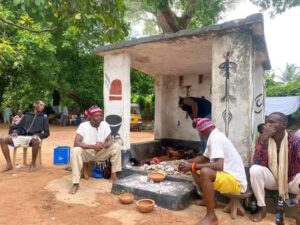
Imoka Shrine
The strongest celebration of this tradition comes alive every year during the Imo-Oka (Imoka) Festival, one of the biggest cultural events in southeastern Nigeria. The festival usually lasts for about a week and brings together indigenes, visitors, and tourists in a colorful mix of rituals, dances, and displays. At its core, the festival is a way of honoring the Imoka deity, believed to have defended Awka in times of war, using monkeys as messengers and protectors.
Each day of the festival has its own activities. Priests and elders perform rituals to renew the covenant between the people and their deity, while families gather to retell the stories of how the monkeys helped their ancestors. Music, drumming, and traditional dances fill the air, creating an atmosphere of joy and pride in heritage.
One of the most striking features of the festival is the appearance of masquerades. In Igbo culture, masquerades are seen as the embodiment of ancestral spirits who return to the living world during special occasions. In Awka, masquerades of different types parade the streets during the Imoka Festival, dressed in colorful costumes and masks. Some come out to entertain with playful dances, while others are fierce and commanding, chasing away evil and maintaining order. Their movements, accompanied by drummers and singers, leave spectators in awe.
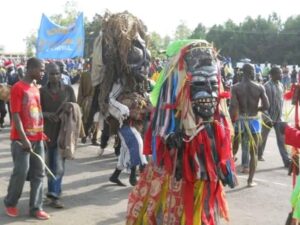
Masquerade performing during the imoka festival
The masquerades are not just about entertainment, they carry deep spiritual meaning. They remind the people of their ancestors, teach discipline to the youth, and show that the invisible world of the spirits is closely linked to the visible world of humans. Visitors who attend the festival often describe the masquerades as both exciting and intimidating, making the event unforgettable.
Beyond the rituals and masquerades, the festival also serves as a period of reunion. Indigenes living abroad return home to join the celebrations, while traders, cultural troupes, and tourists pour into Awka. The entire town comes alive with booming markets, full hotels, and lively streets. The Imoka Festival is covered by local and national media, drawing attention to Awka as a center of Igbo culture.
For many outsiders, this is their first real introduction to the sacred monkey tradition. Seeing monkeys move freely and safely in a bustling capital city, while also watching the dramatic festival that celebrates them, creates a powerful cultural impression. In this way, the Imoka Festival is not just a religious ritual but also a tourist attraction and a showcase of Igbo heritage.
Taboos and Penalties for Killing a Monkey
The sacred status of monkeys in Awka is guarded by strict taboos. Killing or eating a monkey is one of the gravest offenses a person can commit. The belief is that anyone who deliberately does this will be struck by a mysterious illness, often leading to death.
If someone kills a monkey by accident, the matter is still taken seriously. The offender is separated from the community until cleansing rituals are performed by traditional priests. Only after sacrifices and prayers can the person be accepted back into society. These practices keep the covenant alive and ensure that everyone respects the bond between humans and monkeys.
Monkeys as “Humans” in Awka
Because of their sacred position, monkeys are treated almost like members of the Awka community. They are free to move about without fear of harm, and children grow up learning never to disturb them.
When a monkey dies naturally, it is not treated as an ordinary animal corpse. Instead, burial rites similar to those given to human beings are performed. This act symbolizes the community’s recognition of the monkeys as part of their history and spiritual life.
The monkeys are seen as more than animals, they are guardians, companions, and reminders of a time when survival depended on their cries. For Awka people, to care for the monkeys is to honor their ancestors and uphold their cultural identity.
The Tradition in Modern Times
Awka has changed greatly over the years. Once a small settlement known for blacksmithing and farming, it is now the capital of Anambra State — a busy city with government offices, schools, markets, hotels, and modern housing estates. Yet, despite all this growth, the bond between the people and the monkeys has not been broken.
In certain parts of the town, especially around areas where the old forests once stood, monkeys can still be seen jumping from trees, moving across rooftops, or simply strolling along the roads without fear. Locals are used to their presence and take it upon themselves to protect them. Children are taught from a young age never to harm a monkey or throw stones at it. Instead, they are told stories of how their ancestors survived wars with the help of these animals.
Interestingly, even people who no longer practice the traditional religion of the Imoka deity still respect the taboo. Many Awka residents are Christians today, but they see the monkey tradition as part of their cultural heritage rather than something to reject. For them, protecting the monkeys does not go against their faith instead, it is a way of honoring their history and identity.
The Imoka Festival itself has also taken on a more cultural and tourist-centered role in modern times. While rituals and prayers to the deity are still performed, the event now attracts visitors, journalists, and cultural enthusiasts from far and wide. Local businesses benefit from the influx of people, with hotels filling up and markets recording higher sales. In this way, the tradition has not only survived but has also become a source of pride and economic opportunity.
A Symbol of Human–Nature Relationship
The story of Awka’s sacred monkeys is more than just an ancient covenant. It represents the unique way African societies understood their relationship with nature. For the Awka people, the monkeys were not simply wild animals to be hunted or eaten, they were friends, allies, and partners in survival.
This way of thinking shows a deep respect for the natural world. It recognizes that humans and animals share the same environment and that cooperation, rather than exploitation, can lead to survival. Long before modern conversations about wildlife conservation and environmental protection, the people of Awka had already developed their own system of safeguarding animals through spirituality and culture.
This practice also carries an important lesson for the present day. Around the world, many species of animals are becoming endangered because of hunting, deforestation, and climate change. But in Awka, monkeys continue to thrive because of the values tied to them. The community proves that cultural beliefs can play a strong role in conservation when people see animals as sacred or symbolic, they are more likely to protect them.
In this sense, the Awka monkey tradition is not just about the past; it is a model for how cultural values can inspire modern approaches to living in harmony with nature.
Conclusion
The sacred monkey tradition of Awka is one of the most fascinating cultural practices in Nigeria. Rooted in gratitude for the animals that once helped defend the community, it has grown into a lasting covenant that protects monkeys, honors the town’s deity, and strengthens cultural identity.
Through the Imoka Festival, masquerades, and taboos, the people of Awka remind themselves and the world that heritage is worth preserving. Even as modern life continues to change the city, the monkeys remain part of its landscape, free, respected, and cherished.
For visitors, the experience of seeing monkeys moving confidently among people, hearing the stories of their role in history, and witnessing the colorful Imoka Festival offers a rare and unforgettable glimpse into Igbo tradition. For the people of Awka, it is more than just a spectacle, it is a living connection to their ancestors and a proud symbol of who they are.
By treating monkeys almost like humans, the Awka community teaches a timeless lesson that gratitude, respect, and harmony with nature can keep a people’s identity alive for generations.
Read More: Imo Awka Festival: Awka’s Biggest Traditional Masquerade Celebration