

African Culture and Traditions
Igba Nkwu Nwanyi || Traditional Wedding Ceremony in Igboland

Igba nkwu nwanyi is the celebrated Igbo wine‑carrying wedding ceremony. Learn the meaning of Igba Nkwu Nwanyi, step‑by‑step stages, attire, music, symbolism and how modern couples honour this cultural gem in Igboland today.
Igba Nkwu Nwanyi in Igbo Tradition
Marriage in Igboland is not just a union between two individuals, it is a celebration of family, culture and community. At the heart of this celebration is the Igba nkwu nwanyi, the traditional wine‑carrying ceremony that has been passed down through generations. Igba nkwu nwanyi is a vibrant display of heritage, choice, respect and joyous affirmation of love.
During Igba Nkwu Nwanyi, the bride, adorned in colourful traditional attire and beads, publicly searches for her groom among assembled guests, offering him a cup of palm wine as a symbolic gesture of acceptance and consent. The groom’s acceptance signals the blessing of both families and cements the union in the eyes of the community.
Rich with symbolism, music, dance and ancestral traditions, Igba nkwu nwanyi encapsulates the essence of Igbo culture. It is a ritual that binds families together and allows the bride to take the centre stage in her choice of partner, showing that love, respect and tradition can beautifully coexist.
In this article, we explore every aspect of Igba nkwu nwanyi, from its meaning and history to the step-by-step rituals, attire, gifts, music, and modern adaptations that keep the tradition alive today.
Meaning and Cultural Significance of Igba Nkwu Nwanyi
As already hinted, in Igboland, marriage is viewed not just as the joining of two people, but as a union between two families and two lineages. The ceremony known as Igba nkwu nwanyi is the most visible and symbolic part of this union.
The ritual of the bride carrying palm wine and offering it publicly to the groom is rich in meaning. It affirms the bride’s consent, the groom’s acceptance and the support of both families and the wider community.
Palm wine in this context represents life, hospitality and shared future. When the bride presents the wine, she symbolically acknowledges the partnership she is entering. When the groom accepts the drink, he signals commitment to that partnership.
The setting of the ceremony, often the bride’s family home or compound emphasizes that the bride is still under her natal lineage, and by the end of the ritual, she is recognized as belonging to her husband’s family. The public nature of the event means that the community witnesses and blesses the union.
In traditional Igbo thought, a valid marriage is seen as one that strengthens alliances, honours both families and ensures continuity of lineage and culture. Igba nkwu nwanyi marks the climax of that process, the point at which the couple is formally and fully regarded as married under custom.
This ceremony is an embodiment of Igbo values: respect for elders, public accountability in marriage, the bride’s agency, family involvement and community celebration. It ties past generations to the present and helps transmit culture to the next.
Before the Day for the Igba Nkwu Nwanyi
Before the Igba Nkwu ceremony takes place, the marriage process among Igbo people involves several important preliminary stages. These steps help establish consent, alignment of families and the practical arrangements needed for a traditional union.
The very first formal step is in the process of marriage in traditional Igbo custom is when the groom, accompanied by his father and/or other senior male relatives, visits the would-be bride’s family to declare his intention to marry their daughter. That is after they must have done the Iju Ese, that is inquiring about the would-be bride’s family to be sure it is good for them. The Igbo term Iju Ese and Iku Aka means to inquire and to knock the door, respectively.
At this visit, the groom’s side may carry items such as kola nuts, drinks or palm wine as tokens of respect, though actual gift‑giving at this stage varies by community.
The would-be bride’s family then acknowledges the visit, may invite their daughter to express her consent, and may indicate when they will respond.
Following the introduction, the bride’s extended family often carries out inquiries into the groom’s background, his family lineage, character, fertility, social standing and capacity to be a good husband. Simultaneously, the groom’s side may seek assurance that the bride is of good standing and that both families are compatible. Once the extended family gives their consent, the process moves to the next stage.
At this stage, the bride’s family presents a list of items that the groom’s family is expected to provide, often called the “bridal list”. These may include fabrics, wrappers, drinks, food items, livestock, household items and a symbolic cash component.
The purpose is to formally outline what the groom’s family will bring in respect and acknowledgement of the marriage. The groom’s family takes time to review the list and prepare accordingly.
Once the list has been accepted, representatives of both families negotiate the bride price (dowry). This is called Ime Ego or Ego Isi Nwanyi. This negotiation acknowledges that marriage involves both families and respects custom, but the cash amount is usually symbolic and not reflective of the bride’s actual worth. Following agreement, the payment may take place either on a separate date or on the day of the main ceremony. Collections often include the cash component along with items listed earlier.
According to tradition, after collecting the bride price, the bride’s father may return a portion to the groom’s family, implying that their daughter is not for sale, only that she should be taken care of.
After the above steps are completed and both families are in agreement, a date is fixed for the traditional wedding ceremony known as Igba Nkwu Nwanyi. Preparations begin for both families toward the ceremony.
These preparatory stages ensure that the formal union is built on mutual respect, communal consent and clear arrangements. They lay the foundation for the public celebration that follows.
Igba Nkwu Nwanyi Ceremony

Igba Nkwu Nwanyi
Igba nkwu nwanyi is usually held at the bride’s family compound, the site chosen because tradition always placed the event in her natal home. Music, drummers, colourful attire and the hum of gathering guests set the stage for what is often the most visible and culturally significant part of an Igbo traditional union.
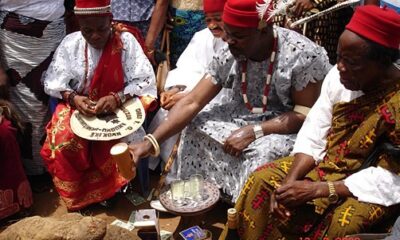
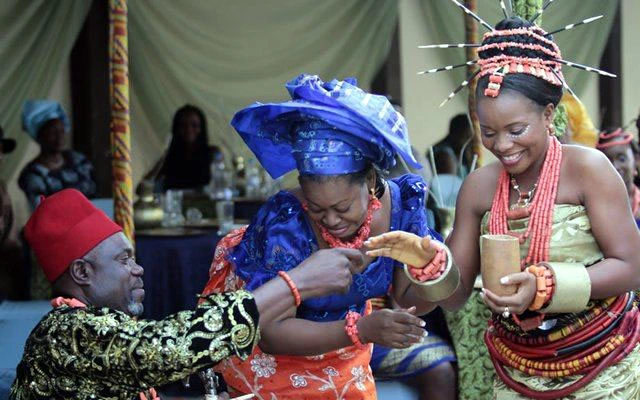
On the day of Igba nkwu nwanyi, the bride emerges in full regalia: bright wrappers, beads around her neck and waist, sometimes, a head‑tie crowns her appearance. In the midst of cheering friends and family she is given a cup, typically carved wood or calabash filled with palm wine by her father or a senior male relative charged with this honour. Through this moment, she is sent to “search” for her groom. She moves through the crowd, the drink in her hand, weaving between well‑wishers who call her attention, urging her to share the wine with them. All this is part of the ritual drama.
Finally, she finds him. He is often seated or standing among the guests, prepared for the moment. She kneels before him and offers the cup. He accepts by drinking from it, sometimes the entire cup, and in doing so, publicly affirms that he takes her as his wife. The gathering witnesses this act and cheers in jubilation.
The groom will often place a sum of money into the empty cup, symbolizing his appreciation and commitment. Then, the couple proceeds to the bride’s father or family elders for formal blessings. The elders invoke prayers, ancestor support, and well‑wishes for longevity, prosperity and procreation. The crowd applauds, and the music erupts again.
After this ritual moment, the celebration flows freely: dancing, feasting, the presentation of guests’ gifts, and ancestral songs fill the air. Eventually, the bride may leave with the groom and his family to begin the next stage of the union, leaving her father’s compound to join her husband’s family. That step marks not just a physical transition but a cultural one: from the daughter’s home, into partnership and community life with her husband’s lineage.
Igba nkwu nwanyi, is thus the public declaration of marriage in the eyes of family, kindred and community. It seals what the earlier stages set in motion – the intentions, negotiations and preparations, and lifts them into lived reality. It connects past and future, the families of both parties, and affirms culture, continuity and choice.
Traditional Attire, Items and Symbols in Igba Nkwu Nwanyi
In the vibrant moments of an Igbo traditional wedding, the clothing, gifts and ceremonial objects are far more than ornamental—they tell a story of identity, heritage and commitment. As the bride and groom step into the limelight of their union, each article of dress and every symbolic gift becomes a living expression of culture.
For the bride, the day often begins with the beautifully made traditional attire, either wrapper and matching blouse or something made to look like it. From the fabrics called George to lace, silk or finely embroidered cloth, the chosen material and its colour convey dignity and warmth. On top of this, she wears what would pass as “jewellery,” but in Igbo custom, it is coral beads made into thick necklaces, wrist bracelets, sometimes, anklets.
These mark her as a woman of standing, ready for this life stage. Waist beads, known as jigida, may encircle her midriff, symbolizing femininity and fertility. Her head is wrapped in an elegant tie, finishing the look with pride and visibility. These adornments simply make a statement that the bride is entering marriage mindful of her roots and known to her people.
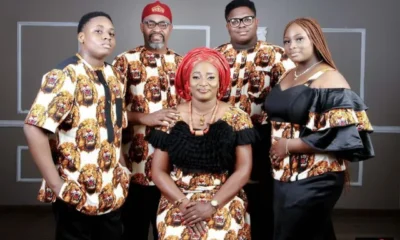
The groom, too, enters the ceremony in dress rich with meaning. He may wear a tunic or shirt made with traditional fabric such as isi agu or George. Paired with trousers or sometimes a wrapper, his attire is complete when he dons a cap, usually the red cap, signifying respect for his heritage. A walking stick, beads or even horsetail may accompany him, not just for style but as symbols of his readiness for the responsibilities of married life.
The items exchanged and used in the run of the ceremony carry their own symbolism. The bride carries a cup or gourd of palm wine as she moves among the guests in search of her groom, a moment packed with meaning. When he accepts the wine, the union is publicly affirmed, witnessed by family and community. The gifts and bridal list items represent the merging of two families and the commitment of the groom’s side to honour the bride’s lineage.
Beyond dress and gifts, the overall presentation reflects deeper values. The vibrant colours, the coral beads, the head-tie, the lion-headed fabric, the palm wine cup, all together weave a rich fabric of tradition. They show that this is not simply a party; it is a ritual, a moment of cultural assertion and familial union. As one source notes, the colours chosen for wedding attire are not simply decorative, they hold deep meaning and symbolism in Igbo culture.
The attire and symbolic items for Igba nkwu nwanyi are the visible language of respect, identity, continuity and celebration. When the bride and groom move through the ceremony, wrapped in cloth, bead and tradition, the community sees not just a couple but a new bridge between families, a new chapter in the lineage, and a reaffirmation of cultural roots that honour the past while stepping into the future.
Symbolism and What Each Step in Igba Nkwu Nwanyi Means

Igba Nkwu Nwanyi
Every gesture in Igba nkwu nwanyi carries deep meaning, weaving together individual choice, family commitment and community responsibility into one rich tapestry of culture. When a bride steps forward with her cup of palm wine, she does so as someone rooted in her lineage but ready to journey into a shared future.
According to Igbo tradition, the act of carrying the wine comes only when earlier steps of introduction and consent have been honoured. So, when she moves through the crowd holding that cup, every family and elder present understands the significance of what is to follow.
As the bride searches the gathering to find her groom, that moment is more than a spectacle. It embodies her free will, public affirmation and the groom’s readiness. When she kneels before him and offers the wine, and he accepts it, the union is declared in full view of the community. The cup of palm wine becomes the symbol of their marriage, a public pact witnessed by both families, community, guests and their ancestors.
The fact that the wine is served in the bride’s family home or compound emphasizes key cultural ideas – the bride’s origin and the respect accorded to her lineage. Then, by accepting the drink, the groom signals his commitment not just to her, but to her family and the community. The wine is life, hospitality, shared future. Its offering and acceptance carry all that.
Even the earlier stages, i.e. introduction, family inquiry and negotiation, though they may seem pragmatic, are rich in symbolism. They reflect that marriage in Igboland is never simply about two people but about two families, two kindreds and the continuity of culture and lineage. Each gift, each wrapper, each discussion before the main ceremony confirms that the bride is valued, that the groom accepts responsibilities, and that the families align in purpose.
Finally, the rituals and objects, namely, coral beads, wrappers, the palm-wine cup are symbols woven into the ceremony to speak of fertility, status, responsibility, respect and cultural identity. They remind the couple and all present that while celebration is joyful, the union carries heritage, duty and hope.
In essence, Igba nkwu nwanyi is not just a wedding event. With each step and symbol, it teaches that marriage is a choice nurtured in cultural soil, honoured by families and celebrated by community, all under the banner of shared future and enduring tradition.
Modern Adaptations and Contemporary Considerations
In recent years, igba nkwu nwanyi has adapted and evolved, blending the rich traditions of the Igbo people with modern lifestyles and global influences. Many couples today still honour the core ritual of the bride carrying the cup of palm wine and the groom accepting it. But they also incorporate new elements and practical modifications to reflect changing social realities.
For instance, while the traditional venue was the bride’s family compound, urban life and international settings have led many to hold their igba nkwu nwanyi in event halls, hotels or even on foreign soil. The bridal attire, likewise, tells of both heritage and modernity. The bride may still wear the classic wrapper and coral beads. However, she might change outfits multiple times or favour lace fabrics, off-shoulder blouses or contemporary head-ties as part of her celebration.
Social and economic shifts have also influenced key components like the “bridal list” or bride-price. Where ancestors may have expected heavy livestock and palm wine in large quantity, today’s couples often agree on symbolic gifts, simpler lists and transparent budgets, showing that the spirit of respect and commitment remains, even if the scale is lighter.
Another adaptation is the coexistence of the traditional ceremony with church, registry or “white-wedding” events. Many Igbo couples view their igba nkwu nwanyi as the cultural anchor, that is, the authentic seal of their union while also having a legal or religious wedding for formal recognition. Music, photography, social-media sharing and themed decors are now common. Notwithstanding, within these modern trappings, the bride’s search for her groom with a cup of wine remains central and basic.
These contemporary considerations do not dilute the ceremony’s meaning, rather, they show how igba nkwu nwanyi sustains its relevance. It shows the eagerness to respect the tradition while embracing present realities. Couples planning the event now often ask how much of the tradition must be honoured, and which modern touches will help the celebration fit their life context. The answer, increasingly, has been to keep the wine-carrying ritual, involve family and community, dress with cultural pride and adapt the rest so that the ceremony becomes both meaningful and manageable in today’s world.
The Enduring Relevance of Igba Nkwu Nwanyi in Modern Nigeria
In contemporary Nigeria, Igba Nkwu Nwanyi stands as more than just a festive rite, it anchors identity, community and cultural continuity at a time when both are under pressure. Among Igbo people, this wine-carrying ritual remains the most visible symbol of a union that involves not just the bride and groom, but their families and wider community.
First, it affirms cultural identity. In an era of fast change, people leaving their home villages for cities or abroad often struggle to retain meaningful links to heritage. Igba Nkwu Nwanyi offers a vivid, communal reaffirmation of Igbo tradition, telling all assembled: “we are here, we are connected to our roots.”
Second, the ceremony reinforces communal bonds and responsibilities. In Igbo culture, marriage is seen not merely as a contract between two people but as a joining of lineages and social networks. The whole process, from introductions through gift exchange to the wine-carrying brings kinsmen, friends, and community into shared responsibility.
Third, the ritual highlights the agency of the bride and public consent of the groom in the wedding process. That moment when the bride carries the cup of palm wine and identifies her groom among the guests is rich with symbolism of her consent and of the groom’s acceptance, thus anchoring the marriage in a shared decision rather than secret arrangements.
Fourth, in the evolving Nigerian social landscape where many couples also choose church, civil or private weddings, Igba Nkwu Nnwanyi continues to hold authentic cultural weight. For many Igbo people, the traditional event remains the true seal of union in the eyes of family and culture, even when other ceremonies happen alongside it.
Finally, the ceremony serves as a living classroom for younger generations. Children, nieces, nephews witness the ritual, learn the songs, see the dress, hear the language, and understand that marriage is rooted in culture, community and continuity, not just romance.
Simply put, Igba Nkwu Nwanyi is relevant in today’s Nigeria because it stands at the crossroads of tradition and change. It preserves heritage, cements social ties, places the couple within family and community structures, celebrates the bride’s choice, and connects generations. In a rapidly changing world, the ceremony offers a strong, visible anchor for identity, relationship and culture.
In Conclusion …
Igba Nkwu Nwanyi ceremony remains one of the most cherished and symbolic expressions of love, family and culture in Igboland. Though modern influences have reshaped many parts of Nigerian life, this traditional wedding rite continues to hold deep meaning for both the young and old. It beautifully blends formality with festivity, honouring ancestral customs while embracing the present.
At its heart, Igba Nkwu Nwanyi is a cultural statement. Every step, from the knocking at the bride’s door to the moment she finds her groom and offers him palm wine, speaks of respect, consent and unity. It reminds both families that marriage is a community affair, founded on shared values, accountability and love.
In a world of fast-paced change and digital weddings, the ceremony stands as a bridge between generations, showing that while style and setting may evolve, the essence of Igbo marriage traditions remains firm. It teaches today’s couples that true celebration is not only about glamour but about grounding their union in meaning, connection and heritage.
As Nigeria continues to modernize, the preservation of such cultural practices ensures that identity is not lost in the rush for progress. Igba Nkwu Nwanyi continues to tell the timeless story of who the Igbo people are – a people of dignity, hospitality and enduring values that remind all that culture, when celebrated, gives life its deepest rhythm and colour.
References
- https://www.ikengajournal.com.ng/admin/img/paper/IKENGA-VOLUME-20-No.-3.pdf
- https://en.wikipedia.org/wiki/Traditional_marriage_in_Igbo_culture
- https://teentrust.ng/the-igbo-wine-carrying-ceremony-igba-nkwu/
- https://ozikoro.com/igba-nkwu-understanding-igbo-traditional-marriage-rites/
- https://www.historybiography.com.ng/2025/08/igbo-traditional-marriage.html
- https://alaafiawrites.wordpress.com/2016/01/20/igbo-traditional-wedding-igba-nkwu-nwayi/
You might want to check this out …