


History and heritage
Umuawulu || A Culturally Progressive Anambra Town

Umuawulu is a warm, culturally rich town in Awka South, Anambra State. This fact-checked profile explores its origin, villages, markets, leadership, schools, festivals, recent development projects and community initiatives.

Umuawulu is a vibrant and culturally rooted town in Awka South Local Government Area of Anambra State. Known for its rich history, strong community spirit and growing development projects, it stands today as one of the most progressive towns in the South-East.
From its deep ancestral origins linked to Awulu, to its three thriving villages and markets, the town blends heritage with modern growth in a way that feels both authentic and inspiring.
Over the years, Umuawulu has become a place where tradition meets innovation. The community continues to honour its age-old customs, especially through festivals, clan histories and traditional leadership while also embracing new roads, solar-energy projects, upgraded schools and agricultural support programmes.
This balance of cultural pride and forward-thinking development is what makes Umuawulu a truly culturally progressive Anambra town.
Origin and History
The history of Umuawulu is deeply rooted in ancestral lineage and long-standing oral tradition. According to documented community history, the town traces its origin to Awulu, the forefather from whom the name Umuawulu, meaning “children of Awulu” is derived. Local accounts preserve Awulu as a descendant of Okpalaeshi, an early patriarch whose lineage expanded gradually as families settled, married and founded the clusters of compounds that would later form the present-day villages of the town.
Over generations, Awulu’s descendants consolidated into three major villages: Enugwu, Umuenu and Agbana. These villages became the earliest social and administrative units of Umuawulu, each with its own families, age grades and communal responsibilities. Their markets – Oye Umuawulu, Oye Umuenu and Nkwo Agbana also developed early and served as points where trade, information and culture flowed between neighbouring communities.
Umuawulu’s historical identity is further preserved through the town’s cultural calendar. Ceremonies such as the annual New Yam Festival honour the town’s agricultural heritage and the memory of ancient ancestors who depended on yam cultivation for sustenance. These festivals reinforce collective memory and remind younger generations of the lineage that began with Awulu.
Another major part of Umuawulu’s history is its traditional leadership which has passed through recognized custodians of culture. In more recent history, H.R.H. Eze G.C. Igboamazu (Eze Udo) served as traditional ruler from 1977 to 2000, helping to stabilize and unify the community during a period of growth. The current ruler, H.R.H. Eze Joel Maduabuchie Egwuonwu ascended the throne on 13 March 2014, continuing the line of traditional authority rooted in the founding families.
Through all these centuries, the people of Umuawulu have retained a strong sense of origin, memory and identity – a historical continuity that still guides social relations, land ownership, cultural practice and community development today.
Location, Administrative Structure and Villages
Umuawulu is a town situated in Awka South Local Government Area (LGA) of Anambra State, Nigeria. Geographically, it occupies a central position in the South-East region, sharing boundaries with several neighbouring communities. To the north, it borders Isiagu; to the east, Amaetiti; to the west, Nibo; and to the south, Awgbu and Mbaukwu. This strategic location places the town within a network of towns that are culturally, economically and socially interconnected.
Administratively, Umuawulu is divided into three major villages:
Enugwu – traditionally the largest village, hosting Oye Umuawulu, the central market for the village.
Umuenu – home to Oye Umuenu, its own vibrant market and social hub.
Agbana – the village where Nkwo Agbana market serves both residents and visitors.
These villages function as the primary social, economic and cultural units of the town. Each village maintains its own internal leadership, age grades and family-based decision-making structures which are coordinated under the authority of the traditional ruler (Igwe). This combination of village-level organization and central leadership ensures both local autonomy and communal unity.
Umuawulu markets are more than trading centres; they are social spaces where community members exchange news, uphold customs and conduct cultural activities. The market days, following the traditional Igbo calendar continue to influence the rhythm of social life, attracting traders, farmers and visitors from neighbouring towns.
Through this administrative structure and clear village delineation, Umuawulu preserves a strong sense of identity and facilitaes cooperation in education, agriculture, infrastructure development and cultural preservation.
People and Population
Umuawulu is a moderately sized town, home to a tight-knit and culturally cohesive community. While exact population figures vary due to the lack of recent national census data, historical estimates provide useful insight into its demographic scale. According to available records, the estimated population of Umuawulu in 2005 was approximately 20,150 residents.
Voter registration data from the Independent National Electoral Commission (INEC) in 2011 provides further detail on the adult population. At that time, Umuawulu had 4,323 registered voters, distributed across its three villages as follows:
- Enugwu: 2,532 registered voters
- Umuenu: 769 registered voters
- Agbana: 1,022 registered voters
These figures which are the only ones readily accessed reflect both the size and distribution of adult citizens, highlighting Enugwu as the largest village in terms of adult population. Almost fourteen years after, the population may have increased.
The people of Umuawulu are of Igbo ethnicity and maintain a strong sense of communal identity, reinforced through shared customs, festivals and traditional governance structures. Family ties, village solidarity and social participation in communal events remain defining characteristics of the population.
Umuawulu’s population is also notable for its engagement in farming, trading, education and small-scale entrepreneurship. These activities, alongside migration for work or education, contribute to a dynamic demographic profile that balances cultural continuity with modern socio-economic growth.
In essence, Umuawulu people form a vibrant, cohesive community whose numbers, while modest compared to urban centres, are sufficient to sustain schools, markets, churches and community development projects, while preserving the town’s cultural heritage.
Traditional Leadership and Governance
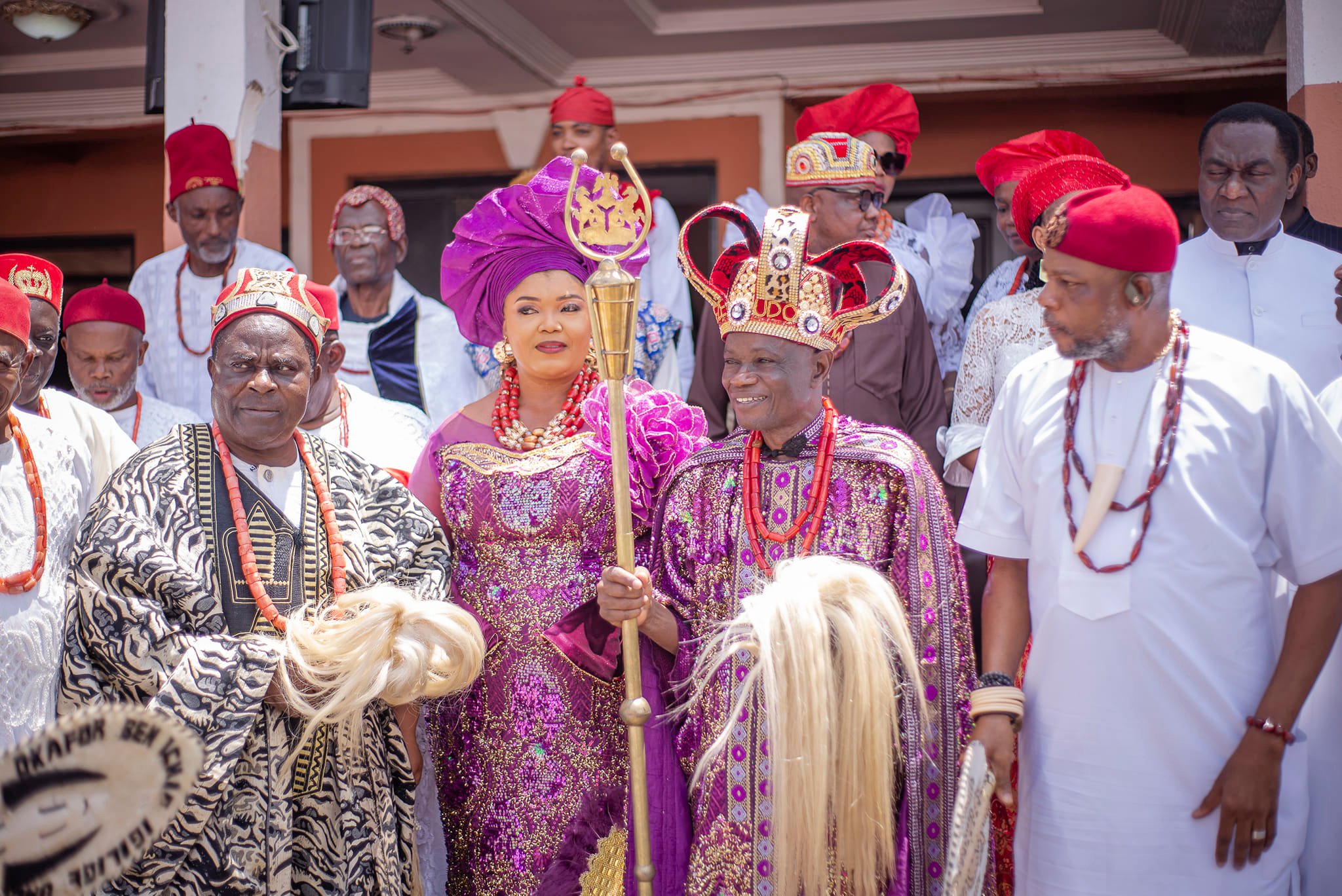
Umuawulu maintains a dual system of governance that combines traditional authority with the modern local government framework. This blend allows the town to preserve its cultural heritage while participating in Nigeria’s democratic processes.
The town’s traditional ruler known as the Igwe is the custodian of culture, customs and communal harmony. Historically, Umuawulu was ruled by H.R.H. Eze G.C. Igboamazu, popularly called Eze who held the throne from 1977 to 2000. His reign is remembered for uniting the villages, strengthening traditional institutions and overseeing the maintenance of customs and festivals.
The current Igwe is H.R.H. Eze Joel Maduabuchie Egwuonwu who ascended the throne on 13 March 2014. As the traditional ruler, he presides over cultural ceremonies, resolves internal disputes and provides guidance on communal matters such as land allocation, conflict resolution and community development initiatives.
Each of Umuawulu’s three villages i.e. Enugwu, Umuenu, and Agbana has internal leadership structures, including village heads and age grades which handle day-to-day matters within the village. These structures operate under the supervision of the Igwe, ensuring both local autonomy and town-wide coordination.
The traditional council, made up of the Igwe, elders and village heads works alongside elected representatives from Awka South Local Government Area. This collaboration allows the town to manage communal projects, coordinate festivals, oversee development programmes and ensure that both customary and statutory laws are respected.
Traditional leadership in Umuawulu is closely involved in modern development efforts. The Igwe and his council facilitate philanthropic projects such as road construction, agricultural support and educational initiatives by liaising with government authorities and private donors. Their involvement ensures that development is aligned with the cultural priorities and that projects benefit all three villages equitably.
Beyond administrative duties, the Igwe and the traditional council safeguard Umuawulu cultural identity. They oversee major ceremonies such as the New Yam Festival, regulate land usage in accordance with ancestral customs and maintain lineage records for all families in the town. This dual role of cultural custodian and community leader underscores the enduring significance of traditional governance in Umuawulu.
Schools and Learning in Umuawulu
Education is a key pillar in Umuawulu, reflecting both the community’s respect for tradition and its desire to grow. The town is served by two primary schools and two secondary schools. One of the secondary schools is Holy Cross High School which is noted as one of the oldest secondary schools in the South‑East region.
A major development in recent years has been the Solar for Schools project by the Glow Initiative which has made a significant impact on learning in Umuawulu. Through this project, a solar photovoltaic (PV) system was installed at the Community Secondary School, Umuawulu (also referred to as Union Secondary School). Before this installation, the school had no stable electricity
Thanks to this system, the school can now power around 15 laptops and 20 light points, enabling students to use computers and study at night.
An especially noteworthy part of the project is that students themselves were involved in the installation process, giving them hands-on exposure to solar technology, a powerful learning experience in itself.
In addition to improving infrastructure, the solar project helps bring digital learning closer to students in this semi-rural community. With power, the school can run computer labs, support research and even host classes later into the evening, all of which improve learning outcomes and the quality of education.
Healthcare and Community Pharmacare
Healthcare in Umuawulu has historically depended on a mix of primary health‑care infrastructure and community-led initiatives. According to Anambra State government records, there is at least one Primary Health Centre (PHC) in Umuawulu.
A major recent development is the commissioning of a state-of-the-art Pharmacare Centre in Umuawulu, driven by the Association of Community Pharmacists of Nigeria (ACPN). The centre was officially inaugurated during ACPN’s 44th Annual Scientific National Conference, marking a significant step in improving healthcare access in the community.
At the commissioning event, Pharm. Ezeh Ambrose Igwekamma, the National Chairman of ACPN described the facility as a dream turned into reality – an investment in health, wellness, and hope. The centre offers comprehensive pharmacy services, including access to essential medicines, health screenings for common conditions, medication counselling and professional advice preventive care services geared toward improving long-term health outcomes.
The commissioning was done by Dr. Afam Obidike, Anambra State Commissioner for Health, on behalf of Governor Charles Chukwuma Soludo.
In recognition of his leadership in bringing this project to life, Pharm. Ezeh was conferred with a chieftaincy title – Nna Tubelu Ugo I of Umuawulu Kingdom by the traditional ruler, HRM Igwe Dr. Joel Maduabuchie Egwuonwu (Eze Udo II). This honour underscores the community’s appreciation for his role in improving local healthcare.
The Pharmacare Centre is being positioned as a model for community-based healthcare delivery, particularly in rural and semi-urban Nigeria. By combining drug access, preventive screenings and counselling under one roof, the Umuawulu centre aims to reduce reliance on distant urban health facilities and address gaps in health services at the grassroots.
Economy, Agriculture and Markets
Umuawulu is a largely agrarian and market-driven community where farming, trade and cooperative enterprises form the backbone of the local economy.
Farming is a dominant occupation in the town as in many parts of Awka South LGA. The fertile soil supports the cultivation of key food crops, including cassava, yam, maize, plantain and other staples.
In 2025, the town witnessed a major boost to its agricultural capacity through a community‑led initiative called “We Must Farm”, spearheaded by High Chief Dr. Christopher Ndubuisi (Ikenga Umuawulu). As part of this programme, ten local cooperative societies benefited from the donation of tractors, truck‑cycles, fertilizers, hybrid seedlings, herbicides, cassava stems, wheelbarrows and other vital farm tools.
These donations were explicitly designed to modernize farming, encourage mechanization, improve yields and increase food security. Speaking at the event, Umuawulu’s farmers expressed gratitude and emphasized that access to these tools would help lift many out of poverty and improve productivity. Anambra State Ministry of Agriculture, represented by Commissioner Dr. Foster Ihejiofor pledged to support the initiative by deploying extension officers and offering technical guidance on mechanized farming.
In the same spirit of food security, Ikenga Umuawulu distributed 3,500 bags of rice to households across Umuawulu. This effort underscores the overlap between agricultural productivity and social welfare in the town’s local economy.
Markets
Trade in Umuawulu revolves around its three principal markets, each aligned with one of the town’s three villages (Enugwu, Umuenu, Agbana). These markets are:
- Oye Umuawulu (Enugwu village)
- Oye Umuenu (Umuenu village)
- Nkwo Agbana (Agbana village)
These markets do more than facilitate the exchange of goods. They are important social and economic hubs. Farmers bring fresh produce to sell, and traders from neighbouring communities converge to buy and resell. Because of Umuawulu’s strategic location in Awka South, its markets also act as collection centres, linking rural production to broader commercial networks.
Economic Significance and Cooperatives
The “We Must Farm” programme particularly emphasizes cooperative farming, reflecting a structured community approach to agricultural development. Cooperatives are instrumental in pooling resources, sharing inputs and coordinating distribution which strengthens the economic resilience of local farmers.
Beyond farming and market trade, Umuawulu economy also benefits from small-scale enterprises and social empowerment. For instance, Ikenga Umuawulu’s broader empowerment drives include distributing shuttle buses, tricycles, grinding machines and freezers to residents. These tools support both individual entrepreneurship and community-level trade, enhancing livelihoods while stimulating local economic activity.
Culture, Festivals and Social Life
Umuawulu is a deeply cultural and socially connected town. Its people preserve traditional values, celebrate agricultural heritage and foster strong unity through communal festivals and social gatherings.
New Yam Festival
The New Yam Festival (Iri Ji) is the most significant cultural event in Umuawulu. In 2023, the festival was held in grand style, with Igwe Joel Maduabuchie Egwuonwu leading the celebrations.
Key features of the festival include:
- An all-night session of praise and thanksgiving which brings together not just natives of Umuawulu, but also friends, in-laws and visitors from neighbouring towns.
- An inter-denominational thanksgiving service held in the Igwe’s palace pavilion where the entire community gathers.
- Recognition of outstanding community members: during the 2023 festival, Igwe Egwuonwu honoured diligent farmers and a high‑achieving student, Mr. Chukwunonso Okeke, a first-class graduate in Microbiology.
- Speeches and messages of unity and gratitude that emphasize the social bonds and shared identity of Umuawulu’s people.
This festival is a reaffirmation of community spirit, hard work, and the town’s cultural continuity.
Cultural Carnival and Youth Engagement
In recent years, Umuawulu has also hosted youth-driven cultural events that showcase its identity on a larger scale. One such event is the NYSC (National Youth Service Corps) Cultural Carnival held at the Nnamdi Azikiwe NYSC Unity Camp in Umuawulu/Mbaukwu (Awka South LGA).
Highlights of the event included traditional dance performances by Corps members from different parts of Nigeria
The traditional ruler of Umuawulu (Igwe Egwuonwu) played a key hosting role, showing the strong relationship between youth initiatives and traditional leadership. The carnival was praised by the Anambra State Governor, Prof. Chukwuma Soludo, as a powerful celebration of national unity and Igbo culture.
Notable Landmarks and Community Institutions
Umuawulu is increasingly defined by its modern infrastructure, landmark projects and community institutions that are transforming its landscape. Among them are:
Solar Street Lights Network: One of the most prominent landmarks in Umuawulu is the 5,000 solar-powered street lights installed across the town. This ambitious project was carried out by High Chief Ikenga Umuawulu (Christopher Ndubuisi) and was officially commissioned by Governor Charles Soludo. These street lights provide neighbourhood lighting, improve security and symbolize the town’s commitment to sustainable energy.
Privately-Funded Roads: A network of 30.5 kilometers of standard roads in Umuawulu and its environs was funded by Ikenga Umuawulu. These roads were inaugurated recently and represent a major infrastructure upgrade for the community. The new roads improve connectivity between the three villages, making trade, travel and access to services easier for residents.
Solar‑Powered School: The Community Secondary School (Union Secondary School) in Umuawulu has a solar PV system installed by the Glow Initiative. The system includes three 200-watt solar panels, a hybrid inverter with a 20‑amp charge controller and batteries. It powers about 15 laptops and 20 light points, making evening study and ICT use possible for students. Students even participated in the installation, gaining practical exposure to solar‑energy technology.
NYSC Orientation Camp: Umuawulu hosts a permanent NYSC (National Youth Service Corps) orientation camp, shared with Mbaukwu in Awka South LGA. This camp is an important national institution. It brings young Nigerians from across the country into the community, exposing them to Umuawulu’s culture while generating economic activity around the camp.
Ikenga Umuawulu Landmark andCivic Spaces: High Chief Christopher “Ikenga” Ndubuisi is a central figure in Umuawulu’s identity. His residence, palace, and civic projects such as the Civic Centre are regarded as symbolic and physical landmarks in the town.
Under his leadership, important community infrastructure has been built, including boreholes at public schools and markets, paths to the Igwe’s palace, and a fence around school premises
Healthcare and Community Pharmacy: While not a traditional “tourist” landmark, the Community Pharmacare Centre established in Umuawulu under the patronage of Ikenga Umuawulu is becoming a key institution. It provides access to essential medicines and health services in the town. The centre’s founding and its recognition in cultural ceremonies also tie it into Umuawulu’s civic and social identity.
Town Union and Community Organization
The Umuawulu Progressive Union (UPU) is the main civic association for the Umuawulu community. According to a World Bank‑affiliated report, the UPU is formally organized, with a President General. The union is explicitly tasked with harnessing community resources in overall development – coordinating local development projects, investments, and communal needs.
In addition to the UPU, the same source mentions other leadership structures in Umuawulu such as sub‑village chairmen, women groups and youth leadership, showing that UPU works in concert with these bodies.
The UPU has branches in different cities. In May 2022, High Chief Ikenga Umuawulu gave ₦10 million through his foundation to 20 entrepreneurs via the UPU (Abuja branch).
The union works with Ikenga Umuawulu’s foundation to channel large-scale philanthropy to both business and social programmes.
Through union-related or community-linked philanthropy, a one‑storey security house was donated to the Umuawulu community. It’s located at Agbana quarters and serves as a base for the town’s security operations. The security house helps strengthen local policing, supports crime prevention and fosters a safer environment for residents.
The UPU appears to be a major channel through which community development, especially through Ikenga Umuawulu is organized. Major infrastructure steps, like road construction while led by Ikenga, are closely aligned with the union’s vision of collective upliftment.
The union’s Abuja branch helps maintain the link between the diaspora and the home community, leveraging resources, organizing community events, and mobilizing financial support.
During key events, prominent political figures acknowledge the union’s work. At the Abuja Ikenga Hall inauguration, Senator Victor Umeh praised the UPU for its role in fostering community citizenship and development.
The UPU, therefore, acts not only as a town union but as a development incubator, bridging traditional civic frameworks with modern philanthropic and infrastructural engagement.
Prominent Sons and Daughters

High Chief Christopher Ndubuisi
Here are some of the most prominent and influential individuals from Umuawulu whose work and legacy have significantly impacted the town and beyond:
High Chief Dr. Christopher Ndubuisi — Ikenga Umuawulu: Probably the most celebrated figure in Umuawulu, High Chief (Dr.) Christopher Chukwunwogo Ndubuisi, also known as Ikenga Umuawulu is a business mogul and philanthropist from the town. He is Chairman/CEO of Pinnatech Group, with interests in sectors such as ICT, real estate, construction, hospitality, and civil engineering.
Under his leadership, the community has undergone remarkable transformation. He has funded roads, built civic infrastructure, donated farming equipment and distributed food to residents. He was honoured in 2024 as Investor of the Year by The Sun newspaper, in recognition of his contributions to development and job creation.
He holds an Honorary Doctorate Degree in Political Science from Institut Supérieur De Communication et de Gestion (ISGC), awarded for his humanitarian work and transformational leadership.
Ifé (Musician): Ifechukwu Mercy Michael, known professionally as Ifé is a singer‑songwriter from Umuawulu. Her music spans Afro-Soul, afrobeats and alté, and she has gained recognition for her soulful vocals and deeply personal lyrics. She has become a cultural ambassador of sorts, helping to put Umuawulu on the musical map and inspiring young creatives in the town.
Ms. Chinwe Okoli: Chinwe Okoli is a notable figure linked to the development of the town in terms of technology. She serves as a Special Adviser on ICT and has partnered with Ikenga Umuawulu in empowering local communities with digital tools. Through her role, she helps drive innovation initiatives and supports the integration of information and communication technology in community development.
In Conclusion …
Umuawulu is a shining example of a culturally rich, progressive town in Anambra State. From its deep historical roots and strong traditional leadership to its vibrant markets, educational institutions and modern infrastructure, the town seamlessly blends tradition with development.
The people are known for their resilience, unity and entrepreneurial spirit. Programmes such as “We Must Farm”, solar-powered schools and community health initiatives demonstrate the commitment of the town to progress, while festivals like the New Yam Festival preserve cultural identity and foster social cohesion.
Leadership, both traditional, through Igwe Joel Maduabuchie Egwuonwu, and philanthropic, through figures like High Chief Ikenga Umuawulu has been instrumental in creating opportunities, improving living standards and promoting sustainable development.
Though challenges remain in infrastructure, healthcare and employment, the proactive community initiatives and cultural pride provide a strong foundation for continued growth. For anyone exploring the heart of Anambra State, Umuawulu is a community to experience, where heritage, progress and opportunity meet.
References
- https://en.wikipedia.org/wiki/Umuawulu
- https://umuawulu.com/about/
- https://guardian.ng/news/nigeria/metro/ikenga-umuawulu-honoured-as-soludo-inaugurates-privately-funded-30km-roads/
- https://absradiotelevision.com/food-security-philanthropist-ndubuisi-distributes-farm-tools-to-farmers-in-umuawulu-community/
- https://glowinitiative.org/wp/wp-content/uploads/2023/02/Project-Report-Solar-for-schools-Community-Project-1.pdf
- https://independent.ng/pharm-ezeh-honoured-with-chieftaincy-title-as-acpn-opens-pharmacare-centre-in-umuawulu/
You might want to check this out …