







Igbo Culture and Tradition
Igbo Chieftaincy System: How Traditional Titles Are Earned and Their Cultural Value

Igbo chieftaincy system explains how traditional titles are earned in Igbo society, their historical roots, ceremonial processes, and deep cultural value in identity, leadership, and community life across Igboland.

In many Igbo communities, a man or woman does not become “Chief” by accident, and the title is rarely treated as decoration. It comes after years of being watched closely, not just for success but for conduct, contribution, and how others feel your presence in the community.
The Igbo chieftaincy system sits at that intersection where achievement meets public approval. It is not a political office in the formal sense. Yet, it carries influence that people recognize immediately. In some cases, a person earns it through visible development work. In others, it grows from consistent acts of support that the community never forgets, even when they are not loudly announced.
Across different Igbo towns, the details may differ, but the underlying expectation remains steady. A chieftaincy title is not handed out casually. It is discussed, weighed, and eventually agreed upon by those who understand both tradition and reputation. That is why the moment of conferment often feels less like a personal celebration and more like a communal decision being made public.
To talk about the Igbo chieftaincy system is to look at how the Igbo society records honour without writing it down in formal records. It is a system built on memory, observation, and shared standards of respect. Over time, it has also adapted to modern realities, especially in urban areas and among Igbo communities in the diaspora where recognition still carries emotional and cultural weight.
What follows is a closer look at how these titles are earned, what they represent beneath the ceremonies, and why they continue to resonate in everyday Igbo life.
Understanding the Igbo Chieftaincy System
The Igbo chieftaincy system is often misunderstood as a simple ranking of traditional titles. However, in practice, it is better described as a cultural process of recognition. It is a way Igbo communities publicly acknowledge individuals who have earned respect through contribution, character, and sustained involvement in community life.
Unlike systems where authority is strictly tied to political power, the Igbo approach has historically leaned more toward collective approval. Leadership in many Igbo societies was traditionally shared among elders, age grades, and titled societies, rather than concentrated in a single ruler. Within that structure, chieftaincy titles emerged as a form of distinction aimed at marking individuals who stood out in service, influence, or moral standing.
In modern usage, titles such as Ozo, Nze, Ichie, and other community-specific honours are often conferred by traditional rulers like the Igwe or Eze, working alongside councils of elders and titled men. However, in Igbo chieftaincy system, the authority behind the title is not only ceremonial. It carries social expectations that extend into how the person behaves, contributes, and participates in community affairs.
One important feature of the Igbo chieftaincy system is that it is not uniform across Igboland. Each community defines its own criteria, processes, and symbols. What qualifies as a respected title in one town may differ slightly in another. Still, the underlying principle remains consistent, and that is the fact that recognition is earned, not assumed.
Over time, the Igbo chieftaincy system has also adjusted to social and economic changes. In many places today, people in the diaspora receive titles during visits home, and ceremonies are sometimes held in urban centres. Even with these changes, the cultural foundation has not disappeared. The Igbo chieftaincy system still functions as a bridge between personal achievement and communal validation where society pauses to say, in effect, “we have seen what you have done, and we acknowledge it.”
Historical Background of Chieftaincy Titles in Igbo Society
To understand the Igbo chieftaincy system, it helps to begin with how Igbo society was organized before colonial rule. In many parts of Igboland, there was no single centralized authority. Communities operated through councils of elders, lineage heads, age grades, and respected titled groups. Decisions were discussed and agreed upon collectively. Authority was shared, and influence came from reputation, experience, and community trust.
Within this setting, early forms of title-taking already existed. Institutions such as the Ozo society held social and spiritual importance. Membership was not casual. It followed established customs and was tied to personal conduct, ritual obligations, and community standing. These early titles were not political offices. They were markers of status, responsibility, and moral expectation within the community.
The arrival of the British colonial administration introduced a major shift. Colonial officers needed identifiable local authorities to work through. So, they created the system of “warrant chiefs.” In many cases, these individuals did not emerge from existing Igbo structures of leadership. This created tension and, over time, changed how authority was perceived in some communities.
As colonial rule continued, and later with the development of post-independence Nigeria, the role of traditional rulers became more formalized. Titles such as Igwe or Eze gained wider administrative recognition. Alongside this, the Igbo chieftaincy system began to take on a more structured form that combined older cultural practices with newer institutional frameworks.
Today, what exists is a mix of both worlds. The system still draws from indigenous traditions of recognition and community approval, but it also reflects historical changes brought by colonial and modern governance. This is why the Igbo chieftaincy system can appear both deeply traditional and clearly adapted to contemporary society at the same time.
Types of Chieftaincy Titles in Igbo Culture

The Igbo chieftaincy system does not operate with a single uniform list of titles across all communities. Instead, each town or kingdom in Igboland develops its own structure based on history, tradition, and local values. Still, there are well-known title systems and honourific categories that appear repeatedly across many Igbo communities, even if their meanings and requirements differ slightly.
Ozo Title
The Ozo title is one of the most widely recognized and respected institutions in Igbo culture. In many communities, it is considered a sacred and prestigious title. Ozo title holders are traditionally expected to maintain a high level of moral discipline and social responsibility. In some areas, they are seen as custodians of cultural values and community order.
The process of becoming an Ozo title holder is usually strict and involves approval from elders, spiritual consultation in some communities, and a formal initiation ceremony. While modern interpretations vary, the Ozo institution is still strongly associated with dignity, integrity, and long-standing respect within Igbo society.
Nze Title
The Nze title is another highly respected institution inside the Igbo chieftaincy system found in many parts of the region. In some communities, it overlaps with or exists alongside the Ozo system, depending on local tradition.
Nze title holders are often regarded as individuals who have attained wisdom and social maturity. They may play advisory roles in community matters, especially in cultural and moral discussions. The title is not just ceremonial; it is often linked with expectations of exemplary conduct and leadership within the community.
Ichie Title
The Ichie title is commonly used to recognize seniority, influence, or significant contribution to community development. In many towns, Ichie title holders serve as members of traditional councils or advisory groups to the traditional ruler.
Unlike some deeply ritualized titles, Ichie can sometimes be more flexible in meaning, depending on the community. In some places, it is strictly reserved for respected elders, while in others, it may be awarded to individuals who have made notable contributions to development, leadership, or philanthropy.
Community-Specific Honorary Titles
Beyond the widely known categories of titles in Igbo chieftaincy system, many Igbo communities create their own honourary titles. These titles are often tied to local history and cultural identity. Examples include titles that recognize exceptional philanthropy, leadership in town development unions, contributions to education or healthcare, and service in diaspora community associations.
These titles may not always follow the same spiritual or ritual depth as Ozo or Nze, but they still carry strong social recognition.
One important feature of the Igbo chieftaincy system is its diversity. What is considered a major title in one community may not carry the same weight in another. This variation is not a weakness, rather, it reflects the decentralized nature of Igbo society where each community maintains its own identity and standards.
Despite these differences, the underlying purpose of Igbo chieftaincy system is the same – to publicly recognize individuals who have earned respect through action, service, and character.
Together, these titles form a layered system of honour that continues to evolve. While modern influences have introduced new expectations and practices, the cultural foundation remains deeply rooted in community recognition and traditional values.
How Igbo Chieftaincy Titles Are Earned
In the Igbo chieftaincy system, a title is not something someone simply applies for and receives. It is something a community gradually arrives at, after observing a person over time. The process is less about a single event and more about a long record of conduct, contribution, and public perception.
Across Igboland, the exact requirements differ from one town to another, but the underlying expectations remain similar. A chieftaincy title is earned when a community feels that an individual has consistently added value to its life and has earned a place of public recognition.
One of the most important ways titles are earned in Igbo chieftaincy system is through visible contribution to the community. This may include supporting local development projects such as roads, schools, health centres, or community halls. In many Igbo towns, individuals who invest in the growth of their community are closely observed. However, contribution alone is not enough. The community also considers whether the effort is genuine and sustained over time.
Character carries significant weight in the Igbo chieftaincy system. A person’s reputation often speaks louder than wealth or status. Before a title is considered, community members, elders, and traditional authorities usually have a clear sense of how the individual behaves in daily life. Integrity, honesty, and respect for cultural values are often part of the unspoken requirements.
In many cases, a person may have influence or resources but without a strong moral reputation, title consideration may not progress.
Many chieftaincy titles conferred in Igbo chieftaincy system are linked to acts of generosity. This can include helping families in need, supporting education through scholarships, assisting widows or vulnerable groups, or contributing to communal welfare projects. Philanthropy is not viewed as random charity. In Igbo communities, it is often seen as a way of returning value to the society that helped to form the individual.
No chieftaincy title is conferred in isolation. Elders, titled men, and traditional councils usually play a central role in the process. A potential titleholder is often discussed privately within these groups. Their conduct, contributions, and public reputation are reviewed before any formal decision is made. This stage ensures that the title reflects community agreement rather than personal ambition.
In Igbo chieftaincy system, once a candidate is considered acceptable, the process moves into formal approval. This may involve consultation with the traditional ruler, council of chiefs, and in some cases, spiritual or customary checks, depending on the community’s tradition.
After approval, the candidate is officially prepared for the title-taking ceremony. This stage marks the transition from private recognition to public honour.
The final stage is the public ceremony. This is where the community officially announces and celebrates the new titleholder. It is often marked by gathering, traditional rites, cultural displays, and communal participation. At this point, the title becomes a public identity. The individual is now expected to uphold the responsibilities associated with it, both in behaviour and in continued service to the community.
One of the most important things to understand is that the Igbo chieftaincy system does not reward sudden success alone. It is built on observation over time. A person is often “known” long before they are ever “titled.” This slow process is part of what gives the system its weight. It ensures that titles are not just symbols, but acknowledgments of a life already lived in the view of the community.
The Rituals and Ceremonies of Title Taking
In the Igbo chieftaincy system, the moment a title is finally conferred is never treated as a private achievement. It becomes a public event, one that brings together family, elders, community members, and cultural custodians. The ceremony is not only about celebration; it is also about validation. It is the point where a decision already agreed upon in principle is made visible to everyone.
Although details vary from one Igbo community to another, the structure of the title-taking ceremony often follows familiar cultural patterns that have been passed down over time.
Before the public ceremony, there is usually a period of preparation that begins after the candidate has been approved by elders and relevant traditional authorities. During this stage, the family of the candidate is informed, and plans for the ceremony begin.
In many communities, the date is chosen carefully to align with cultural calendars or community availability. The preparation stage is often intense as it involves coordination between the family, the titled society, and community representatives.
The kola nut holds a central place in Igbo tradition, and it is often the first symbolic act in a chieftaincy ceremony. It is presented, broken, and shared according to custom, usually with prayers for peace, prosperity, and unity. This act signals acceptance and blessings for the occasion. In many Igbo communities, no serious traditional gathering is complete without breaking and sharing kola nut.
Depending on the community, certain rites may be performed by elders or custodians of tradition. These rites are not uniform across Igboland, but they often include prayers, symbolic gestures, and invocations tied to ancestral customs.
The purpose of these practices in Igbo chieftaincy system is to formally transition the candidate into a new social status within the community. In some places, spiritual elements are included while in others, the focus is more social and cultural.
A key moment in the ceremony is the official announcement of the new titleholder. This is usually done by a traditional ruler, council elder, or authorized spokesperson. At this point, the individual is publicly addressed with the new title for the first time. This moment often draws applause, chants, and cultural expressions from attendees. It is the point where recognition becomes official in the eyes of the community.
After the formal announcement, the atmosphere usually shifts into celebration. Music, drumming, traditional dances, and cultural performances are common features of Igbo title-taking ceremonies.
Family members, friends, and well-wishers often join in festive activities. Food and drinks are shared, and the event becomes a communal gathering that extends beyond the individual being honoured.
In many ceremonies, the new titleholder is presented in traditional attire that signifies status and respect. This may include culturally significant garments, traditional beads, staff/walking stick/hand fan, traditional cap or other symbolic items, depending on the community. These symbols serve as visible markers of the new social identity. They are often worn or displayed during and after the ceremony, especially in formal community settings.
One of the most important aspects of the ceremony is that it is witnessed by the community. The presence of people is not accidental; it is essential. In the Igbo chieftaincy system, recognition is communal. The ceremony ensures that the entire community acknowledges the new status, not just a select group of individuals.
Basically, in Igbo chieftaincy system, the title-taking ceremony is not only about honour. It is also about responsibility. Once the title is conferred, the individual is expected to continue contributing to the community and to uphold the values that led to their recognition.
In this sense, the ceremony serves as both an ending and a beginning. It closes one chapter of recognition and opens another that carries higher expectations within Igbo society.
Cultural and Social Value of Chieftaincy Titles
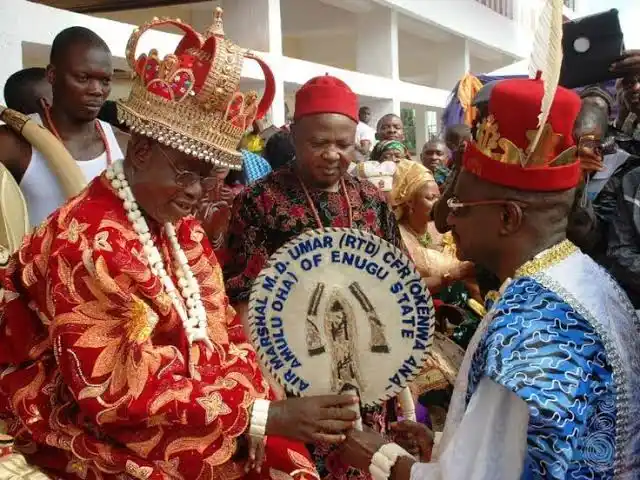
Within the Igbo chieftaincy system, a title is never treated as a personal decoration or a final reward. It carries meaning that extends into how a person is seen, how they participate in community life, and how their actions are remembered. In many Igbo communities, the value of a chieftaincy title is not written in documents. It is lived, observed, and continuously reinforced through daily interaction.
A title in Igbo chieftaincy system is, first of all, a public acknowledgment. It tells the community that an individual has reached a point where their actions can no longer be ignored. This recognition is not based on secrecy or private approval alone. It is rooted in shared observation. People have seen the contributions, the behaviour, and the consistency over time. The title simply makes that recognition official.
Once a title is conferred, the individual is addressed differently and treated with a higher level of respect in social settings. This is not just about formality. It is about cultural order. In gatherings, meetings, and ceremonies, titled individuals are often given priority in seating, speaking, and participation. This respect is not automatic for everyone in society. It is earned through the Igbo chieftaincy system where recognition is tied to contribution and reputation.
In Igbo chieftaincy system, titled individuals often play advisory roles in their communities. They may be called upon to help resolve disputes, offer guidance on development matters, or support traditional rulers in decision-making.
Their input is valued because they are seen as people who have demonstrated responsibility over time. In many cases, they form part of councils that help to maintain order and continuity in local governance structures.
Chieftaincy title holders also serve as custodians of cultural practices. They participate in ceremonies, uphold traditions, and help to pass cultural knowledge to the younger ones. As such, the Igbo chieftaincy system acts as a bridge between the past and the present. It ensures that cultural practices are not only remembered but actively practiced within the community.
For many people, receiving a title strengthens their sense of identity. It connects them more deeply to their ancestral home and community. This is especially significant for those living outside their hometown or in the diaspora. A chieftaincy title becomes a reminder that they are still part of a living cultural system, no matter where they reside.
Alongside honour comes expectation. In Igbo chieftaincy system, a titled person is often expected to maintain a higher standard of behaviour in public and private life. Actions are more visible and more closely observed. In many communities, a titleholder is seen as someone who should lead by example, not through instruction but through conduct.
This expectation is one of the reasons the Igbo chieftaincy system is taken seriously. It does not only reward achievement; it also demands continued responsibility.
Titled individuals often contribute significantly to community projects. This may include funding infrastructure, supporting education, or assisting in local initiatives.
Their involvement is not only financial. It also includes mobilizing others, offering guidance, and supporting collective efforts. In many cases, their influence helps to accelerate community development projects.
The cultural and social value of titles in Igbo chieftaincy system lies in this balance. It is not just about being recognized. It is about remaining useful to the community after recognition.
Through the Igbo chieftaincy system, honour is tied to responsibility, and status is tied to service. This connection is what keeps the institution meaningful across generations, even as the society continues to change.
Chieftaincy Titles in Modern Igbo Society
The Igbo chieftaincy system has not remained frozen in time. While its roots are deeply traditional, its expression today has adjusted to modern realities such as urban migration, global exposure, and changing economic conditions. Yet, even with these shifts, the meaning attached to chieftaincy titles in Igbo society has not disappeared. Instead, it has found new ways to stay relevant.
In earlier times, chieftaincy titles were mostly conferred within the community where the traditions originated. Today, that has expanded. Many ceremonies now take place in cities like Lagos, Abuja, or even abroad in Europe and the United States, especially where Igbo communities are strong. Diaspora associations often organize title conferment ceremonies when respected members return home or are honoured during community gatherings.
This shift shows how the Igbo chieftaincy system has adapted to migration without losing its cultural base. The connection to the hometown remains central, even when the ceremony happens elsewhere.
In modern times, contributions to community development often carry more visible weight. Many title recipients are recognized for funding infrastructure such as roads, schools, churches, town halls, or water projects.
While wealth has become more visible in the process, it is not meant to stand alone. In most communities, financial contribution is still expected to be tied to goodwill and long-term involvement in community growth. This has led to a modern interpretation of chieftaincy where development impact is highly valued, sometimes more visibly than in earlier generations.
Today, many Igbo communities have more structured traditional councils and chieftaincy committees. These bodies help to regulate how titles are proposed, reviewed, and conferred. Traditional rulers such as Igwe or Eze often work with councils of elders, titled men, and community development unions. This structure helps to reduce disputes and ensures that the process follows agreed cultural guidelines.
The Igbo chieftaincy system has, therefore, become more organized in its modern form, even while keeping its traditional foundation.
One of the major conversations around modern chieftaincy titles is the concern about commercialization. In some cases, critics argue that titles are becoming more accessible to financial influence rather than purely cultural merit.
This debate is ongoing within many communities. Some argue that economic contribution is a legitimate form of service, while others believe that moral standing and long-term community engagement should remain the primary criteria. Despite these concerns, many communities continue to emphasize character and service alongside material contribution.
The Igbo diaspora plays an increasingly important role in the modern Igbo chieftaincy system. Many successful Igbo individuals abroad maintain strong ties to their hometowns and are often honoured during cultural visits or annual festivals. For many in the diaspora, receiving a title is not just about recognition. It is also a way of staying connected to identity, ancestry, and cultural belonging. This has helped to strengthen community development funding and cultural exchange between Igbo communities at home and abroad.
Despite modernization, chieftaincy titles still carry strong emotional and cultural weight. In weddings, funerals, festivals, and town meetings, titled individuals are still given visible respect.
The Igbo chieftaincy system continues to serve as a bridge between generations. Older traditions remain visible in ceremonies as the younger generations are increasingly involved in both receiving and questioning how the system should evolve.
The Igbo chieftaincy system today is neither unchanged nor abandoned. It is actively adapting. It continues to balance heritage with modern realities, even when debates arise about its direction. What remains constant is the idea that a title is not just a personal achievement. It is a community statement. It represents recognition, expectation, and continued responsibility within Igbo society, whether in rural towns or global cities.
Misconceptions About Igbo Chieftaincy Titles
Though the Igbo chieftaincy system is widely respected, it is also frequently misunderstood, especially by people who are not familiar with how Igbo communities operate internally. Over time, modernization, migration, and social media conversations have added new layers of confusion about what these titles actually mean and how they are earned.
Clearing these misunderstandings is important because chieftaincy titles are not random honours. They sit within a structured cultural system that blends tradition, community judgment, and social responsibility.
One of the most common misconception is that chieftaincy titles are only for the rich. While financial capacity can play a role in modern ceremonies, it is not the sole requirement in most Igbo communities. In practice, titles are expected to reflect community contribution, personal reputation, long-term involvement in local development, and respect within society.
Wealth alone does not guarantee acceptance in many traditional settings. A person may have resources but still be denied recognition, if their character or community relationship is questionable.
Another misunderstanding is the assumption that every title in Igboland carries identical meaning. In reality, the Igbo chieftaincy system is not uniform. Each community defines its own titles, requirements, and significance. An Ozo title in one area may carry a slightly different cultural weight or initiation process compared to another town.
Even titles with similar names may differ in ritual expectations, social responsibilities, level of prestige, and eligibility requirements. This variation is a natural outcome of Igbo decentralized social structure.
Chieftaincy titles are often confused with political offices but they are not the same. Political offices involve formal governance structures, elections, and administrative authority. Chieftaincy titles, on the other hand are cultural recognitions granted by communities to honour individuals. While titleholders may influence community discussions, they do not automatically hold government power. Their influence is moral and social, rather than official or constitutional.
There is ongoing debate about commercialization in some areas, especially in urban settings. However, it is inaccurate to generalize this across all Igbo communities. In many towns, the process still involves vetting by elders and titled councils, community discussions, approval by traditional authorities, and public acceptance during ceremonies. Even where financial contributions are important, they are usually only one part of a broader evaluation process.
Some people assume that chieftaincy titles end at the ceremony. On the contrary, in many communities, they come with ongoing expectations. A titleholder is often expected to maintain good conduct, participate in community development, serve as a respected voice in social matters, and uphold cultural values. In this sense, the title is not just recognition of past actions. It is also a reminder of continued responsibility.
There is also the misconception that the system is outdated and no longer relevant. This misconception ignores how deeply the Igbo chieftaincy system has adapted to modern society. Today, titles are still actively conferred in villages, cities, and diaspora communities.
They continue to strengthen cultural identity, support community development, maintain traditional leadership structures, and connect the younger people to heritage. While the system has evolved, it has not disappeared. It remains part of how many Igbo communities express respect and belonging.
Many misconceptions about chieftaincy titles come from viewing them only through modern or external lenses. Within the Igbo society, however, the system is still grounded in community observation, cultural expectation, and shared values.
The Igbo chieftaincy system continues to function as a living institution where recognition is not just about status but about how a person is remembered within their community.
Why Igbo Chieftaincy System is Still Relevant
The Igbo chieftaincy system is often discussed as a traditional institution, something rooted in the past. Yet, in everyday Igbo life, it is still very present. It appears in town meetings, family discussions, cultural festivals, and major community projects. Even in a rapidly modernizing society, it continues to carry meaning that people recognize without needing long explanations.
What keeps it relevant is not only tradition but the way it connects identity, responsibility, and community life in a practical way.
For many Igbo communities, chieftaincy titles remain one of the strongest links to cultural identity. They carry language, customs, rituals, and social values that might otherwise weaken under modern influence.
When someone receives a title, it is not only a personal moment. It becomes part of a shared cultural memory. The ceremony, the symbols, and the public recognition all help to preserve practices that have been passed down across generations. In this sense, the Igbo chieftaincy system continues to serve as a cultural anchor.
One of the practical reasons the system still matters is its connection to development. In many Igbo towns, individuals are often recognized for contributing to infrastructure and community projects. This has created a culture where people in business, politics, and the diaspora feel a sense of responsibility toward their hometowns. Roads are built, schools are supported, water systems are improved, and community halls are maintained through collective effort. The Igbo chieftaincy system, in this sense, quietly supports local development without replacing formal government structures.
The Igbo chieftaincy system is built on the idea that society should recognize those who give back. It reinforces the belief that personal success should not exist in isolation from community impact. This recognition motivates continued contribution. It also encourages others to participate in community life, knowing that actions are seen and remembered over time. In many communities, this creates a cycle where service and recognition reinforce each other.
Even without formal legal authority, titled individuals often play an important role in maintaining social balance. They are consulted in disputes, community disagreements, and cultural decisions. Their influence comes from respect, not enforcement power. Because of this, they often help to reduce tension and support dialogue within the community. The Igbo chieftaincy system provides a structure where experience and reputation still matter in guiding community behaviour.
For Igbo people living outside their hometowns or outside Nigeria, chieftaincy titles often serve as a strong emotional connection to home. Many diaspora communities participate in title ceremonies during visits or through organized community associations. This helps to maintain cultural ties even across distance.
It also encourages investment in hometown projects, which in turn strengthens the relationship between those abroad and their local communities.
The younger generations often encounter the Igbo chieftaincy system during festivals, family events, or community ceremonies. Through these experiences, they learn about respect, service, and cultural responsibility. Even when they do not fully participate in the system, its presence helps to transmit values about leadership, contribution, and identity.
Despite urbanization and changing lifestyles, the Igbo chieftaincy system has not disappeared. It has adjusted. It now exists alongside modern governance, education systems, and global influences. Its survival is not based on resistance to change but on its ability to remain meaningful. It continues to offer recognition, belonging, and cultural continuity in a world that is constantly shifting.
Fundamentally, the Igbo chieftaincy system is still relevant because it answers a simple question that remains relevant across generations: how does a community recognize those who contribute meaningfully to its life? The answer, in Igbo society, is still found in titles that carry history, responsibility, and respect.
Conclusion…
The Igbo chieftaincy system has never been just about ceremony or titles written beside a person’s name. It is a living cultural practice that continues to connect achievement with responsibility in Igbo society.
Across generations, what stands out is not only how these titles are given, it is what they represent after they are given. A chieftaincy title carries public memory. It carries expectations. It also carries a quiet reminder that recognition is tied to continued service, not just past success.
Even as the Igbo society changes, the system has remained present in both rural communities and urban spaces. It has adjusted to migration, modern development, and diaspora life. Yet, it still holds onto its cultural core. In every ceremony, every title announcement, and every community gathering, there is a shared understanding that respect is earned through visible contribution and consistent character.
Ultimately, the Igbo chieftaincy system is not only about honouring individuals. It is about affirming values that communities continue to live by, namely, responsibility, contribution, and belonging. It stands as a reminder that leadership is not always formal or political. Sometimes, it is expressed through recognition given by the people who have watched, known, and accepted one’s journey.
In that sense, chieftaincy titles remain more than tradition. They are a continuing symbol of how the Igbo society remembers, respects, and rewards those who leave a lasting mark on their community.
References
- https://www.igbostudies.org/journal/igbo-studies-review/isr-6-2018/of-the-cultural-and-the-dramatic-significance-and-value-of-igbo-chieftaincy-titles/
- https://thesun.ng/ndigbo-and-chieftaincy-titles/
- https://www.odogwublog.com/the-chieftaincy-title-among-both-genders-in-our-igbo-culture/
- https://umuigbo.com/title-taking-in-igboland/igbo-culture
- https://www.mdpi.com/2226-471X/9/12/385
You might want to check this out …