




National News
Nnamdi Kanu’s Conviction ‖ All You Need to Know

Nnamdi Kanu’s conviction on terrorism charges has shocked Nigeria. Here’s everything you need to know about the life sentence, the court’s reasoning, and what it could mean for the Southeast.

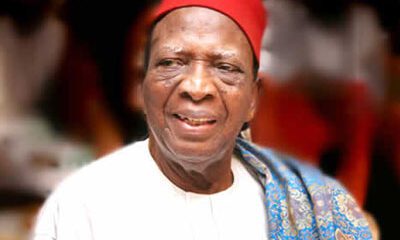
Nnamdi Kanu
Nnamdi Kanu’s conviction has sent shockwaves across Nigeria and beyond. On November 20, 2025, the Federal High Court in Abuja found the leader of the Indigenous People of Biafra (IPOB) guilty on terrorism-related charges and sentenced him to life imprisonment.
The court ruled that Kanu’s broadcasts, his orders for “sit-at-home” directives, and his leadership of a proscribed organization amounted to acts of terrorism.
This landmark judgment is not just about one man; it is a judgment that has significant implications for the Southeast, the nation’s legal system and the future of separatist movements in Nigeria.
In this article, we break down everything you need to know about Nnamdi Kanu’s conviction, and what it could mean for his region.
Before Nnamdi Kanu’s Conviction: Background of the Case

The story of Nnamdi Kanu’s conviction began long before his November 2025 judgment. Kanu is the leader of the Indigenous People of Biafra (IPOB), a separatist movement pushing for the independence of Nigeria’s Southeast region. He holds dual citizenship (British and Nigerian) and founded Radio Biafra, a London‑based station that he used to broadcast his message for Biafran self-determination.
Kanu’s first major arrest came in October 2015 when Nigerian authorities charged him with treasonable felony, terrorism and other offenses. He was granted bail in 2017 on health grounds. But later that year, he fled Nigeria. His home in Umuahia, Abia State was raided by the military in a controversial operation, after which he went into exile, travelling between London, Israel and Kenya.
On June 19, 2021, Kanu was re-arrested in Kenya. He was then given extraordinary rendition, that is, moved without formal extradition back to Nigeria, a move his legal team strongly criticized. According to IPOB and its supporters, this re-arrest violated Kenyan constitutional protections and international legal norms. In June 2025, a Kenyan court awarded him compensation, declaring the rendition illegal.
Back in Nigeria, Kanu faced a revised 15-count indictment, including terrorism, treasonable felony and other charges. Over time, several counts were struck out. By his final trial phase, he was facing seven terrorism-related counts. In April 2022, a Federal High Court dismissed eight of the initial 15 counts, deeming them “lacking in substance.” But in December 2023, Nigeria’s Supreme Court overturned an appeal court decision that had previously quashed his case, restoring the seven-count charge and clearing the way for trial.
During this long legal battle preceding Nnamdi Kanu’s conviction, he and his defense repeatedly challenged the legitimacy of his trial. They argued that his rendition from Kenya was unlawful and that he was being tried under a repealed law. Specifically, they claimed that the Terrorism Prevention Act used to charge him had been replaced by a newer legislation. Meanwhile, IPOB insisted that sit-at-home orders, which Kanu allegedly issued to his followers in the Southeast are a form of civil protest, not terrorism.
This complex background involving cross-border arrest, legal controversy and political agitation set the stage for Nnamdi Kanu’s conviction in 2025.
Details of the Court Proceedings Prior Nnamdi Kanu’s Conviction

Regarding Nnamdi Kanu’s conviction, the path in court was fraught with legal drama and fierce objections. Justice James Omotosho of the Federal High Court in Abuja presided over the trial which centered on seven terrorism‑related counts filed by the Federal Government.
Refusing to Open Defence and Waiver of Right
Kanu repeatedly refused to mount a defence. Despite being granted six days by the court to present his case, he did not open his defence within that timeframe. On November 4, 2025, Justice Omotosho warned him that if he failed to either enter his defence or file a final written address, he would be deemed to have waived his right to defend himself.
Two days later, when he still did not mount a traditional defence, the court formally foreclosed his right to open a defence, ruling that he had effectively waived it.
In the judge’s words, although the right to a fair hearing is constitutional, Kanu “waived” that right by not using the opportunity the court gave him. Omotosho even said he would have extended the opportunity, if Kanu had started to defend, but since he declined, the court could not force him.
Legal Objections and Preliminary Motions
Part of the court proceedings that led to Nnamdi Kanu’s conviction focused on jurisdictional challenges by Kanu. He argued that the law under which he was charged, that is, the Terrorism Prevention (Amendment) Act, 2013 had been repealed by the newer Terrorism (Prevention and Prohibition) Act, 2022. According to Kanu, prosecuting him under a repealed statute was unlawful.
He also filed a motion asking the court to strike out his “not guilty” plea, claiming that it was obtained under “deception” and that part of the charge sheet did not reflect a valid written law.
In response, prosecuting counsel Adegboyega Awomolo (SAN) argued that Kanu’s new motion should be treated as his final written address. Omotosho accepted that the filings were properly made, but noted that since Kanu was defending himself, without a full legal team, he should be given more time to consult legal counsel for guidance.
Final Steps Before Nnamdi Kanu’s Conviction
By November 7, 2025, the court formally set November 20 as the date to deliver its judgment in the terrorism trial. The judge reaffirmed that Kanu had already “waived” his right to defend himself by failing to open a defence, making the case ready for judgment.
Despite Kanu’s objections about the legality of the charge, the court said it would address his preliminary motions, including his jurisdictional challenge during the final judgment.
The Verdict – Nnamdi Kanu’s Conviction
With regards to Nnamdi Kanu’s conviction, the Federal High Court in Abuja could be said to have delivered a forceful and decisive ruling. Justice James Omotosho, after examining the evidence and Kanu’s courtroom behaviour, found him guilty on seven terrorism-related counts and sentenced him to life imprisonment.
Based on the judgment, the key points of the verdict are thus:
Conviction on All Counts
The court held that the prosecution successfully proved all seven counts against Kanu beyond a reasonable doubt. These included, among others:
Acts of terrorism through his broadcast messages where he allegedly used Radio Biafra and other platforms to intimidate or threaten Nigerians.
Issuing and enforcing sit‑at‑home orders in the Southeast which the court determined amounted to a restriction of free movement – a power Kanu did not constitutionally have.
Leading a proscribed organization, as the court confirmed his role and leadership in IPOB which has been designated illegal.
Incitement to violence or terrorism, including instructions that encouraged attacks on government facilities and security personnel.
Sit‑at‑Home Orders Found Terroristic
One of the most significant parts of Nnamdi Kanu’s conviction is the court’s treatment of his “sit-at-home” directives. Justice Omotosho declared that these orders, particularly when backed by threats and actual enforcement, were not just political speech. He called them terrorist acts because they deprived Southeastern Nigerians of their right to freedom of movement.
In his judgment, the judge emphasized that Kanu lacked any constitutional or legal authority to impose such a directive. As the court noted, only the President has power to restrict movement under Nigerian law.
Evidence of Armed Enforcement
The court referred to testimony and exhibits linking gun violence to IPOB’s enforcement of the sit-at-home orders. One significant piece of evidence was a medical report (Exhibit PWK) which detailed gunshot wounds on a man connected to IPOB’s armed wing, the Eastern Security Network (ESN). The judge concluded that Kanu, as leader of IPOB, had de facto control or influence over these operatives, making him liable for these acts.
Characterization by the Judge
In a strong and symbolic statement, Justice Omotosho described Kanu as having “turned himself to a tyrant.” He argued that Kanu’s rhetoric and actions went far beyond mere political agitation, threatening public order and security in a way that necessitated his removal from society.
Sentencing
Even though prosecutors asked for the death penalty, the judge opted for life imprisonment, citing both the gravity of the offenses and international trends against capital punishment. The court noted that under Section 16 of the Terrorism Prevention Act (Amendment) 2013, the offenses in some counts carry either death or life imprisonment.
By choosing a life sentence, Justice Omotosho said he was applying justice with a measure of mercy.
Legal and Constitutional Observations
Unchallenged Evidence: Because Kanu declined to present a defense, the court treated the prosecution’s evidence as unchallenged. Justice Omotosho pointed out that “facts not controverted are deemed admitted” under Nigerian law.
Lack of Authority: The court underscored repeatedly that Kanu had no legal or constitutional basis for issuing public orders that restrict people’s movement. The sit-at-home orders, in particular, violated citizens’ constitutional rights.
Proscribed Organization: By convicting him for leading IPOB, the court reaffirmed that the group is illegal under Nigerian law.
Connection to Violence: The court held that the broadcasts and directives issued by Kanu were not abstract political statements, they were linked to real instances of violence, including shootings, making them acts of terrorism.
Significance of the Verdict
Strong Legal Precedent: This verdict sets a powerful precedent that political activism, even calls for self-determination, can be legally framed as terrorism if they involve threats, enforcement or violence.
Criminalizing Sit‑at‑Home Orders: By labelling the sit-at-home orders as terrorism, the court has legally invalidated a tactic that IPOB used for years to exert economic and social pressure. This significantly weakens one of IPOB’s main tools.
Message to Separatist Movements: The life sentence sends a signal, not just to Kanu, but to other separatist or militant leaders, that the government and the judiciary will treat certain forms of agitation as criminal and punishable by life in prison.
Nnamdi Kanu’s conviction is a reflection of a court that saw his actions, not as peaceful or purely political activism, but as a serious threat to national security. By convicting him on all seven terrorism counts, including for sit-at-home orders and handing him life in prison, the court has made a landmark judgment.
Justice Omotosho framed the verdict not simply as punishment, but as a defense of constitutional order and citizens’ rights. For those watching Nigeria’s political future, Nnamdi Kanu’s conviction means more than a legal decision, it is a turning point.
Courtroom Drama at Notable Moments During Nnamdi Kanu’s Conviction
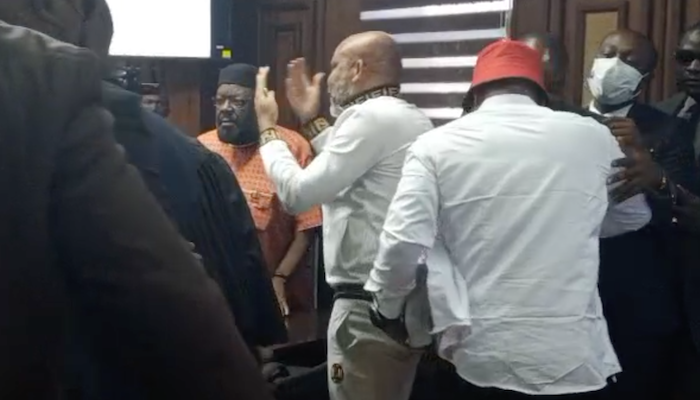
In the course of the proceedings leading to Nnamdi Kanu’s conviction, the courtroom itself became a theatre of tension, confrontation and spectacle, moments that underscored how high‑stakes and emotionally charged the case was.
Unruly Behaviour and Ejection from Court
During the judgment session, Justice James Omotosho described Kanu’s behaviour in court as “unruly.” Kanu repeatedly interrupted the judge’s reading, shouting objections and demanding that he be allowed to file his final written address.
At one point, Kanu challenged the basis of his prosecution thus:
“Which law states that you can charge me on an unwritten law? … Any judgment declared in this Court is a complete rubbish,” he shouted.
He also accused Justice Omotosho of bias and of lacking legal understanding.
After a brief recess, the judge, citing Kanu’s repeated misconduct ordered security agents to remove him from the courtroom so that the court could proceed to deliver its verdict.
Absence During Verdict Delivery
Following Kanu’s ejection, the court delivered the judgment in his absence. Justice Omotosho justified this by saying that, while defendants do have a constitutional right to be present, persistent misconduct can allow the court to continue without them. He called the courtroom “a temple of God,” emphasizing that order and respect for the court must be maintained.
Final Written Address Dispute
One major point of contention in the course of Nnamdi Kanu’s conviction was his insistence on presenting a final written address before judgment. He argued that without that, any verdict would be unfair. The court, however, had dismissed three fresh motions he filed, calling them unmeritorious.
Kanu’s demand to file a final written address came even as he previously declined to mount a defence.
Fiery Exchanges and Accusations
Throughout the proceedings on Nnamdi Kanu’s conviction, his tone was defiant and accusatory. He repeatedly criticized the court, declaring that any judgment passed that day would be “rubbish.” He also shouted, “You don’t know the law … Nonsense,” directly at the judge.
In response, Justice Omotosho referred to Kanu’s conduct as not only disruptive but part of a pattern. According to the judge, “The unruly behaviour of the defendant is not new”.
Moral and Religious Undercurrents
In his ruling preceding Nnamdi Kanu’s conviction, Justice Omotosho added a moral dimension. According to reports, he spoke of mercy being “a central tenet of both justice and faith,” citing religious values even as he condemned Kanu’s actions. This framing underscored that the court saw its role not just as punitive, but as exercising a careful balance between judgment and mercy.
What These Moments Mean in Nnamdi Kanu’s Conviction
These courtroom dramas reinforced the seriousness of Nnamdi Kanu’s conviction. His removal and the court’s decision to proceed without him pointed to a breakdown in decorum and respect. The exchanges highlighted Kanu’s rejection of the court’s authority which may resonate with his supporters as a political stance.
By saying that repeated misconduct justifies proceeding in someone’s absence, the court set a precedent that the behaviour of a defendant can meaningfully affect how and when judgment is delivered.
Simply put, the courtroom drama surrounding Nnamdi Kanu’s conviction was a reflection of deep legal, political and ideological conflict. His removal, the heated exchanges and the judge’s moral framing all contributed to a moment that will be remembered as central to the history and significance of this case.
Implications of Nnamdi Kanu’s Conviction

Nnamdi Kanu’s conviction and life sentence carry deep and wide-ranging implications legally, politically and socially. Here is a detailed look at what Nnamdi Kanu’s conviction means for Nigeria, especially the Southeast, and how it might shape future separatist dynamics.
Strengthening State Response to Separatism
By convicting Kanu on all seven counts, including issuing sit-at-home orders, the court has signaled that political agitation, when combined with threats, coercion or violence, may be treated as terrorism. This verdict could deter other secessionist or militant leaders. The message is clear – calls for self‑determination must operate within constitutional limits, or risk life imprisonment. The ruling gives security forces firmer legal backing to crack down on IPOB’s more aggressive activities, particularly those previously justified as political activism.
Impact on the Southeast: Sit‑at‑Home Orders
One of the most significant outcomes of Nnamdi Kanu’s conviction is that the court declared Kanu’s sit-at-home directives terrorist acts. By legally invalidating this tactic, the verdict undermines a major tool IPOB used to exert economic and social pressure.
The Southeast has long suffered economic disruption from repeated sit-at-home orders, with banks, schools, and businesses regularly shut down. The ruling may pave the way for more consistent economic activity and a more stable business environment.
Some residents who complied with the sit-at-home orders may feel vindicated by this verdict, believing that a long-standing burden is being legally challenged. Others, especially die-hard IPOB supporters may see it as a political suppression of their cause.
Political Implications and National Unity
Nnamdi Kanu’s conviction reframes part of the Biafran agitation, not just as a political struggle, but as a security challenge. That could push the federal government to treat separatism more as a national security issue rather than a purely political grievance.
While the court’s firmness may deter violence, critics worry that a strictly legal approach may sideline political dialogue. Analysts suggest that without meaningful engagement, the root causes of secessionist sentiment may persist.
For many in the Southeast, especially among IPOB sympathizers, Nnamdi Kanu’s conviction could deepen a sense of marginalization. If they interpret the verdict as a political crackdown, it may fuel further resentment.
National Security and Stability
There is a risk that Nnamdi Kanu’s conviction might provoke unrest. IPOB supporters could view this as martyrdom, potentially giving rise to more aggressive resistance or new forms of agitation. The government may feel justified to intensify security operations in the Southeast, potentially including more aggressive policing, surveillance and counter-insurgency tactics.
Other separatist or militant groups may take note. The conviction could either discourage similar movements or push them to re-think their strategies, perhaps becoming more clandestine or shifting tactics.
Human Rights and International Reactions
The judge opted for life imprisonment instead of the death penalty, citing international norms against capital punishment. This may ease some international criticism. While the verdict targets Kanu and IPOB, its ripple effects reach ordinary people. Questions may arise about collective punishment, whether people who followed sit‑at-home orders under threat will face legal or social consequences.
Given Kanu’s dual citizenship (Nigerian‑British) and international interest in the trial, his conviction may draw more global scrutiny. How Nigeria handles the post-verdict tensions could affect its diplomatic image.
Legal System and Governance
Nnamdi Kanu’s conviction reinforces the role of the judiciary in dealing with national security threats. For some, this is a victory for the rule of law; for others, it raises concerns about the legal system being used for political ends. The case could influence how terrorism legislation is enforced or even revised. The court’s interpretation, especially on sit-at-home as terrorism could guide future legislative or judicial changes.
While the conviction is a hardline legal outcome, it could also pressure political actors to find lasting political solutions for Southeast grievances. If dialogue follows, this verdict may be a turning point.
Implications for IPOB and Separatist Movements
With Kanu in prison for life, IPOB may face a leadership vacuum or fragmentation. New leaders may emerge, some more militant, others more political. IPOB might reconsider its tactics. With sit-at-home orders delegitimized in court, the movement may lean toward more covert organizing or political advocacy.
There are two plausible paths – some IPOB members may soften their approach to avoid further crackdowns; or others may take up more radical strategies, if they view legal routes as blocked.
Long-Term National Impact
Nnamdi Kanu’s conviction could either contribute to peace, if followed by dialogue, or deepen polarization, if seen as repression. How this plays out may influence other regions with separatist sentiments. The precedent could serve as a blueprint for how Nigeria treats future secessionist claims. The ruling underscores a broader governance challenge, that is, holding separatist leaders accountabl, while also addressing legitimate regional grievances in a democratic and constitutional way.
Overall, Nnamdi Kanu’s conviction is a potential turning point for Nigeria’s approach to separatism, national security and regional reconciliation. While the verdict strengthens the state’s hand legally, its success in promoting peace and stability will depend largely on what happens next, whether political leaders choose to engage, whether IPOB reconfigures its strategy, and whether the Southeast feels heard again.
Was It a Fair Judgment?
Nnamdi Kanu’s conviction raises serious and valid questions about fairness, due process, and whether the court truly respected his rights. Below are the main arguments on both sides, to assess whether Nnamdi Kanu’s conviction could be considered fair.
Arguments Supporting That It Was a Fair Judgment
Court Says He Was Given a Real Opportunity
Justice James Omotosho explicitly stated that Kanu was given six full days to open his defence. When he declined, the court foreclosed his defence, meaning they decided his refusal was a valid waiver, not a denial. The judge claimed that he appealed to Kanu “in the name of God” and encouraged him to get legal representation.
According to the judge, Kanu had a long history of legal representation. Lawyers were present through the trial, even after Kanu changed his legal team. In his judgment, the court rejected Kanu’s claim of being denied fair hearing, ruling that by refusing to defend himself, Kanu “waived” that right.
No-Case Submission Was Properly Evaluated
At an earlier stage, Kanu filed a no-case submission, arguing that the evidence presented by the prosecution was insufficient. The court rejected this, saying there was a prima facie case to answer.
By rejecting this no-case submission, the court affirmed that there was enough credible evidence for the trial to continue which suggested that the court took Kanu’s defence seriously.
Court Followed Legal Process
On the point of jurisdiction, although Kanu argued that the law used to charge him was invalid (he claimed the old terrorism law was repealed), the judge said that he would address these objections in the final judgment. The court also stressed that it cannot force a defendant to open a defence. A person is legally free to waive his own right to defend himself, though this comes with consequences.
According to the court, Kanu’s health was not a barrier. They assessed his fitness, and the judge said that he was fit to stand trial, even without waiting for a fresh medical report.
Fair Hearing by Court’s Standards
The Cable reports that the court rigidly applied constitutional standards on fair hearing. It rejected Kanu’s repeated claims that he was not properly heard, observing that delays and motions were largely self-inflicted. The court’s handling of motions and procedural issues showed that it was not simply steamrolling Kanu: it considered his legal challenges, e.g. no-case, jurisdiction and allowed formal filings.
Arguments Suggesting Questions About the Fairness of Nnamdi Kanu’s Conviction
Alleged Use of a Repealed Law
Critics, including the American Veterans of Igbo Descent (AVID) argue that Kanu is being prosecuted under the Terrorism Prevention (Amendment) Act, 2013 which they claim was repealed. AVID argues that using a repealed law violates constitutional safeguards. They hold that the judge’s refusal to immediately resolve questions of jurisdiction and the validity of the charges undermines due process.
If true, this raises a foundational concern – can a valid conviction rest on a law that may no longer be in force?
Rights to a Valid Defence
While the court says it gave Kanu ample time to defend himself, Kanu’s camp might argue that those six days were insufficient, especially for a self-represented defendant making complex legal arguments, including on jurisdiction and rendition.
There is also the issue of his extraordinary rendition from Kenya. Kanu’s legal team has repeatedly claimed that his abduction and return to Nigeria violated his rights, but some argue that the court did not fully probe these claims in a way that respected his defence.
According to AVID, the court should have first resolved jurisdictional and double jeopardy issues before proceeding to judgment. They said that delaying these critical questions until the final ruling weakens his ability to mount a fair defence.
Allegations of Judicial Bias or Travesty
AVID strongly condemned the trial as a “judicial travesty.” They claim that the trial violates both domestic constitution and international human rights standards. They argue that the court’s posture on key legal questions such as the valid terrorism statute and the legitimacy of Kanu’s extradition reflects a refusal to confront constitutional issues head-on.
Practical Limits of Fair Access
Kanu’s insistence on defending himself, as opposed to simply using lawyers may have limited his capacity to engage with complex legal arguments, especially when dealing with technical issues like criminal legislation and international law.
There is concern that even though the judge says he gave “ample opportunity,” the actual legal and logistical support available to Kanu, given his self-representation and switching legal teams may not have been enough to prepare a full, robust defence.
In evaluating whether Nnamdi Kanu’s conviction was fair, the evidence points to a mixed but defensible decision by the court. On one hand, the court clearly made efforts to give him time, legal opportunity and respect for constitutional procedure. The judge argues that Kanu’s refusal to truly defend himself meant he waived key rights.
On the other hand, serious and principled concerns remain, that is, using a potentially repealed law, delaying resolution of jurisdictional questions, and the challenges of self-representation raise real doubts in the eyes of Kanu’s supporters and legal critics.
Ultimately, whether one views the judgment as fair may depend on how much weight they place on procedural formality versus substantive justice. For supporters of Kanu or critics of the government, the trial may feel politically motivated or legally flawed. For others, Nnamdi Kanu’s conviction may represent a legitimate enforcement of the rule of law against what the court considered dangerous separatist agitation.
What Nnamdi Kanu’s Conviction Means for the Southeast
One of the most immediate implications of Nnamdi Kanu’s conviction relates to the sit-at-home orders. The court declared these orders to be terrorist acts. By criminalizing the directive, the court is essentially saying that no individual, not even Kanu has the constitutional authority to tell citizens to stay home, disrupt schools, or close businesses.
For many businesses, families and communities in the Southeast, this could be a turning point. If enforced, it might restore normal economic activity, allowing banks to open, schools to run and daily commerce to resume.
However, the path may not be smooth: Some IPOB supporters may defy the court’s ruling and continue to issue or obey sit-at-home orders. There’s a risk of escalation as Nnamdi Kanu’s conviction could lead to retaliation, especially if IPOB feels unjustly treated.
To that effect, the government and civil society may need to engage more deeply with Southeastern communities to address why these orders gained traction in the first place. Poverty, marginalization and perceived injustice are real issues.
In Closing …
Nnamdi Kanu’s conviction marks a major turning point in Nigeria’s legal and political landscape. Beyond the courtroom, the judgment has stirred emotions, opened old wounds and sparked new conversations about justice, governance and the future of the Southeast. Whether one agrees with the ruling or questions its fairness, one thing is clear: Nnamdi Kanu’s conviction has implications that will outlive the news cycle.
For many in the Southeast, the judgment raises fears about what happens next. Will it reduce the tension that has defined the region in recent years, or will it trigger new waves of uncertainty? Will the government use the ruling as a starting point for genuine dialogue, or will it further deepen mistrust? How communities, leaders and the federal government respond in the coming months will largely determine whether this moment becomes a chance for healing or a spark for more unrest.
What is certain is that Nnamdi Kanu’s conviction cannot be viewed in isolation. It affects the sit-at-home culture, the region’s economy, the country’s national security conversations and Nigeria’s broader democratic image. As the dust settles, Nigerians everywhere will be watching closely to see how justice, peace and national cohesion are managed moving forward.
References
- https://apnews.com/article/nigeria-nnamdi-kanu-9708d396efd89ac07b90b77d02fd96ff
- https://www.theguardian.com/world/2025/nov/20/nigerian-court-convicts-biafran-separatist-leader-on-terrorism-charges-nnamdi-kanu
- https://www.africanews.com/2025/11/08/nigerian-court-to-deliver-judgment-in-nnamdi-kanus-terrorism-case-on-november-20/
- https://guardian.ng/news/terrorism-trial-court-forecloses-nnamdi-kanus-defence-fixes-november-20-for-judgment/
- https://dailypost.ng/2025/11/12/nnamdi-kanu-cant-be-convicted-under-repealed-law-lawyer-faults-terrorism-trial/
- https://dailypost.ng/2025/11/10/nnamdi-kanu-files-motion-to-set-aside-supreme-court-judgment-remitting-trial-to-fhc/
- https://guardian.ng/news/court-forecloses-nnamdi-kanu-fixes-november-20-for-judgment-in-terrorism-trial/
- https://www.thisdaylive.com/2025/11/20/court-convicts-kanu-on-terrorism-charge-intimidation-of-nigerians/
- https://nairametrics.com/2025/11/20/court-convicts-nnamdi-kanu-over-sit-at-home-orders-in-southeast/
- https://www.vanguardngr.com/2025/11/breaking-court-sentences-nnamdi-kanu-to-life-imprisonment/
- https://saharareporters.com/2025/11/20/justice-omotosho-rules-nnamdi-kanu-turned-himself-tyrant-cant-be-allowed-remain-safe
- https://www.thecable.ng/just-in-fg-seeks-death-sentence-for-nnamdi-kanu-after-terrorism-conviction/
- https://newskobo.com/2025/11/12/nnamdi-kanu-moves-to-halt-judgment-on-terrorism-case-at-federal-high-court/
You might want to check this out …