

Nigerian Celebrities
P-Square: The Rise and Fall of Nigeria’s Iconic Twins

P-Square represents Nigerian twin brothers, Peter and Paul Okoye, known for their chart‑topping hits, energetic performances and global success. Discover their origin, albums, awards, breakup, legacy and solo careers as Rudeboy and Mr P.
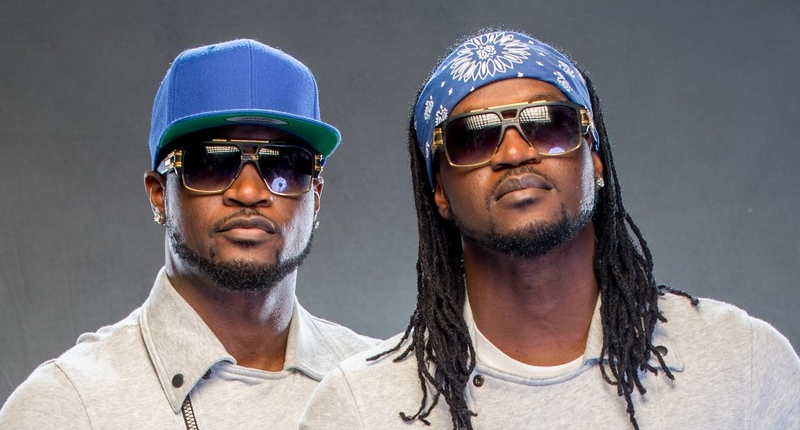
P-Square
P‑Square is one of Nigeria’s most iconic music brands renowned for their electrifying performances, chart-topping hits and unmatched influence on African pop culture. Comprising identical twin brothers, Peter and Paul Okoye, P‑Square rose from humble beginnings in Jos, Nigeria to dominate the music scene with their unique blend of Afrobeat, R&B and pop.
Over the years, they released multiple successful albums, won prestigious awards and inspired a generation of African artists with their catchy songs, intricate dance routines and innovative music videos.
From their debut album “Last Nite” to the blockbuster “Double Trouble”, P‑Square consistently set high standards for musical excellence and showmanship. Yet, behind the glitz and glamour, the duo faced personal and professional challenges that eventually led to a public split, with Peter and Paul now pursuing solo careers as Mr. P and Rudeboy, respectively.
Despite these changes, the legacy of P‑Square remains indelible as it continues to shape the sound and style of modern African music.
In this article, we take a deep dive into the life and career of P‑Square, from their origins and rise to fame, albums and awards, to their solo ventures, providing a warm, engaging and fact-checked look at one of Africa’s most influential music acts.
Origin and Background of P-Square
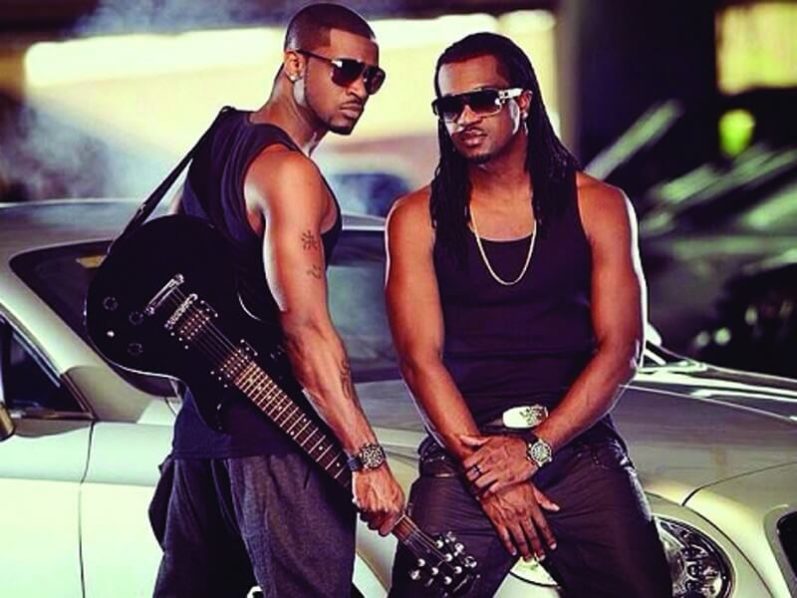
P-Square’s early days
P‑Square comprises identical twin brothers, Peter and Paul Okoye who were born on 18 November 1981 in Jos, Plateau State, Nigeria. They hail from Ifitedunu in Anambra State, Nigeria, a region that deeply roots their identity and heritage as Igbo.
Their parents, Mr. Moses Okoye and Mrs. Josephine Okoye raised the twins along with their siblings – Jude, Mary, Tony, Lilian and Ifeanyi in a devout Catholic household. This upbringing shaped their values, discipline and early exposure to performance.
Peter and Paul attended St. Murumba Secondary School in Jos where their passion for performing arts got the first spark. While in school, they joined the music and drama club, singing, dancing and mimicking acts by icons such as Michael Jackson, Bobby Brown and MC Hammer.
In 1997, they founded a dance crew called the Smooth Criminals, after initially forming an acappella group, MMMPP, which later became “MMPP” with friends. This marked the beginning of their professional performance journey, combining choreography, vocals and showmanship.
By 1999, Peter and Paul had developed their musical skills beyond vocals. They learned to play keyboard, drums, bass and rhythm guitar. Their early work even included composing soundtracks for Nigerian films like Tobi, Mama Sunday, Moment of Bitterness and Eva’s River.
Despite parental hopes for them to follow academic paths, the twins remained committed to music. In 1999, they enrolled at the University of Abuja to study Business Administration, blending their artistic passion with formal education.
Their hard work began to pay off when they won the Grab Da Mic talent competition in 2001. The victory earned them sponsorship from Benson & Hedges which helped to facilitate the production of their debut album, “Last Nite”.
Career Journey: The Rise of P‑Square

P SQUARE PERFORMS LIVE at the AFRICA MOVIE ACADEMY AWARDS (AMAA) 2022
P‑Square didn’t become African music superstars overnight. Their rise was built on grit, relentless performance and a sharp musical vision that helped them transform from local dancers into one of the most celebrated duos in Nigerian and African pop music.
Early Beginnings and Breakthrough
After refining their performance skills in school drama clubs and dance crews in Jos, Peter and Paul won a talent competition called “Grab da Mic” in 2001. Their victory landed them sponsorship from Benson & Hedges which enabled them to record their debut album, Last Nite released in 2003 under the Timbuk2 label.
The album featured songs like “Señorita” and “Gbedu,” giving early proof of the duo’s potential, though not yet fully breaking them into mainstream fame.
The Game-Changer: Get Squared (2005)
P‑Square’s real breakthrough came in 2005 with their second studio album, Get Squared released under their own imprint, Square Records. This album spawned several major hits such as “Bizzy Body,”“Temptation,”“Say Your Love,” and “Omoge Mi” which dominated airwaves in Nigeria and beyond.
The success of Get Squared marked their transition from promising newcomers to bona fide stars. Their music videos also gained major traction. One of the album’s videos stayed at number one on the MTV Base chart for four straight weeks.
Cementing the Legacy: Game Over (2007)
In 2007, P‑Square released their third album, Game Over which many consider one of their most ambitious works. Unlike a traditional album, Game Over functioned more like a visual album as almost every track came with a music video, bringing their high-energy performance style to the screen.
Musically, the album explored a range of themes – love, regret, betrayal, political criticism and desire. Hits like “Do Me”, featuring Waje, “Ifunanya,” “Roll It,” and “No One Like You” emphasized both their vocal versatility and their dance-driven performance identity. According to some sources, Game Over achieved massive sales, reportedly selling around 8 million copies worldwide.
Continued Success: Danger (2009)
P‑Square kept their momentum going with the release of their fourth studio album, Danger, on September 12, 2009. The album blended Afro-pop and R&B and featured five singles: “I Love You,” “Possibility,” “E No Easy,” “Danger,” and “Gimme Dat.”
On this project, they collaborated with major Nigerian artists such as 2Face Idibia and J Martins, further showing their ability to blend styles and bring in big voices.
Global Recognition and Expansion: The Invasion (2011) and Beyond
By 2011, P‑Square had fully matured as international artists. Their fifth studio album, The Invasion demonstrated their growing ambition and reach. The album’s success consolidated their place, not just in Nigeria, but across Africa and on international stages.
During this period, they also expanded their business model. Reports note that they signed a distribution deal with Universal Music (South Africa) while maintaining control via their own Square Records.
Later Work: Double Trouble (2014)
In 2014, P‑Square released Double Trouble, arguably one of their most high-profile albums. The album featured collaborations with global stars such as Akon, T.I., Awilo Longomba, Jermaine Jackson and others. Tracks like “Alingo,” “Personally,” “Shekini,” “Testimony,” “Bring It On,” and “Ejeajo” became major hits, showcasing P‑Square’s maturity, versatility and ability to fuse African and international sounds.
The Performance Advantage
One of P‑Square’s biggest strengths during their rise was their live performances. Their dance-heavy shows, tight choreography and polished stage presence set them apart from many contemporaries. Their background in dance, from their days in the “Smooth Criminals” crew helped them craft shows that were just as visual as they were musical.
Building The P-Square Brand and Legacy
Through these years of momentum, Peter and Paul didn’t just rely on external labels. They ran Square Records which gave them control over their music production and helped cement their brand in the industry. Their self-sufficiency and business acumen were key to their long-term sustainability.
P‑Square’s rise was not about catchy melodies and dance moves alone. It was about vision; building their own record label, understanding the power of visuals and always pushing for international relevance. From Last Nite to Double Trouble, they carved out a legacy as innovators in African popular music.
Awards and Recognition for P-Square
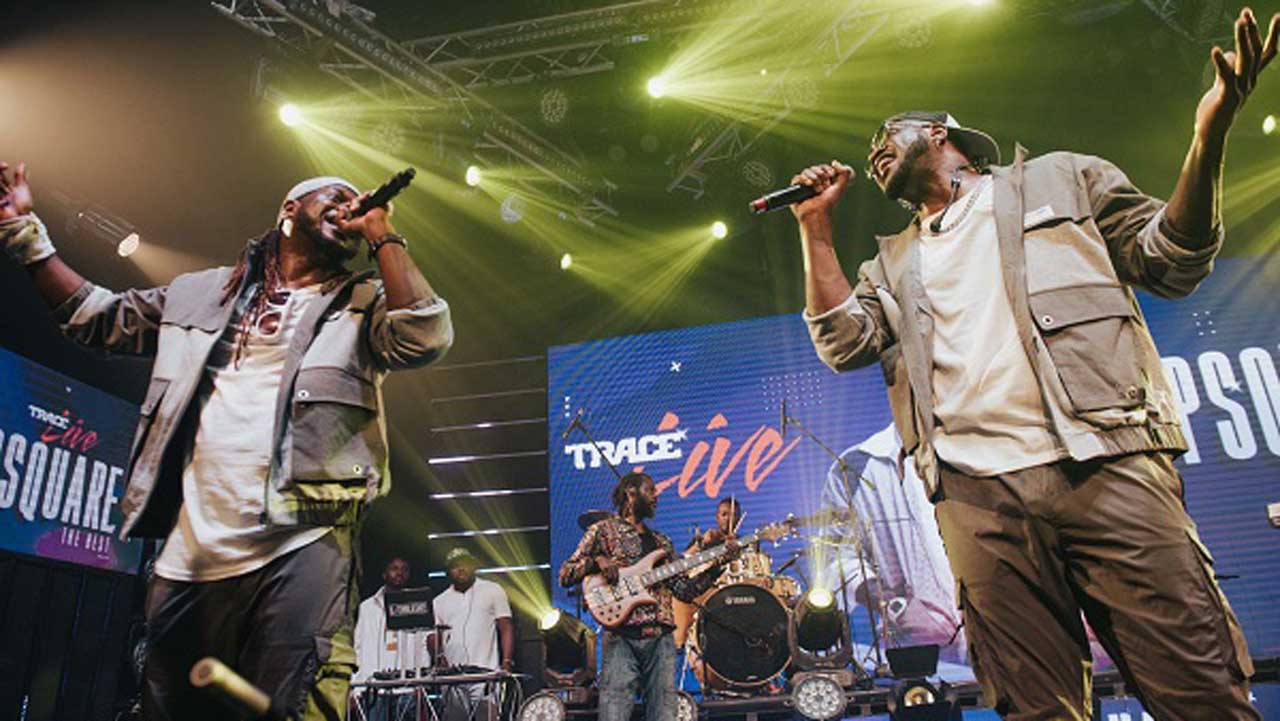
P-square lights up Trace Live concert
P‑Square earned widespread acclaim throughout their career, winning numerous local and international awards that cemented their legacy in African music. Their accolades reflect both their musical talent and their influence as a top-performing duo.
Major Awards Won by P‑Square
KORA All‑Africa Music Awards
In 2010, P‑Square won the Artiste of the Year award at the KORA Awards, one of Africa’s most prestigious music ceremonies. Earlier, they had been nominated for “Most Promising African Group” in 2003.
MTV Africa Music Awards (MAMA)
P-Square won Best Group back-to-back at the MTV Africa Music Awards in 2008 and 2009. In 2015, P‑Square was honoured with the Artist of the Decade award, underlining their long-term impact on African music.
Channel O Music Video Awards
In 2007, P‑Square won Best Duo or Group. In 2008, they again won Best Duo or Group for their music video work. Their hit video “Do Me” won Video of the Year at the 2008 Channel O Awards.
In 2012, they won Most Gifted Group of the Year for their video “Chop My Money”, feat. May D & Akon. In 2013, their single “Alingo” won Most Gifted African (West) Video.
The Headies (formerly Hip Hop World Awards)
In 2006, for their Get Squared album, P‑Square won Album of the Year, Best R&B/Pop Album, and Best Music Video. In the same year, their song “Bizzy Body” won Song of the Year, and P‑Square themselves won Artiste of the Year at The Headies.
City Mag Awards
At the City Mag 9th Awards Show, P‑Square took home Best Hip Hop Group in 2006.
Nigerian Music Awards (NMA)
In 2006, Get Squared by P-Square won Album of the Year. Get Squared also won Music Video of the Year at the NMA.
Lil Perry Productions
In 2010, P‑Square was awarded Producer of the Year by Lil Perry Productions.
Other Recognitions and Nominations for P-Square
MOBO Awards: P‑Square was nominated multiple times (e.g., for Best African Act), though they did not secure a MOBO win.
BET Awards: P-Square was nominated for Best International Act at the BET Awards in 2010.
MTV Europe Music Awards: P-Square earned nominations in categories such as Best African Act (2006, 2013) and Artist of the Decade (2015).
Soul Train Music Awards: P-Square’s song “Personally” was nominated for Best International Performance in 2013.
These awards reflect how P‑Square bridged local and international recognition. They were not just successful in Nigeria, they made an impression across Africa and beyond. Winning the KORA Artiste of the Year in 2010 was particularly meaningful as the KORA Awards are widely respected and seen as a pan-African benchmark of success.
Their repeated wins at the Channel O Music Video Awards highlighted their strength in visual performance and music videos, showing that they were not only great singers but also savvy performers, and the Artist of the Decade award from MTV Africa in 2015 underscored their longevity and lasting impact on African music culture.
The Rift and First Breakup of P-Square
Despite their meteoric rise and status as one of Africa’s most successful music acts, P‑Square also faced deep internal challenges that eventually caused a painful split.
The Roots of the Rift
According to Rudeboy (Paul Okoye), the first major breakup was not driven by creative differences or music but by family issues. He explained in an interview with Joey Akan that it was a family issue that had nothing to do with music. P‑Square just became the sacrifice.
He said that he stayed silent during the fallout, even when fans expressed anger because he understood the nature of the problem. In more than one interview, Rudeboy reiterated that much of the tension came from their home life and the management dynamics within their family.
More Than Just Family: Spiritual Dimensions
For Rudeboy, the issues weren’t only familial. At a later event, he attributed some of the deep-rooted conflict to spiritual forces, even saying that it was the devil that stoked the divisions between him and Peter. While that may be a more symbolic way of speaking to spiritual battle, it underlines how intensely personal the rift was.
Financial, Creative and Management Friction
Beyond family and spiritual causes, some reports suggest there were professional tensions too. According to come reports, Peter (Mr. P) was unhappy about how songs were selected for P‑Square albums and how decisions were made within their shared venture.
There was also a legal dimension to the rift. Peter is said to have relocated with his family and, at one point, hired a lawyer to help split joint assets.
There are also suggestions of a fallout over the role of their elder brother Jude Okoye who acted as their manager.
The Breakup
As tensions escalated, Peter Okoye reportedly paused activities under the P‑Square brand. The disagreements intensified to the point where legal representation became necessary to divide their shared business interests.
Over time, the fracture was no longer just a private matter. It became public. The split left fans shocked and disappointed, especially as P‑Square had been largely viewed as the inseparable twins making music together.
Solo Careers as Rudeboy and Mr P
After their split, both members of P‑Square, Paul and Peter Okoye embarked on solo journeys, rebranding themselves as Rudeboy and Mr P, respectively. Each built a distinct identity and musical style while drawing on the legacy they built together.
Rudeboy (Paul Okoye)
Shortly after P‑Square’s first disbandment, Paul Okoye adopted the stage name Rudeboy. In 2017, he released his first solo singles, “Fire Fire” and “Nkenji Keke.” He founded his own record label, Fire Department Inc. in 2019.
One of his signature songs as a solo artist is “Reason with Me” released in 2019. Its music video became one of the most-watched African music videos on YouTube, cementing his stature as a solo star.
Rudeboy’s first full-length solo album, Rudykillus dropped on 5 August 2021. The album has 12 tracks, and although it features no guest artistes, it showcases his range from Afrobeats to reggae and highlife. On Rudykillus, Rudeboy blends social commentary, love and personal reflection. Songs like Audio Money address societal pressures while others like Fall in Love and Ayoyo highlight his melodic strengths.
He played a strong role in producing Rudykillus, serving as executive producer under his Fire Department label and collaborating with producers like Chrisstringz, Sele B, Orbeat and Lord Sky.
As Rudeboy, Paul Okoye has successfully translated his P‑Square fame into a solo career. His independence, entrepreneurial mindset and consistent output have made him a respected figure in the African music scene.
Mr P (Peter Okoye)
Peter Okoye, on the other hand reintroduced himself as Mr P after P‑Square’s split, and on 2 April 2021, he released his first solo studio album, The Prodigal via his label PClassic Records. The Prodigal is a 16-track project that fuses Afro-pop, R&B, dancehall and Afrobeats. It features heavyweight collaborators such as Wande Coal (“Follow My Lead”), Tiwa Savage (“I Do”), Teni, Simi and even American R&B star Tamar Braxton (“I Love You”).
The single “Follow My Lead”, featuring Wande Coal and released in late 2020 set the tone for the album, emphasizing Mr P’s philosophy of trusting his instincts and forging his own path.
Beyond music, Mr P is also a businessman. He launched PClassic Label under which he continues to grow his brand and sign talent. Mr P has also ventured into acting. He played the role of Arinze in the Nollywood movie “Lionheart”, directed by Genevieve Nnaji.
In 2021, he received an honourary doctorate from ESCAE University in Benin Republic, recognizing his achievements in music and entertainment.
As Mr P, Peter Okoye presents himself as a mature artist who balances his rich performance history with refined vocals, meaningful collaborations and personal storytelling.
How Their Solo Paths Reflect Their P‑Square Legacy
Both Rudeboy and Mr P retain elements of the music style that made P‑Square famous, namely, tight choreography, catchy hooks and polished production. But their solo work also shows growth. Rudeboy explores more solo vulnerability while Mr P leans into collaborations and diversified sounds.
Each brother launched his own label (Fire Department Inc for Rudeboy; PClassic for Mr P), giving them creative freedom and business independence.
By and large, their solo success has helped to sustain and even grow the legacy of P‑Square, reminding fans that the Okoye brothers are lasting artists with distinct voices.
Reunion and Second Split of P-Square
After years of estrangement, P‑Square reunited in November 2021, sparking hope among fans that the iconic duo of was back for good. Their public reconciliation was heartfelt. In a viral video shared online, the brothers embraced warmly in the presence of family, including their older brother and former manager, Jude Okoye.
P-Square returned to the music scene with new singles like “Jaiye (Ihe Geme)” and “Find Somebody”, thereby reigniting excitement among long-time fans. Their reunion also carried big ambitions. They announced a 100-city world tour and teased a forthcoming album, and for a while, it seemed like P‑Square was forging a new, lasting chapter.
Why the Reunion Was Meant to Be Different
Rudeboy later revealed that he was very intentional about restructuring P‑Square’s creative process during the comeback. He pushed for a more balanced partnership, suggesting that, if they recorded ten songs, five should come from him and five from Mr P. He said that he didn’t want their past mistakes to repeat themselves. He wanted to preserve the signature P‑Square touch while giving Peter more agency.
The Second Split of P-Square
Despite the optimism, the reunion began to unravel. However, in August 2024, Rudeboy publicly confirmed that P‑Square no longer existed. According to him, Peter told him that he was no longer interested in being part of the group, even before the split was made public.
Rudeboy also claimed that there was tension around how they shared creative control. According to him, he had asked for equal input on songs to avoid the recurring conflict of the past but it wasn’t working. What deeply hurt was the belief that Peter didn’t fully commit to the new P‑Square in the way Rudeboy hoped.
Deeper Conflict
The second breakup of P-Square exposed more than just creative differences. It sparked serious accusations. Rudeboy alleged that Mr P filed a petition against him and their elder brother, Jude Okoye, with Nigeria’s Economic and Financial Crimes Commission (EFCC). He claimed that he was invited by the EFCC, though he was eventually cleared.
In response, Mr P penned an open letter in August 2024, accusing Rudeboy of demeaning his efforts, disrespecting his talent and sidelining him on the P-Square brand. According to Mr P, Rudeboy’s public comments minimized his role in P‑Square’s success and diminished their joint legacy.
Mr P later said in a radio interview that despite their attempt to reunite, it was not working, and his decision to go solo brought him more joy.
What the Split Means for the Legacy of P‑Square
The second split of P‑Square is a sobering reminder of how even the most beloved musical partnerships can fracture. Their 2021 reunion raised hopes and for a while, things seemed different. But the resurfacing of old wounds, disputes over creative control and public allegations showed just how fragile reconciliation can be.
For Rudeboy, the split of P-Square marked a return to fully focusing on his solo career, and for Mr P, it underscored how his role and contributions were still a source of tension, even after giving the reunion a second chance.
For fans, the P-Square split was both a disappointment and a reality check that legacy acts don’t always stay united, and sometimes, the personal stakes are as high as the public applause.
Legacy and Impact of P-Square
P-Square’s legacy in African music is one that continues to shape the industry long after their transitions into solo careers. As one of the most successful music duos in Nigeria and across the continent, P-Square helped to redefine what Afrobeats, Afro-pop and contemporary Nigerian music could sound like on a global stage. Their unique blend of R&B, dance-pop and African rhythms set a new standard for artists hoping to cross over into international markets.
One of the biggest parts of P-Square’s impact is how they proved that African artists could achieve global success without losing their cultural identity. Their hit songs like “Do Me,” “No One Like You,” “Beautiful Onyinye,” “Personally” and “Chop My Money” travelled far beyond Africa, earning airplay in Europe, the Caribbean and even mainstream American media. P-Square’s collaboration with international artists, most notably, Akon and Rick Ross opened doors for other Afrobeats musicians who later followed the global wave.
P-Square also changed the business of music in Nigeria. At a time when record labels dominated the industry, they showed that artists could independently manage their brand, negotiate international deals and run successful tours across Africa, Europe and North America. Their concerts regularly sold out stadiums and huge arenas, proving the commercial power of Nigerian pop acts long before the global “Afrobeats to the World” movement became popular.
Another major part of their legacy is their influence on younger musicians. Many Nigerian and African artists cite P-Square as inspiration, from their sound and dance-driven videos to their performance style and work ethic. They helped normalize high-budget music videos in Nigeria, raising production standards by consistently delivering top-quality visuals that matched global trends.
P-Square’s story, complete with success, conflicts, reunions and reinvention also taught many lessons about family, business and the pressures that come with fame. Even though they eventually pursued solo careers, their years together shaped modern African pop culture forever.
Today, the influence of P-Square remains visible in the sound, visuals and stagecraft of many Afrobeats artists. Whether together or individually, their contribution to music continues to inspire millions and marks them as one of the most iconic music groups to ever emerge from Africa.
In Conclusion …
The story of P-Square is one of talent, resilience, creativity and undeniable influence. From their humble beginnings in Jos to becoming one of Africa’s most celebrated music duos, the Okoye brothers changed the sound and business of modern Afrobeats. Their journey, filled with chart-topping albums, global tours, award-winning hits and unforgettable performances proved that Nigerian artists could reach world-class heights while still staying true to their roots.
Even with the challenges, disagreements and separate paths they eventually took as Rudeboy and Mr P, their individual successes continue to reflect the strong musical foundation they built together over the years. And while P-Square fans still debate the possibility of a permanent reunion, what remains certain is that P-Square’s legacy is already secure. Their music defined an era, inspired a new generation of African artists and pushed Afrobeats into the global spotlight long before it became a worldwide movement.
In the end, the P-Square story is much bigger than the rise, split or reunion of a music duo. It is a testament to the power of African music, the importance of artistic evolution, and how two brothers helped to shape global pop culture in a way that will be remembered for decades.
References
- https://en.wikipedia.org/wiki/P-Square
- https://en.wikipedia.org/wiki/P-Square_discography
- https://en.wikipedia.org/wiki/Last_Nite_%28P-Square_album%29
- https://en.wikipedia.org/wiki/Game_Over_%28P-Square_album%29
- https://en.wikipedia.org/wiki/Get_Squared
- https://en.wikipedia.org/wiki/Double_Trouble_%28P-Square_album%29
- https://www.vanguardngr.com/2010/04/p-square-is-kora-africa%E2%80%99s-best/
- https://www.opinionnigeria.com/psquares-split-caused-by-family-issues-not-music-rudeboy-opens-up/
- https://en.wikipedia.org/wiki/Mr._P_%28singer%29
- https://allafrica.com/stories/202408050038.html
- https://guardian.ng/saturday-magazine/weekend-beats/i-am-my-own-square-mr-p-declares-as-p-square-ends/
You might want to check this out …