




African Culture and Traditions
OFALA 2025: CELEBRATING AN AGE-LONG ONITSHA HERITAGE

Ofala 2025: Celebrating an Age-long Onitsha Heritage explores the rich cultural significance of the Ofala Festival – a timeless celebration of kingship, unity, and tradition in Onitsha. Discover the history of Onitsha, the origins of the Ofala Festival, and how the 2025 edition showcased the vibrant spirit and enduring legacy of the Igbo people.

It was that time of the year again! The ancient city of Onitsha came alive once again this October as indigenes, dignitaries, and culture enthusiasts gathered to celebrate Ofala 2025, one of Nigeria’s most colourful and enduring royal festivals.
It was that time of the year again. The air was thick with excitement, the streets adorned in regal colours, and the sound of drums echoed through the heart of the kingdom. The Obi of Onitsha, His Majesty Igwe Nnaemeka Alfred Achebe, stepped out in royal splendour to bless his people, marking yet another chapter in a tradition that dates back to centuries.
More than just a cultural event, Ofala is the living heartbeat of Onitsha. A powerful symbol of unity, renewal, and the deep-rooted respect for kingship among the Igbo people. It is a time when history meets modernity, when ancient rituals blend seamlessly with today’s celebrations, and when the entire Onitsha community, both at home and abroad, reconnects with its identity.
In this article, we journey into the story of Ofala 2025, exploring the historical origins, of Ofala, the cultural significance, and how this year’s festival reaffirmed the place of Onitsha as a beacon of tradition, pride, and cultural excellence in Nigeria and beyond
A SHORT HISTORY OF ONITSHA
Perched on the eastern banks of the River Niger, Onitsha stands as one of Nigeria’s oldest and most influential urban centers. A city where history, culture, and commerce beautifully intertwine. The story of Onitsha dates back to the 16th century when its founders, led by Eze Chima, migrated from the Benin Kingdom. According to oral history, they crossed the River Niger and settled on its eastern shores, establishing what would become a thriving Igbo kingdom known for its strong monarchical structure and rich traditions.
Over the centuries, Onitsha grew into a cultural and commercial powerhouse. Its strategic location by the River Niger made it a natural hub for trade, attracting merchants from across Nigeria and beyond. When British explorers and missionaries arrived in the mid-19th century, Onitsha became a key point of contact between Europeans and the interior parts of Igboland. The establishment of the Onitsha Market, now one of the largest open-air markets in West Africa, further cemented its place as a vital economic center.
But beyond commerce, Onitsha is a city deeply rooted in tradition. The people’s identity revolves around respect for the Obi i.e. the traditional monarch who serves not only as a ruler but also as the custodian of culture, values, and spiritual heritage. This respect finds its greatest expression in the Ofala Festival, an annual celebration that reflects the city’s resilience, unity, and continuity through generations.
Today, Onitsha is not just a city of trade but a living archive of Igbo civilization A place where the past and present blend harmoniously, and where cultural pride remains as vibrant as the waters of the Niger that cradle it.
ORIGIN AND MEANING OF OFALA

The Ofala festival is the royal festival of the Onitsha kingdom and related Igbo communities. Linguistically, “Ofala” is commonly explained as combining two Igbo words: ọfọ (a symbol of authority, justice and ancestral affirmation) and ala (land).
In practice, Ofala celebrates the Obi i.e. the traditional ruler and functions as a ritual of renewal. The monarch reappears to bless his people after a period of seclusion and spiritual preparation. Scholars and cultural custodians trace the origin of Ofala to the time when Onitsha royal institution was established, with some accounts linking the custom to practices carried from Benin and adapted locally.
Over time, the festival evolved into both a sacred rite and a large public celebration that reaffirms community identity.
THE CULTURAL AND CIVIC SIGNIFICANCE OF OFALA
Ofala is more than spectacle. It’s a living archive of the values and political system of Onitsha. At the simplest level, the festival reaffirms the Obi’s role as spiritual and cultural head of the people; serves as a public ritual of renewal. The Obi’s reappearance signals continuity and protection for the year ahead; brings the community together. Age-grade groups, women’s societies, red-cap chiefs (ndichie), musicians and dancers all take part.
Ofala also provides room for public recognition. It is a time to confer chieftaincy titles, honour citizens and display local arts and crafts. It strengthens identity and tourism as it attracts local and international visitors, promotes cultural pride and economic activity.
These functions make Ofala both a sacred rite and a civic festival. It blesses the community spiritually while showcasing living cultural heritage of the people.
OFALA 2025: THE THEME, DATES AND HEADLINE FACTS
Ofala 2025 festival in Onitsha was officially packaged under the theme “Njikọta na Ntachi”, translated “Unity & Perseverance”. The programme ran across October with two headline days traditionally called Iru Ofala (the monarch’s day of spectacle) and Azu Ofala (the people’s day).
Major activities and the climax of pageantry were scheduled for October 17 and 18, with lead-up events and community carnivals in the days before the grand appearances. The Obi of Onitsha presiding over the festival is His Majesty Igwe (Obi) Nnaemeka Alfred Achebe, a widely respected traditional ruler whose Ofala celebrations in recent years have drawn government officials, cultural institutions and national media attention.
WHAT ACTUALLY HAPPENS AT OFALA
Ofala festival follows a carefully structured ceremonial rhythm that mixes solemn rites with jubilant celebration. While local practices may vary slightly from one edition to another, the core sequence usually includes:
- Seclusion and spiritual preparation: In the days before Iru Ofala, the Obi traditionally withdraws from public life for spiritual cleansing and reflection. This seclusion is a ritual preparation believed to secure the monarch’s spiritual strength and the welfare of the kingdom. Ofala 2025 again observed this age-long practice.
- Ufie (royal gong) drumming and twenty-one gun salute: The festival often begins with royal gongs and a formal salute that announce the celebration to the community.
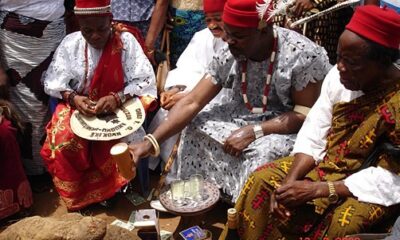
- Processions and the entry of the Ndichie (red-cap chiefs): Dressed in their rank-marked regalia, the ndichie lead organized processions, performing formal homage to the Obi. They bring with them the rituals, songs and symbolic objects that narrate the community’s history.
- Iru Ofala (the Obi’s emergence): The Obi appears in full regalia of ornate robe, coral beads, ceremonial fan and often a sword, and processes into the public arena. Cannon shots or gun salutes mark his arrivals and dances. During Iru Ofala, the Obi may step forward, wave, dance and bless the crowd. This is the ritual’s apex. The monarch’s public presence affirms continuity and protection.
- Homage and title ceremonies: After the Obi’s appearances, chiefs, friends and community members pay homage. Distinguished citizens might receive chieftaincy titles or other honours, and visiting chiefs present tributes.
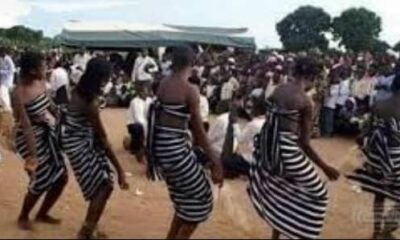
Azu Ofala (the people’s day): Azu Ofala is more participatory. Age-grade societies, masquerades, dancers and cultural troupes parade perform, and display the colours and rhythms of Onitsha’s culture. Markets, art shows and food stalls often accompany the public festival, making it both cultural and economic.
THE OFALA PAGEANTRY

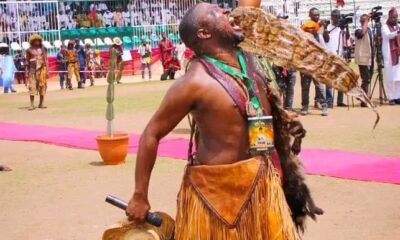
Ofala is famous for the visual spectacle of high-feathered hats, coral beads and richly embroidered gowns. Certain symbolic items matter repeatedly:
- The Obi’s crown and regalia: The monarch’s hat (or ceremonial headdress), robe and coral beads signal status. The Obi also carries a ceremonial fan or staff used during dances.
- Ndichie regalia: Red-cap chiefs wear robes and regalia that indicate rank; their processions are choreographed to traditional music.
- Music and dance: Royal drums, flutes and the Ufie gong set a rhythm for processions. Traditional dances narrate local histories and spiritual themes.
- Masquerades and age-grade displays: These groups add theatricality: masquerades can embody ancestors or spirits, while age grades show social cohesion through synchronized steps and costumes.
These visual and musical elements are not mere decoration. They are communicative acts that broadcast history, rank and community bonds, and Ofala 2025 showcased all of that.
OFALA 2025 AS A MODERN CULTURAL FESTIVAL
In recent decades, Ofala has grown beyond a purely local ritual. Organizers now work with corporate sponsors, tourism bodies and national media to stage events that meet modern safety, broadcasting and hospitality standards.
Ofala 2025 announced partnerships with major brands and media houses and received endorsement and promotional support from cultural organizations. This strategy expanded the festival’s reach and helped bring investment and visitors to Onitsha.
Such sponsorships reflect a trend across many Nigerian festivals where cultural heritage aligns with tourism and corporate social investment.
VOICES AND MESSAGES AT OFALA 2025
Because Ofala gathers traditional authority, political leaders and civil society in one public setting, it often becomes a platform for civic messages.
At Ofala 2025, the Obi used his address to highlight contemporary concerns. From economic hardship and insecurity to calls for unity and perseverance, he reminded leaders and citizens of their duties to the community.
This spiritual and civic role is an old one. Traditionally, the monarch not only blesses but also advises, rebukes and advocates for the people.
Modern Ofala ceremonies, therefore, often combine culture with constructive political commentary.
THE ARTS, THE CULTURE AND THE SMALL BUSINESS BOOST
Ofala is also an economic engine. The festival draws artisans and traders who sell clothing, beadwork, food and crafts. Cultural exhibitions and art shows staged alongside Ofala showcase local artists and preserve visual traditions.
For the hospitality and market economy of Onitsha, the influx of visitors during Ofala translates into revenue for hotels, transporters, caterers and market women.
In a country where cultural tourism is an under-leveraged asset, Ofala offers a working model of how tradition and commerce can benefit local livelihoods.
OFALA AND PRESERVING HERITAGE

Cultural custodians and festival organizers increasingly see Ofala as part of Nigeria’s intangible heritage worthy of protection and wider recognition.
In public statements and media features ahead of Ofala 2025, elders and organizers expressed hope that the festival would attract national and international recognition, possibly through heritage registers or UNESCO channels.
Such recognition could bring resources for preservation, documentation and sustainable tourism. It can also bring questions about how to balance ritual authenticity with tourist demands.
CHALLENGES AND CONTEMPORARY CONCERNS
Like many traditional institutions, Ofala faces modern pressures. While Ofala 2025 was a grand success that showcased Onitsha’s rich heritage and royal splendor, it also drew attention to some of the challenges facing traditional festivals in today’s fast-changing world.
From modernization and urban pressures to waning youth participation and cultural dilution, the festival now stands at a crossroads of balancing the need to preserve its sacred traditions with the realities of contemporary life.
Here are the emerging concerns and the ongoing efforts to keep Ofala relevant, authentic, and impactful in the modern era:
- Commercialization vs authenticity: As sponsors and media cover the festival, there is a risk that ritual meanings become overshadowed by spectacle. Organizers must keep sacred rites intact while accommodating larger public audiences.
- Security and logistics: Large crowds require planning for safety, traffic, and public health, especially in a tight urban environment like Onitsha.
- Youth engagement: Preserving Ofala depends on teaching younger generations the stories, dances and meanings behind the pageant so the festival remains alive and meaningful.
- Political neutrality: The festival’s civic platform can be used for political statements. Custodians typically aim to keep the occasion dignified and serve the community’s long-term interests.
Addressing these challenges is part of ensuring that Ofala remains both relevant and respectful to its roots.
MEMORABLE HIGHLIGHTS FROM OFALA 2025
Ofala 2025 combined tradition with new initiatives. Highlights included:
- Street carnival and youth parades that energized the city in the lead-up to the royal days.
- Cultural exhibitions and art showcases that displayed Onitsha’s visual heritage and contemporary creativity.
- Public addresses by the Obi emphasizing unity, perseverance and calls for political leaders to prioritize citizens’ welfare.
- Corporate partnerships and media coverage that widened the festival’s audience and supported logistics.
These aspects show how Ofala 2025 honoured the rituals while engaging a 21st-century audience.
IN CLOSING…
Ofala as a living heritage
As the drums quieten and the colours of Ofala 2025 fade into memory, what lingers in the hearts of many is not just the grandeur of the celebration, but the deeper meaning it carries for the people of Onitsha and Nigeria at large. The Ofala Festival remains more than a royal ceremony. It is a living testament to the resilience, unity, and spiritual strength of a people who have held on to their roots despite the tides of time.
Through the centuries, Ofala has evolved from a purely traditional rite into a cultural phenomenon that bridges generations, attracts global attention, and reinforces the essence of community. Ofala 2025 once again reminded the world that culture, when preserved and celebrated, becomes a powerful force for identity and continuity.
Yet, as Onitsha steps into the future, the responsibility of sustaining this priceless heritage rests on both the custodians of tradition and the younger generation. For Ofala to thrive, it must continue to blend reverence with renewal, keeping its spiritual depth alive while embracing creative expressions that appeal to today’s audience.
Ultimately, more than a festival, Ofala 2025 is a renewal of pride, a call to unity, and a celebration of the enduring spirit of Onitsha. It reaffirms the timeless truth that culture is not a relic of the past, but a living rhythm that beats in every generation willing to honour its roots and carry its light forward.
REFERENCES
- https://en.wikipedia.org/wiki/Onitsha
- https://en.wikipedia.org/wiki/Ofala_Festival
- https://guardian.ng/features/culture/onitsha-set-to-host-2025-ofala-festival/
- https://nico.gov.ng/onitsha-ofala-festival/
- https://tourafricamag.com/ofala-festival/
You might want to check this out…