

African Culture and Traditions
OGBANJE IN IGBO TRADITION: WHAT IT WAS THEN AND HOW IT IS TODAY

In the heart of Igbo tradition lies one of the most mysterious and emotionally charged beliefs. The story of the Ogbanje. To the Igbo, the Ogbanje is not just a myth. It is a spirit-child believed to move between the world of the living and the spirit realm, bringing untold sorrow to families through repeated births and untimely deaths. Long before modern medicine could explain childhood illnesses or hereditary conditions, the Ogbanje provided a spiritual answer to the painful mystery as to why some children never stayed long enough to grow.
More than just a superstition, the Ogbanje phenomenon reveals how deeply the Igbo understood the relationship between life, death, and the unseen world. It shaped family rituals, inspired countless stories, and even found its way into literature and modern identity. Today, scholars, health experts, and writers revisit this powerful concept to understand what it tells us about culture, grief, and the human search for meaning.

THE HISTORICAL AND CULTURAL ROOTS
The idea of spirit-children is not unique to Igbo people. West African cultures have related beliefs. Example, the Yoruba abiku. But within Igbo cosmology, often referred to as Odinani, ogbanje occupies a particular place. Traditional stories and oral history describe ogbanje as beings that deliberately torment a mother by entering her womb, being born, dying young, and then, returning several times.
Ogbanje children are often believed to have special spiritual powers that enables them fly in the dream, predict the future, and change in their behaviour. They tend to be wiser than their age. Every Ọgbanje is believed to come from a spiritual family lineage tied to ancestral spirits like Agwu, Ana, Udu, Ngene, Ngu, Oji, Ogwugwu, Ndi mmiri, Akwaraomumu and Ndiichie.
This phenomenon was, and is explained through local spiritual practices, diviners, and remedies intended to break the cycle. The classic Yoruba-Igbo comparison of the concept has produced long academic interest, because similar family patterns of infant death appear in different cultures and got similar spirit-based explanations before modern medicine supplied biological explanations. Scholars who studied folklore and religious practice have traced these beliefs in both oral history and written records.
HOW AN OGBANJE IS RECOGNIZED
Traditional Igbo communities listed certain signs or patterns that made people suspect that a child is an ogbanje:
- A child who enjoyed being sickly, then dying young, while other family members view that as a pattern.
- Repeated infant deaths in one family, sometimes with similar timing or circumstances.
- A child who behaves oddly, is stubborn, unusually obstinate, or shows strange temper tantrums.
- In some stories, children who remember previous lives, or talk about places or objects they could not have known about.
- Physical tokens – the belief that the ogbanje bury an object called an iyi-uwa (Iyi-uwa is something like a charm or stone which links the spirit to the world. If the iyi-uwa is discovered and destroyed, the cycle of dying and being reborn might stop.
Chinua Achebe’s Things Fall Apart gives a vivid account of ogbanje. In the novel, Ekwefi’s repeated losses of children, the suspicion that the child Ezinma is an ogbanje, and the medicine-man digging up Ezinma’s iyi-uwa are classic examples that show how the idea works in community imagination. Achebe’s story helped bring the concept to global readers and preserves how people spoke about and treated suspected ogbanje in earlier times.
RITUALS AND SOCIAL RESPONSES
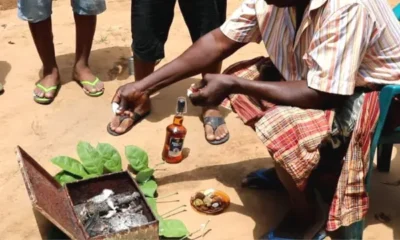
When a child was suspected to be an ogbanje, families often sought help from a dibia i.e. traditional healer or diviner. The dibia might perform divination to discover whether an ogbanje spirit was at work and to locate the iyi-uwa, if present. The methods included:
- Searching for and digging up the iyi-uwa. The discovery was taken as proof and its destruction as a way to break the spirit’s hold.
- Naming rituals and special birth names. Some names were meant to plead with death or to protect the child. For example, a name like “Ozoemena”, meaning “may this not happen again”.
- Protective charms, sacrifices, or other ritual observances to keep the spirit away or to placate it.
These practices were social as well as spiritual. The whole community could become involved in diagnosing and responding to persistent infant deaths, and the rituals often gave families a sense of agency and meaning during grief.
MEDICAL, PSYCHOLOGICAL AND ANTHROPOLOGICAL REINTERPRETATIONS OF THE OGBANJE PHENOMENON
As medical knowledge spread, scholars and clinicians began to interpret ogbanje stories in the light of identifiable medical and genetic causes. Some of the most common re-interpretations given to it include:
Sickle cell disease and other inheritable illnesses. Some researchers argue that families who lose several children to the same genetic condition might conclude that the same child keeps returning, when in fact the family is experiencing a hereditary cause. This idea has been discussed in academic journals, noting a probable link between repeated infant mortality patterns and conditions like sickle cell or other childhood disorders.
Sudden Infant Death Syndrome (SIDS), infectious diseases, malnutrition or poor access to healthcare that historically caused high infant mortality. Where infant death was not well understood biologically, spiritual explanations like ogbanje filled the explanatory gap.
Psychological and social meanings. Anthropologists show that ogbanje beliefs can be a cultural way to make sense of recurrent loss, to channel grief into action by searching for iyi-uwa and performing rituals, and to manage the social consequences of repeated infant death, for example, justifying infertility treatments, adoption, or changes in childcare. Modern social science cautions against simply demystifying such beliefs. Instead, scholars study how they function in family life and how they interact with medicine and gender dynamics.
It is important to stress that these reinterpretations do not prove the spiritual claim false for believers, rather, they offer parallel explanations that help public health workers and clinicians respond sensitively to patients and families who hold these kinds of traditional beliefs.

OGBANJE IN LITERATURE AND MODERN CULTURE
Ogbanje has been a fertile subject for African writers and global literature.
In Chinua Achebe’s Things Fall Apart, the tale of Ezinma and Ekwefi is the most famous literary depiction of an ogbanje. It shows the emotional cost to mothers and the communal steps taken to break the cycle. Achebe’s portrayal made the term widely known beyond Nigeria and is often the entry point for readers learning about ogbanje.
In Akwaeke Emezi’s Freshwater which is more recent, the novelist, Akwaeke Emezi has explicitly invoked the ogbanje identity to tell stories about multiplicity, identity, and mental health. Emezi’s work complicates the idea as it presents ogbanje as a way of understanding being multiple, spiritual experiences, and non-binary identity. Thus, showing how the concept can be reclaimed in new artistic and personal narratives. Major book reviews and profiles, e.g. in The New Yorker, discuss this modern literary use.
Academic and creative reinterpretations. Scholars and artists continue to analyze ogbanje in relation to gender, colonial history, and modern mental health frameworks. Research articles explore whether the ogbanje label has been used historically to police female behaviour, or to explain illness in ways consistent with social structure and patriarchy, and others look at how contemporary writers rework the concept.
SOCIAL EFFECTS OF OGBANJE
The belief in the ogbanje phenomenon is not without social consequences
Multiple infant deaths often hit them, emotionally and socially. In some contexts, mothers are blamed or suspected, if a child dies repeatedly. At the same time, ritual practices like digging up the iyi-uwa and naming ceremonies which are centered on mothers also emphasize the mother’s central role and can validate her grief.
Labeling a child or family as affected by an ogbanje can attract community attention both for support (ritual help, sympathy) and stigmatization (gossip, fear). Scholars point out that the label sometimes shields families from blame by placing the problem in the realm of spirits rather than human fault. At other times, it increases isolation.
Some scholars argue that the ogbanje concept intersects with gendered power. How male elders, diviners, and in-laws interpret infant deaths can shape women’s social standing. Anthropological work explores these power relations and how belief in ogbanje is embedded in broader social systems.

CONTEMPORARY BELIEFS AND PRACTICE
Belief in ogbanje is not as universal as it once was, especially in urban areas and among people with access to modern healthcare or formal education. Nevertheless, the concept persists in many communities and in popular culture. Radio programmes, local newspapers, and online platforms in Igbo language, sometimes, discuss ogbanje. For instance, BBC Igbo has run conversations and interviews about the concept, showing that it remains part of public discourse, even today. At the same time, modern reinterpretations as in literature and scientific awareness have changed how people approach or talk about it.
HOW MODERN HEALTH WORKERS AND NGOS APPROACH THE OGBANJE BELIEFS
Public health programs working in regions with traditional beliefs often take this culturally sensitive approach:
- Respect and dialogue: Health workers are encouraged to listen and respect local beliefs, while providing clear medical explanations and options. This preserves trust and increases the chance families will accept medical help.
- Education: Where genetic conditions like sickle cell may explain repeated childhood illness and death, education about diagnostics, vaccination, nutrition, and genetic counselling helps families take preventative steps.
- Collaborations with traditional healers: In some programmes, cooperation with trusted community figures, including diviners and elders helps to bridge the gap between biomedical services and cultural practice. This collaborative approach can improve uptake of services without directly confronting or dismissing beliefs.
PUTTING OGBANJE INTO A MODERN FRAME: PLURAL MEANINGS OF OGBANJE
Today the word ogbanje carries more than one meaning depending on who uses it. For traditional elders and some rural communities, it may still be a literal spirit explanation for repeated child deaths. For scholars and public-health workers, it is a cultural label that can point to underlying medical or social causes.
And for writers and artists, ogbanje has become a powerful metaphor for multiplicity, identity, trauma, and the persistence of the past in the present.
This plurality shows how traditional ideas adapt rather than vanish: they can be medicalized, reclaimed, criticized, or celebrated in new ways.
PRACTICAL TIPS
Per adventure, you or someone you know is dealing with repeated child illness or infant death in a community where ogbanje is a known idea, the following steps may help:
- Seek medical evaluation early. Many childhood illnesses can be treated or managed effectively through vaccination, nutrition, sickle-cell management, or infection control, if diagnosed.
- Respect beliefs while offering help. If a family hold traditional beliefs, listen and offer medical care in a non-judgmental way. Blunt denial of beliefs often blocks access to help.
- Explore genetic counselling, if patterns repeat. For hereditary conditions e.g., sickle cell, counselling and testing can help families understand risks and plan for care.
- Use community leaders. Work with trusted community figures to communicate health information. They can help reconcile medical advice with cultural practices.
- Provide psychological support. Repeated loss is traumatic. Grief counselling and social support can be essential.
Combining culturally aware practice with modern medicine gives families the best chance for healthy outcomes.
IN CONCLUSION
Ogbanje in Igbo tradition is more than an old superstition. It’s a cultural lens that helped people make sense of suffering, and it remains socially meaningful. Understanding ogbanje gives us insight into how cultures explain disease, how grief is managed, and how identity and storytelling shape social life.
When medicine and tradition meet, the best outcomes come from mutual respect. Medical knowledge can reduce infant mortality and genetic illness. Cultural knowledge can help families grieve and find meaning.
Scholars, health workers, and writers continue to study and reinterpret ogbanje, proving that traditional ideas can adapt and keep showing us new truths about human life.
REFERENCES
https://en.wikipedia.org/wiki/Ogbanje
https://med.virginia.edu/perceptual-studies/wp-content/uploads/sites/360/2016/12/STE20.pdf
https://www.sciencedirect.com/science/article/abs/pii/S0277953600002458
https://acjol.org/index.php/aku/article/view/3403
https://www.cliffsnotes.com/literature/t/things-fall-apart/summary-and-analysis/part-1-chapter-9
Also check out…