






Cultural Heritage
Omabe Festival: The Enugu Ezike Masquerade Experience

Discover the cultural ritual of Omabe festival, a five‑yearly masquerade celebration in Enugu‑Ezike, Enugu State, Nigeria. Learn about its meaning, history, rituals, cultural significance, rules, and its relevance in today’s world.

Omabe Festival || The Enugu-Ezike Masquerade Experience
Omabe festival is one of the most captivating cultural celebrations in Enugu‑Ezike, Enugu State, Nigeria. This unique masquerade festival brings together ancestral tradition, spiritual rituals and vibrant performances that have been preserved for generations.
Celebrated mainly in the Imufu community, Omabe festival is not just a spectacle of colourful masquerades and lively dances; it is a sacred event that unites the community, honours ancestors and reinforces cultural identity.
For anyone interested in Nigerian heritage, African masquerade traditions, or the spiritual and social life of Igbo people, Omabe festival offers a fascinating glimpse into a tradition that continues to thrive, even in modern times.
Meaning of Omabe Festival
Omabe festival is more than a community event. It is a deeply symbolic and sacred celebration for the people of Imufu autonomous community in Enugu Ezike, in the Igboeze North Local Government Area of Enugu State, Nigeria.
At its heart, the term “Omabe” designates a spirit‑masquerade figure that is believed to serve as an intermediary between the living and the ancestral or spirit world. During the festival, the appearance of the Omabe masquerade signals a moment when that spiritual force walks among the living.
One of the primary meanings of the festival is purification. It is believed that when the masquerades emerge, they cleanse the community by driving out evil influences, both human such as immoral behaviour, and spiritual e.g. hidden threats or misfortune. For instance, one report states that the ritual procession purges the community of evils in human and spiritual forms because it comes with fire that is inimical to evil.
On another level, Omabe festival re‑affirms identity, continuity and connection with ancestors. The masquerades are treated as living embodiments of ancestral power. After the festival, they remain among the people for about a year before returning to the spirit world. This stay symbolizes the ancestors dwelling among the living, protecting and guiding the community.
Moreover, the festival reinforces social cohesion. By establishing a dramatic, communal moment of purification and celebration, Omabe festival brings community members together, those living locally and those returning from afar. The event strengthens collective memory, shared values and a sense of belonging among the people of Enugu Ezike.
In everyday language, Omabe festival is when the community honours its ancestors, cleanses itself of hidden dangers, celebrates its unique culture, and renews the bonds among its people through the appearance of powerful masquerade spirits who walk in the world of the living for a time.
Historical Background of Omabe Festival

Omabe Festival
Omabe Festival has its roots deep in the cultural life of the Enugu‑Ezike community in the Igboeze North Local Government Area of Enugu State, Nigeria. According to one widely cited account, the festival has existed for several centuries among the people of the Imufu autonomous community in the Mba Waawa region.
Oral tradition links the origins of the Omabe masquerade to migratory movements. One version holds that the masquerade spirit‑institution migrated from the Igala region in present‑day Kogi/Benue area into what is now the Nsukka/Enugu zone. The festival is said to have been transmitted through that cultural corridor.
Over time, the Imufu community preserved the Omabe tradition, viewing the masquerades as powerful ancestral or spiritual agents. Historical reports show that by, at least, the mid‑20th century the community regarded Omabe as a sacred institution only for adult male initiates, and as a communal purification ritual.
Although the festival is currently celebrated every five years, historical sources suggest that in earlier times, the intervals may have been longer, and the scheduling was strictly determined by age‑grades, priestly councils and traditional calendar systems.
In recent decades, Omabe Festival has witnessed revival phases. For instance, after a period of interruption, one account notes that the festival returned in full splendour in 2022 following a 25‑year hiatus in some quarters of the region.
Thus, the historical background of Omabe Festival is layered. It draws on ancient belief systems, migratory traditions, communal rituals of purification and local social structures. The festival stands as a rich cultural heritage of the Imufu people and the wider Enugu‑Ezike community.
How and When Omabe Festival Is Celebrated
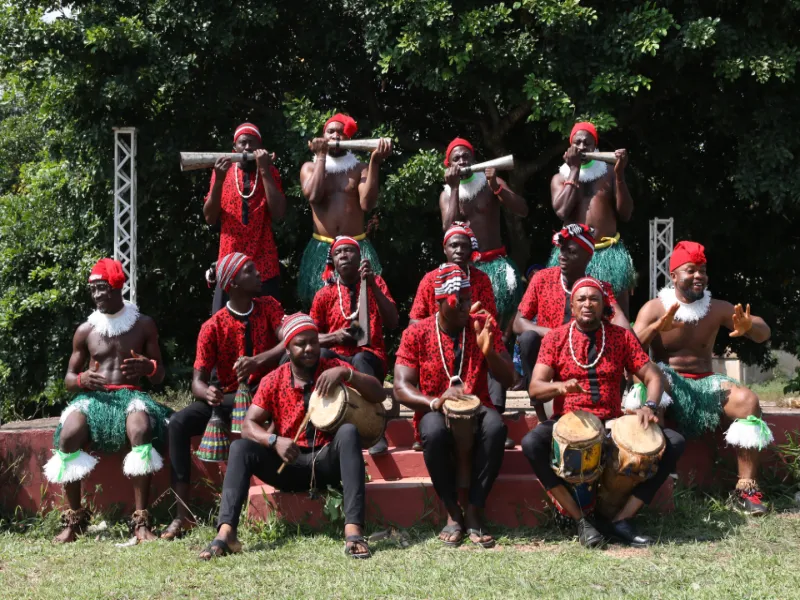
Omabe Festival of Enugu-Ezike
Omabe Festival is celebrated in the Imufu community of Enugu‑Ezike. According to sources, the festival is held roughly every five years.
Preparations begin well in advance, with community members repairing masquerade houses, clearing paths and readying drums, gongs, costumes and other ritual implements.
On the day of the festival, events often begin very early, around 5 a.m., when the smaller masquerades make their first appearance in the streets. As the morning progresses, the more imposing masquerades appear, especially by midday, when the larger, more complex masquerade figures take the centre stage.
The festival day is typically held on a market day such as “Afor Imufu” which ensures that many people, including indigenes living elsewhere can attend. After the main public display, the masquerades are believed to remain among the community for about a year before they “return” to the spirit world.
The sequence of celebration
Smaller masquerades parade through the village and market areas early in the morning dancing, interacting lightly with spectators and building anticipation.
As from midday, larger and more powerful masquerades enter, some of whom are regarded as spiritually intense or even dangerous. They are often preceded or accompanied by the smaller ones to manage their movement and to protect spectators.
The masquerades visit the home or palace of the eldest man in the community (the Onyishi) to pay homage, symbolizing respect to tradition and ancestral authority. People from Imufu who live in other parts of Nigeria, and sometimes, abroad return home for the festival. This bolsters the crowd, brings reunion and adds to the festive atmosphere.
After the main day, the masquerades stay in the community for the remainder of a one‑year period, during which they remain active in varied ways. After that year they retreat until the next festival cycle.
Location and community involvement
The main venue is the open village arena or market ground within Imufu, Enugu‑Ezike. Streets are cleared, village paths repaired, and the community is transformed into the stage for masquerade performance and ritual movement. Young men of the community often assist with preparation, path clearing, masquerade houses or shrines, costume making and logistics of the festival.
Unique features
The festival features hundreds of masquerades in a single celebration. Some reports indicate over 600 different masquerade figures from the Imufu community alone. The presence of fire or burning elements is often noted in the display, symbolizing purification or spiritual cleansing during the parade of masquerades. The timing every five years means that the anticipation builds, the scale remains large and the tradition is preserved without becoming routine.
Conditions and rules during celebration
It is considered taboo for women to approach certain masquerades too closely. Non‐initiated persons must maintain respectful distance.
The day of festival is free from major adverse events like funerals or other major disruptions, allowing the community to focus on unity, renewal and celebration.
Put simply, Omabe Festival is a major ritual event that occurs about every five years in Imufu, Enugu‑Ezike. It begins early in the morning with smaller masquerades, progresses to the more imposing ones, involves deep preparation and communal participation and concludes with the masquerades living among the community for about a year before withdrawing.
The high level of participation, the strict ritual rules and the blending of performance and sacred meaning all make it a rich cultural celebration rooted in tradition, yet, alive in the modern era.
Purpose of Omabe Festival
Omabe festival serves multiple layered purposes, namely, spiritual, social, cultural and communal.
Spiritual cleansing and purification
One of the primary purposes is to purge the community of evil, both the seen and unseen. The masquerades are believed to bring cleansing fire and spiritual power. A veteran in the community put it plainly that the masquerades purge the community of evils in human and spiritual forms because it comes with fire that is inimical to evil.
Honouring ancestors and continuity
Omabe festival honours the ancestral spirits that the masquerades represent, reaffirming continuity with the past. After the main parade, the masquerades stay for a year among the living, symbolizing the presence of the ancestors.
Community unity and identity
The festival draws back indigenes from far‑away living, uniting them around the shared heritage of Imufu and Enugu‑Ezike. It reaffirms local identity and strengthens ties among families, age grades and village‑units.
Moral regulation and social order
The masquerades are seen as enforcing community norms. They punish offenders, chase away negative forces, remind the people of moral responsibilities. The festival is, therefore, linked with peace, social harmony and communal prosperity.
Cultural transmission
This festival acts as a platform for transmitting cultural values, masquerade arts, music, chants, rhythms and stories from one generation to the next. Youths participate in preparations and learn the ways of their elders.
Cultural and Spiritual Significance of Omabe Festival

Omabe Festival carries deep layers of meaning for the people of Imufu community in the Mba Waawa region of Enugu State. Rooted in long‑standing belief systems and communal practices, the festival weaves together spirituality, culture, identity and social order.
In the worldview of Imufu people, masquerades are not mere puppets or costumed performers. They are regarded as spirits or embodiments of ancestral and supernatural forces. According to the local cultural institute, Omabe masquerades are seen as intermediaries between the living and the spirit world. One source states that the masquerades serve as intermediaries between the human and spiritual realms.
Because the masquerades are regarded as spirits, their appearance in the festival marks a moment when the boundary between the human world and ancestral/spiritual reality becomes blurred. After the public display, the masquerades remain in the community for about a year, symbolizing that the ancestral or spiritual presence dwells among the living before returning to the spirit world.
One of the major spiritual significances of Omabe Festival is purification. The festival is held, in part, to rid the community of evil influences, both physical, like immoral behaviour, and spiritual, like hidden misfortune. The National Institute for Cultural Orientation reports that the festival is a time of purification and spiritual cleansing. During the 2020 celebration, a community leader observed that the masquerades purge the community of evils in human and spiritual forms because it comes with fire that is inimical to evil.
Beyond cleansing, the festival functions as a form of moral regulation and communal protection. The masquerades are seen as guardians enforcing social norms. One article states that through dramatic performance, the Omabe masquerades act as instruments of the gods, ensuring order and punishing wrongdoing. The rules of behaviour during the festival reinforce that masquerades should not harm innocent spectators, and community elders emphasize that the festival is not a licence for crime or violence.
Omabe Festival also carries cultural significance in terms of identity, heritage and continuity. The people of Imufu regard it as a key moment of connection with their ancestors. The masquerades, dwelling among the people for a year post‑festival symbolize the presence of ancestral power and protection. A research document states that the festival brings the community together, fostering a sense of unity and pride in their shared heritage.
Because the festival only happens about every five years, it becomes a milestone event. The anticipation itself reinforces communal bonds and the memory of tradition. During the celebration, sons and daughters living far from home often return, reaffirming their link to the community and their roots.
Culturally, the festival functions as a time of renewal and re‑settling of social relations. The communal gathering strengthens age‑grades, families, kinships and reconnects those in diaspora with the home community. One feature of the festival is that major disputes or funerals are avoided during the proceedings, allowing focus on unity.
The festival’s spectacle of hundreds of masquerades, vibrant performance, music, dance also draws outside visitors and cultural tourists. This intercultural interaction not only boosts local pride but positions the community as a site of cultural interest. For example, the 2020 festival was reported to have drawn tourists and out‑of‑town indigenes to Imufu.
On a deeper level, Omabe Festival reflects Igbo cosmology in terms of the interplay between living humans, ancestral spirits, land and community. The masquerades themselves carry symbolic features: their costumes, animal skins, beads, fire and dance movements all represent power, purification, ancestry and respect. Some of the major masquerades that feature during the festival include Eshiwe, Obele Monwu, Oshagenyi, Eji, Mgbedike, Mukwu Monwu, Ajulaka, Agbe‑Eji, Ajija, Agelle, each with distinct roles.
Specific rituals such as paying homage to the oldest man (Onyishi) in the village tie the festival to respect for elders and the tradition of leadership.
In an era of rapid change, migration and modern influences, Omabe Festival remains a symbol of continuity. Scholars note that the festival acts as a platform for transmission of cultural knowledge, values and norms to the younger generation. While modernization poses challenges, the festival’s enduring presence underscores how tradition adapts, and yet, remains rooted.
Overall, the cultural and spiritual significance of Omabe Festival is multi‑dimensional. It is at once a sacred bridge between the living and ancestors, a mechanism for cleansing and community protection, a reaffirmation of identity and heritage, and a moment of communal renewal. For the people of Imufu in Enugu‑Ezike, it remains a vibrant expression of culture, spirituality and belonging.
Cultural Rules and Taboos for Omabe Festival
Omabe festival is not simply a public spectacle. It is governed by tradition, ritual propriety and respect for the spiritual dimension of masquerades.
Only initiated male members participate in the actual masquerade institution. According to research, Omabe masquerade cult is composed exclusively of men, and uninitiated men or women must not control or impersonate the masquerade spirits.
Women are generally not permitted to approach or be in close proximity to many of the masquerades during the festival. One news report states that it is a taboo for a woman to come near a masquerade, as some of them are seen to possess some mystical powers
Non-indigenes, that is, those who are not members of the community who violate the rules of the masquerade tradition may be subject to punishment. A study noted that non‐indigenes who violate the law of the Omabe will be whipped by the youths.
The masquerades are regarded as spirits dwelling temporarily among the living. For this reason, certain behaviour is expected. The masquerades should entertain and purify the community, not harm innocent spectators. The community leader stated that the masquerade is not to beat any person but to entertain, and any owner of a masquerade who violates the rules will be fined.
On the festival and during masquerade movements, women are advised not to come out at night in certain contexts. A local study reports that during the masquerade parades, women are not allowed to come out in the night among those observing the Omabe cult.
Modern Relevance
Omabe Festival of Imufu community in Enugu-Ezike continues to hold notable relevance in the modern era. Among its key contemporary functions, the festival draws visitors from outside the local area. For example, during the 2020 celebration the community noted that the festival attracted tourists from far and near. This increased visibility helps the town and surrounding region promote its heritage and can provide economic benefits to local vendors, artisans and hospitality providers.
Many indigenes living elsewhere, within Nigeria or abroad return home for the festival. One report stated that the sons and daughters of the land, even those in the Diaspora return home for the festival. This return strengthens social bonds, encourages investment in the home community and keeps the tradition alive across generations.
The festival also acts as a platform for passing on traditional customs, songs, dances, masquerade arts and communal rituals to younger generations. A recent study noted that Omabe festival brings the community together, fostering a sense of unity and pride in their shared heritage.
With the rise of social media and global connectivity, Omabe festival is increasingly visible online. This gives the celebration new reach. However, scholars warn that online circulation may risk reducing sacred practices to spectacle or misunderstanding. For instance, a study of social media impact on the festival in Enugu-Ezike reveals that, while digital platforms offer opportunities to project festivals like Omabe to local, national and international audiences, they also sometimes, distort cultural authenticity.
In a time when younger generations migrate to cities or abroad, and global culture influences local life, Omabe festival remains a meaningful anchor. It provides continuity in a changing world, offering a moment of rootedness and tradition. A cultural article describes the festival as a timeless celebration of Igbo culture and mystique, highlighting that it still transforms the local space into a vibrant stage of tradition and community pride.
Essentially, the modern relevance of Omabe festival lies in its ability to bridge the past and present; to celebrate and preserve ancestral tradition; to engage dispersed community members; to provide cultural and economic value; and to adapt to digital and social change, even as it retains its ritual core.
In Conclusion …
Omabe Festival stands as one of the most powerful symbols of Igbo cultural identity, spirituality and communal unity. More than just a masquerade performance, it is a living tradition that connects the people of Enugu-Ezike to their ancestors, their beliefs and their collective history. Rooted in centuries of custom, Omabe festival continues to embody the values of respect, courage, morality and reverence for the unseen world.
Every aspect of the festival, from the preparation of the masquerades and the sacred songs to the observance of taboos and communal feasting reflects the people’s deep relationship with their heritage. It is a time when the community pauses to honour the spirits, celebrate identity and remind one another of the moral codes that sustain social harmony. The festival’s enduring appeal lies in its dual nature: sacred, yet, communal, ancient, yet, continually relevant.
In today’s fast-changing world where cultural erosion often threatens traditional values, Omabe festival remains a cultural anchor. It bridges the gap between the old and the new, reminding younger generations that tradition and modernity can coexist. Its growing recognition through cultural tourism, academic research and digital storytelling ensures that this rich heritage of Enugu-Ezike continues to inspire pride and belonging among its people, both at home and in the diaspora.
Ultimately, Omabe festival is not merely a celebration; it is a cultural declaration. It reaffirms that the strength of a people lies in their ability to remember, to honour and to celebrate who they are. Through the echoes of the drums, the rhythm of the dance and the majesty of the masquerades, the spirit of this Igbo festival continues to come alive and remain vibrant and unbroken through time.
References
- https://jatr.unn.edu.ng/wp-content/uploads/sites/309/2023/07/4.pdf
- https://ozikoro.com/omabe-festival-enugu-ezike-a-timeless-celebration-of-enugu-igbo-culture-and-mystique/
- https://azresearchconsult.com.ng/project-the-role-of-social-media-and-its-impact-on-the-omabe-festival-of-the-people-of-enugu-ezike-in-igbo-eze-north/
- https://www.vanguardngr.com/2020/09/enugu-community-celebrates-omabe-festival-in-grand-style/
You might want to check this out …