






African History
The Oyo Empire: Rise, Military System, and Fall

The Oyo Empire was one of the most powerful and well-organized pre-colonial African empires. Located in what is now southwestern Nigeria and parts of present-day Benin and Togo, the Oyo Empire rose to prominence through military strength, strategic trade, and a well-structured political system. At its peak, it was one of the largest and most influential Yoruba kingdoms in West Africa.
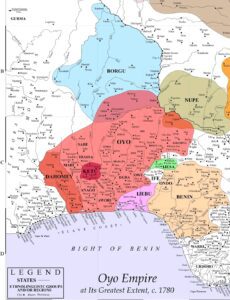
Oyo Empire Map
Origin of the Oyo Empire
The origin of the Oyo Empire can be traced to the Yoruba people, who are believed to have migrated from the northeastern regions of Africa. According to Yoruba oral tradition and historical accounts, the empire was founded by Oranmiyan, a descendant of Oduduwa, the mythical progenitor of the Yoruba people.
Oranmiyan is said to have traveled from Ile-Ife (considered the spiritual heartland of the Yoruba people) and established the Oyo Kingdom around the 11th century. He became the first Alaafin (king) of Oyo. His legacy laid the foundation for what would become a powerful empire that lasted several centuries.
Location and Geography
The Oyo Empire was situated in a strategic location within the savannah region north of the tropical forest belt in what is today western Nigeria. This location allowed Oyo to develop strong cavalry forces and maintain open trade routes across the savannah and into the forest zones.
The capital city, Old Oyo (Oyo-Ile), was built near the Niger River and later moved further north due to expansion and defense needs. The geographical advantage allowed the empire to access trade with northern Hausa states and connect to trans-Saharan routes.
Structure of the Early Kingdom
Political System
The Oyo political structure was highly advanced. At the top was the Alaafin, the king who ruled as the political and religious leader. He was supported by a council of noble chiefs known as the Oyo Mesi, who had the power to check the king’s authority. This system provided a balance of power and helped maintain order in the empire.
The kingdom was also divided into provinces, each governed by a local chief called an Oba, who paid tribute to the Alaafin but had local control. This decentralized system allowed for effective administration over a large and diverse territory.
Religion and Culture
The Yoruba people practiced a traditional religion centered around Orisha worship. These were deities representing various natural forces and aspects of life. The most important Orisha in Oyo was Sango, the god of thunder and lightning, who was also a former Alaafin.
The people of Oyo also believed strongly in ancestral worship, divination, and the importance of festivals. These religious and cultural practices helped unite the people and strengthen the identity of the empire.
The Rise of Oyo Power (15th–17th Century)
The real rise of the Oyo Empire began in the 15th century, as the kingdom began to expand militarily and economically. Several factors contributed to this growth.
Military Development
Oyo was one of the first Yoruba kingdoms to adopt cavalry warfare. Unlike the forested regions to the south, the savannah terrain allowed the use of horses. The Oyo army developed an elite cavalry force, which gave it a major advantage over its neighbors.
By the 16th century, the empire began to conquer surrounding towns and villages, incorporating them into its territory. The military campaigns were well-organized, and conquered areas were often allowed to keep their leaders as long as they pledged loyalty to the Alaafin and paid tribute.
Economic Growth and Trade
Trade played a significant role in the rise of the Oyo Empire. The empire was positioned between the Hausa states to the north and the Yoruba and coastal kingdoms to the south. This location allowed Oyo to control north-south trade routes.
Oyo traded goods such as:
- Kola nuts
- Ivory
- Textiles
- Salt
- Slaves
By the 17th century, the trans-Saharan trade network had connected Oyo with Arab traders and European merchants on the Atlantic coast. This brought wealth and further enhanced Oyo’s military capabilities through the acquisition of firearms and European goods.
Key Leaders and Expansion
Several powerful Alaafins contributed to the rapid expansion and consolidation of the Oyo Empire during this period. They are:
Alaafin Orompoto (c. 1554–1562)
Alaafin Orompoto was one of the earliest known female rulers of Oyo. She was known for her military skill and leadership. Orompoto expanded Oyo’s territory and strengthened its cavalry forces, further establishing the empire’s military tradition.
Alaafin Ajiboyede
Ajiboyede is remembered for bringing relative peace and prosperity after years of conflict. He focused on rebuilding infrastructure and stabilizing trade. He also established Yam festivals, an important cultural celebration that became a major event in Oyo.
Alaafin Abipa
Abipa was the ruler who moved the capital of the empire from Oyo-Igboho back to Oyo-Ile. His reign marked a return to central governance and religious rituals, including sacrifices to honor past rulers and gods. He played a major role in consolidating political control and spiritual unity.
The Expansion into Dahomey and the South
In the 17th century, the Oyo Empire expanded westward into modern-day Benin Republic, conquering Dahomey and subjugating various other states. Dahomey, which later became a rival empire, was forced to pay annual tribute to the Alaafin of Oyo for many years.
Oyo also extended influence into the southern forest regions, including Egba and Ijesha lands, although these regions were more difficult to control permanently due to their terrain and resistance to cavalry warfare.
The System of Tribute and Control
The Oyo Empire maintained control over distant regions through a complex tribute system. Vassal states and provinces were required to:
- Pay annual tribute in goods, slaves, or money
- Offer military assistance when called upon
- Maintain loyalty to the Alaafin
To enforce this, the empire appointed Ilari, special royal agents or tax collectors, who lived in vassal states and reported directly to the central government in Oyo-Ile. These agents ensured the steady flow of resources and information.
Internal Organization and Governance
The empire was organized in a hierarchical manner, that is,
- The Alaafin held supreme authority.
- The Oyo Mesi served as kingmakers and advisors.
- The Bashorun, head of the Oyo Mesi, had the power to demand the king’s suicide if he became tyrannical.
- Provincial Obas governed regions but were subject to the central power.
- The Eso, a group of elite military commanders, managed war efforts and internal security.
This layered political system allowed the empire to grow while maintaining stability over a diverse and expansive territory.
A Rising Power in West Africa
By the late 17th and early 18th centuries, the Oyo Empire had reached the height of its power. It was:
- The dominant Yoruba state
- A key military force in the region
- A thriving center of trade and culture
- An empire respected and feared by its neighbors
Its wealth, military success, and political structure made it one of the most respected empires in West African history.
The Oyo Military System: Backbone of an Empire
The Oyo Empire’s military prowess was one of its defining features. It played a critical role in expanding the empire’s boundaries and maintaining internal order. The military was well-organized, with strategic command structures and specialized forces.
The Role of the Eso (Elite Cavalry Officers)
The military command was largely overseen by a group known as the Eso, or the Eso Ikoyi. These were elite cavalry officers drawn from noble families. They formed a warrior caste, highly trained and respected across the empire. Their leader, the Are-Ona-Kakanfo, was the supreme military commander and one of the most powerful figures in the empire after the Alaafin.
The Are-Ona-Kakanfo: Supreme Commander
The Are-Ona-Kakanfo held a sacred and dangerous title. Once appointed, the Are-Ona-Kakanfo was expected to never return to the capital unless victorious in war. This ensured that only the most capable and daring individuals took the role. The Are-Ona-Kakanfo commanded the standing army and was responsible for defending the empire against both internal and external threats. Famous holders of the title included Afonja of Ilorin, whose later rebellion played a crucial role in the empire’s decline.
Cavalry: The Pride of Oyo
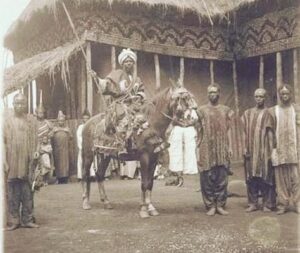
Unlike many other Yoruba states, the Oyo Empire developed a strong cavalry system, thanks to its access to the open savannah lands in the north and its trading links with the Hausa states and beyond. Horses were imported from the northern Sahel regions, and the cavalry became the empire’s most fearsome unit. The Oyo cavalry could move quickly over long distances, enabling swift military campaigns and surprise attacks.
Infantry and Auxiliary Units
In addition to the cavalry, Oyo maintained an effective infantry force, made up of conscripted soldiers from towns and vassal states. These troops were trained in spear and sword combat and were often used in supporting roles during campaigns. Local militias and war captains also played essential roles in defending towns and enforcing the Alaafin’s rule.
Strategies and Campaigns
The Oyo army was not only powerful in structure but also strategic in its campaigns. Military expeditions were launched during the dry season, when movement through the savannah was easier.
The empire expanded southward and westward, subjugating many Yoruba states and neighboring peoples such as the Egbado, Ibarapa, and the Fon of Dahomey. Vassal states were required to pay tribute, provide soldiers during wars, and supply resources like horses and weapons.
One of the most famous military feats was the consistent raids and wars with the Kingdom of Dahomey, a powerful neighbor in present-day Benin. Despite Dahomey’s military strength, Oyo succeeded in forcing it to pay tribute for many years.
Decline and Fall of Oyo Empire
Despite its impressive system, the Oyo Empire began to crumble in the late 18th and early 19th centuries. The fall of Oyo was not the result of a single event, but a combination of internal instability and external pressures.
1. Internal Political Struggles
A key weakness of the Oyo Empire was the conflict between the Alaafin and the Oyo Mesi. As the Oyo Mesi gained more power, they increasingly challenged the authority of the Alaafin. In some cases, they rejected Alaafins outright and forced their suicides, leading to political instability.
The power struggle also weakened the central administration, as factionalism and betrayal spread through the court and military leadership.
2. The Rebellion of Afonja
One of the most damaging events in the fall of the Oyo Empire was the rebellion of Afonja, the Are-Ona-Kakanfo. Afonja, who controlled Ilorin, refused to obey the Alaafin’s orders and invited Muslim Fulani warriors from the north to assist him.
This invitation backfired. The Fulani, under the leadership of Shehu Alimi, soon turned against Afonja, killed him, and took over Ilorin, making it a Fulani emirate. This led to a loss of a strategic part of the empire and opened the door for further Islamic influence and northern incursions.
3. The Rise of the Sokoto Caliphate
As the Sokoto Caliphate expanded under Usman dan Fodio, northern Islamic forces began to encroach on the territories of Oyo. The military superiority of the caliphate, combined with the fragmentation of Oyo, allowed the Fulani to make steady gains in Yoruba territories.
4. Loss of Tributary States
Many of Oyo’s former vassal states began to rebel or break away. Dahomey stopped paying tribute. The Egba people moved to Abeokuta and fortified themselves. Without the revenue and manpower from these areas, Oyo’s central power dwindled.
5. Environmental and Economic Factors
Prolonged droughts and shifts in trade routes also affected the empire. As coastal trade with Europeans increased, power shifted toward coastal Yoruba towns like Lagos and Badagry. Oyo, being inland, began to lose its commercial influence.
Final Collapse and Legacy
By the 1830s, the once-mighty Oyo Empire had effectively disintegrated. The capital city, Oyo-Ile, was abandoned, and a new city, New Oyo (Oyo Atiba), was established further south. However, it never regained the grandeur or power of the original empire.
Despite its fall, the Oyo Empire left a lasting legacy including
- Its political structure influenced many Yoruba and even non-Yoruba states.
- The title of Alaafin of Oyo remains a revered traditional institution today.
- The history of Oyo is a testament to the power and sophistication of pre-colonial African empires.
Conclusion
The Oyo Empire was not just a kingdom, it was a remarkable experiment in governance, military innovation, and cultural leadership in pre-colonial Africa. Its rise was fueled by a unique blend of strategic geography, strong cavalry forces, thriving trade networks, and an advanced political system that balanced royal authority with checks from the Oyo Mesi. For centuries, Oyo stood as a symbol of Yoruba power and sophistication, commanding respect from its neighbors and shaping the destiny of West Africa.
Yet, its decline reminds us that even the strongest empires can be undone by internal disunity, shifting trade patterns, and external pressures. The rebellion of Afonja, the incursion of the Fulani jihadists, and the growing economic dominance of coastal states gradually eroded Oyo’s supremacy, until the empire itself fragmented.
Even so, the legacy of the Oyo Empire endures. The title of the Alaafin remains a respected traditional institution, Yoruba festivals and religious practices rooted in Oyo history continue today, and the memory of Oyo’s achievements lives on as a source of pride for the Yoruba people.
In many ways, the story of Oyo is a timeless lesson, it tells us that unity can build greatness, but division can bring it to ruin. The empire’s history challenges us to reflect on the importance of leadership, accountability, and cultural identity in sustaining any society.
Read More: Queen Moremi Ajasoro: The Yoruba Heroine Who Gave Everything for Her People