





History and heritage
Eri Festival In Enugwu-Aguleri || History, Traditions and Cultural Significance

Eri festival is a powerful annual celebration of Igbo ancestry in Enugwu-Aguleri. Discover its history, traditions, spiritual meaning, and modern-day cultural relevance.

Eri festival – cultural performance
Eri festival in Enugwu‑Aguleri is one of the most celebrated cultural events in Igboland, bringing together thousands of people to honour their ancestral roots. Rooted in the legend of Eri, the revered progenitor of many Igbo communities, this festival blends history, tradition, spirituality and community celebration.
From sacred river rituals to colourful dances, communal feasts and the conferring of traditional titles, Eri festival serves as a living testament to Igbo heritage, connecting past generations with the present.
In this article, we explore the history, traditions, meaning and cultural significance of Eri festival, highlighting why it continues to play a vital role in preserving Igbo identity today.
History and Origin of Eri Festival
The origin of Eri Festival is deeply rooted in the life and legacy of Eri, a foundational figure in Igbo tradition, especially among the Umu‑Eri clans in southeastern Nigeria.
Who Is Eri?
Eri is regarded in Igbo oral history as a semi-divine being sent by Chukwu, the Supreme God, to establish social order, justice and spiritual foundations among early Igbo communities. According to tradition, he settled in Aguleri located along the Omambala River in present-day Anambra State.
Some versions of the tradition even describe Eri as having descended from the sky. Other accounts suggest a symbolic migration from a distant land, with links in oral tradition to ancient Egypt or Israel.
At Aguleri, Eri is said to have built a household with two wives. He fathered several children, each of whom founded new communities or lineages:
- Agulu: considered the ancestor of Aguleri itself.
- Nri: who became the founder of the Nri Kingdom, a highly spiritual theocratic state.
- Onugu
- Ogbodulu, and a daughter,
- Iguedo whose descendants formed other important towns.
Oral traditions often place the lifetime of Eri around 948–1041 AD.
Foundation of the Nri Kingdom
One of the most significant legacies of Eri was the establishment of Nri Kingdom through his son Ìfikuánim who became the first Eze Nri. Nri Kingdom was unusual in that it was not built through warfare, but through spiritual and moral influence. Eze Nri led not just politically but also religiously, conducting rituals, resolving disputes and purifying communities
Cultural and Religious Contributions
Eri is credited with introducing key practices and beliefs such as cleansing of taboos and social “abominations” among people; agricultural spirituality, in particular a strong connection to yam cultivation which became spiritually significant for many Igbo people; a system of moral authority and divine kingship, anchoring societal norms in spiritual principles.
The Birth of Eri Festival
According to tradition, Eri himself initiated a yearly gathering among his people. He invited his wives, children and followers every eighth native month to come together for prayer at the confluence of the Ezu and Omambala Rivers. After these spiritual rites, people would celebrate with food, dance and cultural performances.
When Eri passed on, his children made sure this tradition continued. The festival did not die, instead, it became institutionalized in Aguleri, especially around the Obu‑Gad Palace, a sacred palace that still stands as a symbol of unity among the descendants of Eri.
Symbolism in the Origin Story
The arrivalof Eri from the sky (or from afar) symbolizes his role as a bridge between the divine and the human. His choosing of Aguleri, near rivers, represents the importance of land and water to Igbo life.
By establishing children who founded separate clans and towns, his story links many Igbo communities in a shared ancestry.
Through his son, Ìfikuánim and the Nri Kingdom, his influence became institutional, shaping religious and moral life for generations.
Eri Festival is not just a cultural celebration; it is a profound expression of ancestral reverence, spiritual continuity and communal unity. Its practices are rooted in centuries-old traditions, reflecting the Igbo people’s connection to Eri, their legendary progenitor.
The Cultural Meaning of Eri Festival

Eri Festival
Eri Festival is far more than a cultural celebration. It is a profound symbol of Igbo identity, spirituality and social cohesion. Every aspect of the festival carries meaning, reflecting centuries of tradition and the values passed down from the ancestral figure Eri.
At its core, Eri festival is a tribute to Eri, the legendary progenitor of the Umu-Eri clans. By participating in rituals, prayers and communal events, descendants affirm their connection to their ancestry. It is a way of remembering the origins of their communities and preserving the stories, morals, and teachings of forebears.
Eri festival serves as a period of spiritual cleansing. Through fasting, prayers and libations, participants purify themselves of negative energy, taboos, or social wrongs, seeking blessings for personal growth, family welfare and communal harmony. This reflects the traditional Igbo belief in maintaining balance between humans, ancestors and the spiritual realm.
Eri festival brings together local communities and members of the diaspora, and reinforces a sense of belonging and unity. It is a time when disputes are set aside, families reconnect and communities demonstrate solidarity. This social cohesion is vital in sustaining the cultural identity of the Umu-Eri people.
Traditionally, Eri festival is linked to fertility, farming and harvest. The legacy of Eri is associated with yams which are considered sacred in Igbo culture. The festival celebrates the abundance of the land and encourages sustainable agricultural practices, symbolizing the community’s dependence on nature and the blessings of the earth.
Eri festival emphasizes the values taught by Eri such as honesty, justice, respect for elders and communal responsibility. Through the festival’s rituals and the conferring of traditional titles, the community recognizes individuals who uphold these values, encouraging moral conduct among all members.
Finally, the festival is a living repository of Igbo culture. Music, dance, masquerades, attire and oral storytelling during Eri Festival preserve traditions that might otherwise be lost. It educates younger generations about their roots, ensuring that cultural knowledge continues to thrive.
How Eri Festival Is Done
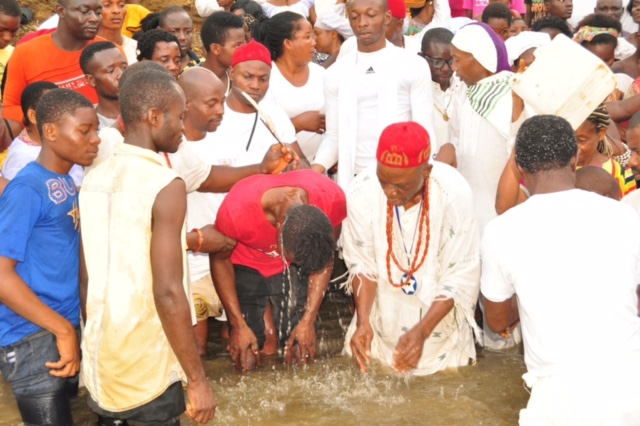
Eri Festival – Cleansing ritual at the Ezu-Omambala Confluence
Eri Festival is a vibrant celebration that combines spiritual, cultural and social elements that reflect the rich heritage of Igbo people. It is organized around several key components that have been preserved through centuries of tradition in Enugwu-Aguleri. Eri festival follows these procedures:
Rituals and Prayers
The festival begins with sacred rituals led by the Eze Eri and his council of elders. Pilgrims and community members gather at Agbanabo Ezu-Na-Omambala, the sacred confluence of the Ezu and Omambala Rivers, to offer prayers and libations to honour Eri and seek blessings for peace, prosperity, and fertility.
Fasting and spiritual preparation often precede the festival. This period allows participants to purify themselves and reflect on their ancestral lineage.
Cultural Performances
Traditional dances, music and masquerades are central to Eri festival. Performers don colourful attire and masks, showcasing Igbo artistry and folklore. These performances entertain participants while also passing down oral history and cultural values to younger generations.
Communal Feast
A major feature of the Eri Festival is the communal feast where local dishes are prepared and shared among attendees. This act of sharing food symbolizes unity, abundance and gratitude. It also provides an opportunity for families, friends and diaspora members to reconnect.
Trade Fairs and Artisan Displays
Eri festival often features markets and trade fairs where local artisans, traders and craftsmen showcase their goods. Visitors can find handcrafted items, traditional clothing and local foods. This component not only promotes economic activity but also preserves traditional crafts and skills.
Conferring of Traditional Titles
During the festival, the Eze Eri may confer chieftaincy titles on individuals who have contributed significantly to the community. These honours celebrate leadership, integrity and service, and reinforce the social fabric and encouraging community participation.
Pilgrimage and Reconnection
For many attendees, Eri festival serves as a pilgrimage to ancestral land. Descendants of Eri, whether living locally or in the diaspora return to Enugwu-Aguleri to reconnect with their roots, pay respects and participate in rituals that have been performed for centuries.
Closing Ceremonies
Eri festival concludes with final prayers, libations and thanksgiving. Elders bless the attendees and the land, thereby reinforcing the spiritual and communal bonds that define Eri Festival.
Time and Where Eri Festival Happens
Eri festival is deeply tied to its ancestral homeland and is held in a very specific place, following both traditional and modern rhythms. The festival is celebrated annually in Enugwu‑Aguleri. In recent years, it has been held in early November. According to available report, the 2024 World Eri Festival began on the first “Eke” day of the eighth month in the traditional Igbo calendar.
In the 2023 edition, the festival ran from November 3 to November 5, with the main day being November 4, starting early in the morning around 5 AM.
The central location for the Eri festival is Enugwu-Aguleri, a historic town in Anambra State, Nigeria. The Obu‑Gad Palace in Enugwu-Aguleri serves as the ceremonial seat of the Eze Eri, where many festivities and titular activities happen.
A key spiritual site during the festival is the confluence of the Ezu and Omambala Rivers, locally called Agbanabo Ezu-Na-Omambala. Pilgrims process there to offer prayers and libations.
On the day of the festival, participants often begin a procession from Obu‑Gad Palace very early in the morning (around 5 AM) to the river confluence for rituals.
Cultural Significance of Eri Festival

Eri festival holds deep cultural significance for Igbo people, particularly those who trace their lineage to Eri in Enugwu‑Aguleri. It is more than a celebration. It is a powerful symbol of ancestry, unity and identity.
Unifying the Igbo Diaspora
One of the most important cultural roles of Eri festival is unity. According to Eri Kingdom sources, the festival was designed to bring together all “sons of Eri”, even those who have dispersed across Igboland and beyond.
This gathering helps reconnect descendants of Eri, reinforcing a shared heritage and collective identity. During such events, Igbo people from different regions and the diaspora come home to Enugwu‑Aguleri to reconnect with their ancestral roots.
Ohanaeze Ndi Igbo, a major Igbo socio-cultural organization has acknowledged the power of Eri festival to unite Igbo communities globally.
Affirming Aguleri as the Cradle of Igbo Civilization
Aguleri is often considered a spiritual and cultural centre for many Igbo lineages. According to a social science study, Aguleri represents the headship of the Igbo race in traditional memory.
By hosting Eri festival in Enugwu‑Aguleri, especially at the historic Obu‑Gad Palace, the community reaffirms its role as a central hub of Igbo history and tradition.
This site is not just symbolic. According to some historians, the location marks an ancient origin point from which Igbo land expanded.
Cultural Diplomacy and Reconciliation
Eri festival also plays a diplomatic role. During past editions, prominent leaders have called for unity beyond Igbo lines. For example, in one festival, the Ooni of Ife, a Yoruba monarch was invited, and leaders from both Igbo and Yoruba lands used the event to emphasize peace and cooperation. This kind of cross-cultural dialogue shows how Eri festival helps foster national unity and reconciliation, using shared heritage as a bridge.
Preservation of Traditional Culture
Through dance, masquerades, music and trade fairs, the festival preserves ancient Igbo customs. During Eri festival, community members perform traditional dances and cultural displays, keeping ancestral practices alive.
Eri festival also supports the transmission of oral history. Stories about Eri, his arrival in Aguleri, and his legacy are retold and honored each year, thereby reinforcing generational memory and cultural education.
Moreover, traditional titles are conferred during the festival as a way of strengthening social structures rooted in Igbo tradition.
Spiritual and Ancestral Significance
Culturally, Eri festival acts as a living ritual that binds participants to their ancestral past. It commemorates the arrival of Eri at the Ezu‑Omambala river confluence, a sacred site in Aguleri where he is believed to have performed rituals.
This spiritual dimension is also a cultural anchor. Through prayer, libation and ancestral veneration, participants renew their spiritual connection to Eri and to one another.
Symbol of Resistance and Continuity
Historically, the festival has represented persistence and cultural pride. During colonial times, the strength and unity displayed at Eri festival reportedly impressed the British, because Aguleri youths showed great stamina and cultural resolve.
Today, this symbolism continues. By celebrating Eri, the community asserts its autonomy and preserves its traditions in the face of modern pressures and religious change.
Modern Relevance
In a time when globalization and urbanization risk diluting traditional practices, Eri festival stands as a bedrock of Igbo cultural identity. It gives Igbo people, both at home and abroad, a yearly moment to pause, remember and celebrate who they are.
Apart from that, Eri festival has the potential to attract cultural tourists – people interested in Igbo traditions, ancestry tourism and heritage travel. Such interest can bring economic benefits to Enugwu-Aguleri and surrounding areas.
Historically, the festival has been used to reconcile descendants of the Igbo race. For instance, in one reported edition, African-Americans of Igbo descent were invited and spiritually “cleansed” at the river confluence. This act helps heal wounds of the diasporic past and build a bridge across continents.
Ohanaeze, the apex Igbo socio-cultural group has recognized Eri festival as a potential international festival to connect Igbo people worldwide. By elevating it to an international scale, Igbo leaders hope to unify cultural heritage from different parts of the world.
But then, there have been challenges. Christianity and modernization have changed how some traditions are practiced. Some older rituals have diminished. And COVID-19 impacted recent editions. For example, the 2020 festival was scaled back due to pandemic restrictions.
Despite these challenges, the festival continues to adapt as traditional leaders, cultural institutions and community members work to keep its spiritual and communal heart alive.
Criticisms and Debates
No cultural festival is without debate, and Eri festival is no exception. Some sources challenge claims about Aguleri being directly descended from Eri. For instance, in a published interview, a historian named Aniegboka argued that the Aguleri people migrated from Igala in Kogi State and are not originally Igbo or descendants of Eri. These debates highlight that oral tradition, archaeology and modern identity politics can sometimes collide.
The story of Eri is deeply rooted in oral tradition, making it difficult to separate myth from historical fact. Some scholars treat him primarily as a mythic or legendary ancestor. There are limited archeological records to fully verify all aspects of his life, and so, much depends on tradition, genealogy and belief.
As Christian beliefs and modern lifestyles spread, some elements of the festival may be downplayed or transformed. There is also a risk that commercialization could overshadow spiritual meaning.
In Conclusion …
Eri festival in Enugwu-Aguleri is a living testament to Igbo heritage, spirituality and communal unity. From its origins honouring Eri, the legendary progenitor, to the vibrant rituals, cultural performances and communal gatherings, the festival preserves centuries-old traditions while remaining relevant in today’s world.
By celebrating Eri festival, descendants of Eri and the broader Igbo community reconnect with their ancestry, uphold moral and spiritual values and strengthen social bonds. The festival also promotes cultural tourism, supports local economies and educates younger generations about the richness of their heritage.
In a modern society that increasingly values heritage and identity, Eri festival serves as a bridge between the past and present, reminding everyone of the importance of honouring ancestry, preserving culture and nurturing unity. It is a celebration that not only commemorates history but also inspires continuity, pride and communal resilience for generations to come.
References
- https://erikingdom.com/eri-festival/
- https://genealogy.igbopeople.org/tree/igbo/individual/X273/ERI
- https://www.igwebuikeresearchinstitute.org/books/INAUGURAL_LECTURE_E_COPY.pdf
- https://iiardjournals.org/get/RJHCS/VOL.%209%20NO.%201%202023/Nri%20People%20and%20the%20Challenges.pdf
- https://independent.ng/aguleri-are-not-descendants-of-eri-aniegboka/
- https://www.vanguardngr.com/2020/11/aguleri-celebrated-low-key-eri-world-festival-due-to-covid-19/amp/
- https://thesun.ng/how-anambra-community-celebrated-eri-world-festival/
- https://iwitness.ng/ndi-igbo-celebrate-2024-world-eri-festival-honoring-ancestry-and-heritage/
- https://nnewicity.com/aguleri-the-ancient-town-at-the-heart-of-igbo-history-towns-in-anambra/