


African Culture and Traditions
Ibu Ozu Nwada || An Age-Old Igbo Tradition

Ibu Ozu Nwada is the Igbo custom of returning a married daughter to her natal home for rites and burial. Discover its meaning, history, cultural logic, how it is practiced, the symbolism, and how the custom is changing today.

To the Igbo people of southeastern Nigeria, death is not seen as an end but a passage. A journey into the world of the ancestors. And every stage of that journey is marked by rituals that honour the individual, reaffirm family bonds and preserve lineage identity.
One such deeply rooted custom is Ibu Ozu Nwada, the practice of taking the body or spirit of a married daughter back to her father’s home for burial or final rites. Though it may seem unusual to outsiders, within Igbo culture, it carries profound meaning. It is a declaration that, no matter how far a woman marries, she remains a daughter of her father’s lineage.
Ibu Ozu Nwada has endured for generations, woven into the moral and spiritual fabric of Igbo society. It reflects how Igbo people understand belonging, ancestry and the unbroken link between the living and the dead.
Today, as modern life, religion and urbanization reshape customs, the practice continues to spark discussion and adaptation.
In this article, we explore the meaning, historical roots, cultural logic, process, symbolism and the modern changes and debates surrounding Ibu Ozu Nwada as an age-old tradition that still speaks powerfully about identity, respect and family among Ndigbo.
What Ibu Ozu Nwada Means
Ibu Ozu Nwada is a deeply symbolic Igbo funeral custom that centres on the return of a deceased married daughter to her natal home so that her family can perform the final rites that properly unite her with her ancestors. The phrase literally translates to “carrying the corpse of a daughter,” but its meaning goes far beyond physical movement. It represents the continued belonging of a woman to her father’s lineage, even after she has married into another family.
Among the Igbo, marriage connects families but does not sever a woman’s ancestral identity. A woman is seen as belonging to two lineages at once: that of her husband, through marriage, and that of her father, through blood.
While her husband’s people have social and marital rights over her, her father’s kindred retains spiritual responsibility for her, particularly in matters of burial and ancestor-hood. When she dies, it is believed that her spirit must be received and accepted by her father’s ancestors who are the true custodians of her spiritual identity. This belief forms the core reason behind Ibu Ozu Nwada.
In many Igbo towns, including Nnewi, Oraifite, Awka and Nsukka, the custom is still observed, though details differ. The husband’s family informs the woman’s natal family of her death, and arrangements are made for her body to be returned home. The act of bringing her home, often accompanied by songs, prayers and traditional rites signifies a final homecoming. It ensures that she does not become a wandering spirit or remain spiritually attached to a household that is not her ancestral root.
Traditional Igbo cosmology holds that every person must “rest” among their ancestors for peace to reign, both for the dead and the living. For a woman, that rest must happen in her father’s lineage because it is believed that her life-force (chi) and ancestral guardians belong to that lineage. Without the natal rites, it is said that her spirit could remain unsettled, unable to fully join the ancestors or watch over her descendants.
The custom also reflects the Igbo understanding of lineage purity and inheritance. In ancestral veneration, prayers and sacrifices are made to forebears from the same bloodline. A married woman, though respected in her husband’s home cannot be invoked as an ancestor in a lineage where she was not born. Therefore, Ibu Ozu Nwada ensures that ancestral lines remain spiritually distinct while still respecting marriage as a social bond.
In practical terms, Ibu Ozu Nwada is both a cultural and spiritual duty. It expresses the love, responsibility and reverence a family owes its daughter, even after death. For the husband’s people, allowing her body to return home is an act of honour and peace, acknowledging that she has another family to which she also belongs. For the natal family, receiving her is an act of acceptance and continuity, ensuring that her memory and blessings remain alive within the lineage.
Although the details of performance vary across Igbo communities, the meaning of Ibu Ozu Nwada remains the same. It is a statement of belonging, identity and respect. It is a bridge between two families, a spiritual reconciliation between marriage and bloodline, and a final affirmation that a daughter, even in death, never stops being her father’s child.
Historical Origin and Background

The origin of Ibu Ozu Nwada can be traced to the traditional Igbo worldview where kinship, ancestry and land were inseparable elements of life. In precolonial Igbo society, identity and belonging were defined through the umunna, i.e. the extended patrilineal family group that shared a common ancestor. Every individual was spiritually and socially tied to this lineage which determined rights to land, inheritance, ritual obligations and ultimately, one’s resting place in the world of the ancestors.
Within this framework, marriage was understood as a social alliance between families, not a transfer of spiritual identity. A woman, upon marriage became part of her husband’s household, bore children who belonged to his lineage and participated in his family’s communal life.
However, her bloodline and ancestral connection remained firmly rooted in her father’s umunna. The Igbo held that while a woman might live and die in her husband’s home, her spirit could only find peace when ritually accepted by her ancestors through the rites of her birth family. This belief system gave rise to the custom of Ibu Ozu Nwada.
Historically, when a married woman died, her natal family would travel to her husband’s home to “carry” her corpse back to her father’s compound for burial. The act symbolized the return of the daughter to the lineage that gave her life. It was also an assurance that her spirit would be properly guided into the ancestral world where she would join her forebears and continue to watch over her descendants.
In ancient times, the process involved elaborate community participation. The Umuada (daughters of the lineage) and the Umunna (male kin) played central roles. The Umuada were often responsible for the emotional and ritual aspects of the burial, ensuring that proper songs, wailings and cleansing rites were performed.
The Umunna handled the negotiations, received the body and supervised the burial arrangements. This cooperation between the male and female members of the lineage reinforced the unity and moral order of the extended family.
Ethnographic studies such as those by Nigerian scholars of traditional religion and anthropology indicate that the custom was common across Igbo communities long before colonial contact. Villages in present-day Anambra, Imo, Enugu and Abia States all practiced variations of the rite, though with local names and procedures.
In Nnewi, it was known as Ibu Ozu Nwada or Imena Ozu Nwada; in Awka, it was called Itogbo Ozu Nwada; and in Nsukka, it is Iweli Ozu Nwada. The consistent feature across these areas was the belief that a woman’s final resting connection must be with her natal ancestors.
The origin of the practice also relates to traditional Igbo land customs. Burial within one’s family compound was a sign of belonging and legitimacy. Since ancestral land was sacred, only true members of the lineage could be buried there.
A woman’s husband’s compound, no matter how long she had lived there, was not considered her ancestral land. Therefore, bringing her back for burial was a way to maintain the purity of lineage graves and the sacred continuity of the ancestral ground.
During the colonial period, as Christianity spread and modern laws on death and burial were introduced, the practice began to face challenges. Missionary teachings discouraged ancestral rites, labeling them as pagan.
Yet, even with Christian influence, many Igbo families quietly maintained the tradition, either by performing symbolic versions of the ritual or by combining Christian and traditional elements. Historical accounts from the early twentieth century show that even when a Christian burial took place in a churchyard, the natal family often performed a quiet rite at home to “receive” the daughter’s spirit, thus fulfilling the ancestral requirement.
Today, oral histories and community records still recall how families observed Ibu Ozu Nwada in the past. Older generations remember how the journey to carry the daughter’s corpse home was both solemn and communal, often accompanied by songs of farewell and the presence of both families to ensure harmony.
The tradition, therefore, is not merely a burial custom but a reflection of the deep moral, social and spiritual fabric of the Igbo people. A system where identity, lineage and the world of the ancestors are inseparably linked.
In essence, the historical background of Ibu Ozu Nwada shows that it is not a random or isolated practice. It grew out of the Igbo understanding of personhood, belonging and the afterlife. It is a cultural declaration that, while marriage may extend a woman’s social world, her spirit remains anchored in the bloodline of her birth.
Cultural Logic Behind Ibu Ozu Nwada
The cultural logic behind Ibu Ozu Nwada lies in the Igbo understanding of life, death, kinship and continuity. To the Igbo, life is not seen as an individual journey but as a shared existence within a lineage that stretches from the ancestors to the unborn.
Every person belongs to a family group whose living members, ancestors and descendants form one continuous community. Death, therefore, is not a separation but a passage into another form of membership within that same family network. Ibu Ozu Nwada is one of the ways the Igbo ensure that this passage happens correctly for a woman who has married outside her natal home.
The custom is guided by several interwoven cultural principles.
- Bloodline and ancestral identity
The first and most important belief is that a woman’s bloodline does not change after marriage. While marriage connects her socially and legally to her husband’s family, her spiritual and ancestral roots remain tied to her father’s lineage.
The Igbo hold that ancestral spirits recognize only those who share the same blood and lineage. A woman, therefore, cannot be fully accepted as an ancestor in her husband’s family, because her spirit belongs to another lineage. The rites performed by her natal family during Ibu Ozu Nwada are meant to guide her safely into the ancestral realm of her birth where her spirit will find peace and belonging.
- Balance between two families
Marriage in Igbo culture is viewed as a bridge between families, not a transfer of ownership. When a daughter dies, both her husband’s and her father’s families have obligations. The husband’s family provides the body and initial mourning, while the natal family provides the spiritual completion of her burial.
This shared responsibility reflects the cultural principle of harmony between families and ensures that neither side feels disregarded. Allowing the natal family to perform their rites is also a way of preventing spiritual tension or conflict between the two lineages.
- Continuity of ancestral lineage
In Igbo cosmology, every properly buried person joins the ranks of the ancestors who continue to influence the affairs of the living. However, this inclusion depends on correct rituals performed by the person’s own lineage.
Ibu Ozu Nwada ensures that the deceased woman’s spirit joins her true ancestral line, keeping the lineage spiritually complete. It is believed that if the proper rites are not done, the woman’s spirit may wander or bring misfortune as her connection to her ancestors would remain unsettled.
- Respect for womanhood and daughterhood
Though sometimes misunderstood, Ibu Ozu Nwada also expresses deep respect for the role of daughters in the family. The Igbo regard daughters as blessings who build bridges through marriage and strengthen kinship networks.
Returning a deceased daughter home for burial is both an act of love and a final expression of honour. It says to the community that she still belongs, that her contributions to the family are remembered, and that she will be welcomed among her ancestors as a cherished daughter.
- Land, lineage, and burial purity
Another layer of meaning behind Ibu Ozu Nwada is the sacred connection between ancestry and land. Among the Igbo, ancestral land is hallowed ground where generations are buried. Only blood members of the lineage have the right to rest there.
Because a married woman’s primary blood connection remains with her father’s people, her final resting place is expected to be among them. This preserves the purity of the ancestral burial ground and maintains the symbolic order of lineage continuity.
- Social and spiritual order
In traditional Igbo society, death rituals were not only spiritual but also social acts that reaffirmed the community’s moral structure. Performing Ibu Ozu Nwada publicly reminded everyone of the enduring bonds of kinship and the responsibilities each family holds toward its members.
It reinforced moral values such as respect, cooperation and remembrance. The act of “carrying” the daughter’s corpse home was, therefore, not seen as a mere physical task but as a public demonstration of duty, unity, and continuity.
- Protection and peace for the living
Finally, Ibu Ozu Nwada carries a belief that the peace of the living depends on the peace of the dead. When a daughter is properly received and buried by her natal family, her spirit is thought to rest content, bringing blessings and protection to her children and siblings.
If neglected, her unsettled spirit could manifest through misfortunes, illnesses or family discord. The rite is, thus, both an act of love for the departed and a safeguard for those left behind.
In essence, the cultural logic behind Ibu Ozu Nwada reflects the Igbo view of existence as a web of relationships that transcend birth and death. It harmonizes social bonds with spiritual duty, affirming that even in death, a daughter remains a vital part of her father’s lineage and a link in the endless chain of family life.
Who Takes Part and Who Qualifies
Ibu Ozu Nwada involves several categories of participants, each performing distinct roles rooted in kinship, gender and social duty. The practice is not a random community event but a structured cultural process guided by traditional norms. Understanding who takes part and who qualifies helps to clarify why the ritual holds such deep meaning within Igbo society.
The central figure in Ibu Ozu Nwada is the Nwada herself – the woman who has died. She must be a married daughter of the community, originally born into the lineage that will receive her body. Her marital status is important because the custom applies specifically to women who had married into another family or village. In Igbo culture, a woman never fully severs ties with her father’s home, no matter how far away she marries. The ritual serves to reaffirm this lifelong bond.
Not every deceased woman automatically qualifies for Ibu Ozu Nwada. Traditionally, it was done for women who had lived honourable lives. Those known for good character, faithfulness and loyalty to both her husband’s and her father’s families. A woman who was estranged, divorced or whose death was surrounded by unresolved disputes might not be carried home until the issues were settled. The rite is therefore both a spiritual homecoming and a moral acknowledgment.
The husband’s people play a major role because the woman had been part of their household in life. When she dies, her body is first kept in her husband’s compound or a nearby mortuary. Before any movement is made, the husband’s family sends word to her natal family, informing them of her death. The two families then meet to discuss arrangements and agree on when and how the Ibu Ozu Nwada will take place.
The husband’s family usually provides the casket, clothing for the corpse and other burial materials. They are responsible for the initial mourning, wake and transportation expenses. In some communities, they also present traditional items such as drinks, goats or money to the wife’s family as a sign of respect and to seek their consent to carry the body.
The most important participants in Ibu Ozu Nwada are the deceased woman’s natal family, that is, her brothers, uncles, and most significantly, the Umuada. These women play a sacred role as the custodians of tradition and the spiritual link between the living and the ancestors.
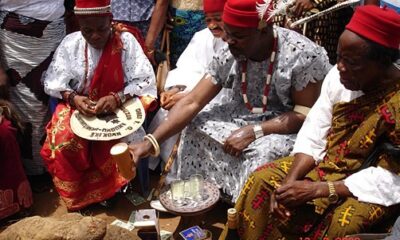
When the body arrives, Umuada receive it with ritual songs, libations and symbolic gestures that acknowledge her return to her roots. They may perform cleansing rites, wash the body, or adorn her with special clothing signifying that she has come home. The men of the lineage prepare the burial ground within the family compound, usually near other ancestral graves.
In some towns such as Nnewi, the practice known as Imena Ozu Nwada is led by the eldest male of the family, in collaboration with the eldest daughter. Together, they ensure that all rites are done according to custom.
While the Umuada of the deceased woman’s own lineage take charge of her final burial, the Umuada in her husband’s village also have roles to play. They help in organizing the wake, guiding the mourning process, and accompanying the husband’s family during the handover. Their presence signifies respect for womanhood across families and ensures the ceremony is conducted with dignity.
Community elders, traditional priests, or titled men often oversee the spiritual and cultural correctness of the entire process. They ensure that the prayers, libations and ancestral invocations are done properly. Their presence gives legitimacy to the ritual and prevents disputes between the two families.
Finally, the wider community takes part as witnesses and mourners. In traditional Igbo settings, death is not a private event but a communal affair. Villagers gather to show solidarity, share in the mourning and reaffirm the shared values that keep the community united. The turnout and manner of the ceremony often reflect the social standing and reputation of the deceased woman and her family.
Generally, Ibu Ozu Nwada is reserved for women who were born into a lineage, married outside it, and died while still recognized as members of both families. Unmarried daughters, or widows who returned to live permanently in their father’s house since they are already within their lineage’s land.
In some modern interpretations, the rite is extended to Christian women whose families still value traditional observances. In such cases, religious prayers may be combined with cultural rites, showing how the custom has adapted to changing times.
In essence, Ibu Ozu Nwada is a collective act involving both families and the wider community. It expresses shared responsibility and cultural continuity. Those who take part do so not merely out of duty but out of respect for ancestral order and the eternal bond between a daughter and her people.
Ibu Ozu Nwada in Today’s Society

Over the years, Ibu Ozu Nwada has evolved, adapting to social change, urbanization, and the influence of religion. While the core meaning, i.e. returning a daughter’s spirit to her ancestral home remains, the way it is practiced today has become more symbolic and flexible than in the past. In many parts of Igboland, including Nnewi, Oraifite, Awka and Nsukka, families continue to observe the custom, though often with modifications to fit modern realities.
In contemporary times, when a married woman dies, her husband’s family first contacts her relatives to officially inform them of the death. This is done either through a family representative, a phone call, or a formal visit known traditionally. The two families then agree on burial arrangements, dates, and who will handle what aspects of the ceremony. Although modern tools like mobile phones have replaced the traditional messengers, the cultural essence of mutual respect and consultation is still maintained.
In the past, the woman’s body was carried home in a symbolic procession, literally “ibu ozu,” meaning “to carry the corpse.” Relatives would travel on foot or by local means singing dirges along the way. Today, it is done differently. In some places like Nnewi, the woman’s picture, plus some other traditional items are what is carried home, not the corpse. The act of bringing her home is no longer about physical labour but about the symbolic fulfillment of tradition. Whether the journey is short or long, the central goal remains to ensure the woman’s spirit rests among her ancestors.
Upon arrival, the woman’s natal family, led by the Umuada and elders receives her with songs of remembrance and short prayers or libations. In traditional settings, these songs express both sorrow and pride, acknowledging that a beloved daughter has returned home. In modern Christian families, these songs have been replaced by hymns, Bible readings or short prayers of thanksgiving for her life.
In Nnewi and surrounding towns, for instance, the corpse may be placed in the family compound briefly for final blessings before taking her to her husband’s home for burial. Some families perform minimal rituals, such as sprinkling native chalk (nzu) or palm wine to mark her return. Others prefer quiet prayers, combining cultural respect with religious belief.
The actual burial may take place in the woman’s husband’s compound or, in some modern cases, in a cemetery close to her ancestral land. In urban areas where family lands are no longer easily accessible, the family may perform a symbolic rite instead, such as taking a handful of soil from her natal compound to place in her grave wherever she is buried. This act represents her spiritual connection to her roots.
Traditionally, the burial was followed by communal feasting and the distribution of food, drinks, and kola nuts. In contemporary practice, families may hold a modest reception or thanksgiving service. The emphasis has shifted from elaborate traditional displays to more private, family-centered ceremonies.
Religion has had a strong impact on the way Ibu Ozu Nwada is carried out today. With the spread of Christianity, many families have replaced ancestral libations with prayers and church services. Some pastors even accompany the family to the burial site to bless the ground. However, even in devout Christian homes, the cultural idea of taking a woman back to her father’s house remains respected. It is often viewed not as idol worship but as an act of honouring family roots.
In many Igbo towns, Ibu Ozu Nwada has become a hybrid of tradition and modernity. While the symbolic “carrying of the body” remains, the process is now shorter, more organized, and less ritualistic. Younger family members may not know all the old chants or rites, but they still uphold the principle of allowing a woman’s spirit to rest among her ancestors.
In some cases, the family may perform a memorial visit instead of physically transferring the body. During this visit, a small ceremony is held in the woman’s ancestral home where prayers are said and tokens such as clothing, jewelry, or framed photographs are symbolically presented to represent her. This adaptation helps families maintain the essence of the practice even when distance or logistics make physical transfer difficult.
Despite modernization, Ibu Ozu Nwada continues to command respect across Igboland. It is not seen merely as a burial rite but as a cultural identity marker that connects present people to their heritage. Families that uphold it often say they do so to preserve ancestral blessings and to teach younger ones the importance of origin and belonging.
Simply put, Ibu Ozu Nwada today reflects a balance between old and new values. While the elaborate rituals of the past may be fading, the cultural message remains alive: every daughter, no matter where marriage or migration takes her has a home that will always receive her, even in death.
Symbolism of the Practice
Ibu Ozu Nwada carries deep symbolic meanings. It says a daughter remains part of her birth family. Bringing her spirit home is how the family honours that fact. It confirms the community’s belief that a proper passage to ancestor-hood requires the natal family’s rites. The rites are steps to make sure the deceased has a respected place among those who came before.
The public nature of the rite shows the community that the family has acknowledged the loss and carried out responsibilities tied to ancestry and memory. That public recognition matters for social order.
Legal and Community Regulation
In some Igbo towns, there are written guidelines or by-laws that mention the tradition and regulate how Ibu Ozu Nwada is carried out.
A clear example is the Nnewi community by-law which explicitly upholds the tradition of Ibu Ozu Nwa Ada while banning certain disruptive practices, such as staging concurrent funeral activities in both natal and matrimonial compounds in ways that encourage public disorder.
This kind of local regulation shows the custom still matters to community order and that communities seek to keep a balance between tradition and public peace.
Modern Changes and Controversies
Like a lot other traditional practices, Ibu Ozu Nwada is changing. Urban life, Christian practices, and modern ideas about burial have altered how and when the custom is followed.
Many families now live far from each other. It is not always practical to carry a corpse by foot over long distances. Transportation and logistics shape decisions and sometimes, limit how much of the old rite can be done.
Christian beliefs and church burial rites have changed expectations. Some families now combine church funeral services with traditional acts, while others opt mainly for church rites. That often reduces the role of purely traditional acts.
Funerals can be expensive. Some families manage costs by shortening or simplifying rites. Researchers have written about how economic factors shape modern burial choices.
Some people argue that Ibu Ozu Nwada reinforces patriarchal ideas by making a woman’s posthumous identity dependent on male kin. Others see it as a way to preserve family memory and duty. These debates are active in discussions about gender roles and family law in Igboland.
In response to social problems around funerals, some towns issued rules that restrict disorderly practices connected to Ibu Ozu Nwada. The Nnewi by-law shows how a community can respect the custom while limiting practices that inflame rivalry or cause disruption.
In Conclusion…
Ibu Ozu Nwada remains one of the most enduring symbols of Igbo kinship, spirituality and cultural identity. Beyond being a funeral custom, it is a profound statement about belonging, ancestry and the unbroken bond between a daughter and her people.
In a world that changes rapidly, where migration, religion and modern lifestyles often reshape traditions, this age-old practice continues to remind the Igbo that roots matter; that identity begins and ends with one’s lineage.
The ritual’s persistence across centuries shows how deeply the Igbo value balance between the physical and spiritual worlds. Through Ibu Ozu Nwada, families affirm that death does not erase relationships but completes them. It reinforces that a daughter’s connection to her father’s home is sacred and eternal, a thread that cannot be cut by marriage or distance.
Today, while the practice has evolved to fit new realities in terms of simplified rites, shorter ceremonies and religious adaptations, its essence endures. Whether performed through full traditional rites or symbolically, Ibu Ozu Nwada still carries the same message of honour, respect, and remembrance. It teaches that family ties go beyond life itself, that every woman deserves to rest among her ancestors, and that cultural heritage is not just about rituals but about meaning, continuity and love.
In preserving Ibu Ozu Nwada, the Igbo are not just keeping a funeral tradition alive, they are keeping alive their understanding of what it means to belong, to remember and to be remembered.
References
- https://www.nkenne.com/blog/igbo-burial-rites-honoring-the-ancestors
- https://www.unn.edu.ng/wp-content/uploads/2015/09/80th-INAUGURAL-LECTURE-BY-PROF-CATHERINE-IKODIYA-OREH.pdf
- https://nnewicommunity.com/nnewi-by-law/
- http://researchgate.net/publication/319482641_Socio-Cultural_Context_of_Death_and_Mourning_Practices_in_Rural_Igbo_Communities_of_Nigeria
- “114 Umuada as the Last Resort for Peace in Igbo Family.” Nigerian Journals Online. Discusses the role of Umuada and the practice of returning a married daughter for burial.
- Oyeka, CN. “Strategies in obituary announcements of married Igbo women”. Journal article and review of practices in Igbo communities.
You might want to check this out…