




African Culture and Traditions
Ikpu Aru | The Ritual of Atonement for Taboos in Igbo Culture

In Igbo culture, Ikpu Aru is the ritual of cleansing and atonement carried out when a taboo or abomination has defiled a person, family or land. Learn the meaning of Aru, examples of Aru in Igboland, the purpose and components of Ikpu Aru, its spiritual and social implications, symbolism, and how the ritual is understood today.

Among the Igbo people of southeastern Nigeria, life is guided by a deep sense of moral and spiritual order. Every action, whether personal or communal is believed to have consequences that extend beyond the visible world.
When someone commits a grave offense or breaks a sacred rule, it is not viewed merely as wrongdoing but as a pollution of the land and an offense to the deities and ancestors who safeguard the community. Such an act is called Aru, meaning abomination or taboo.
To restore harmony between humans, the spirits and the earth, Igbo people perform a cleansing ritual known as Ikpu Aru, that is, the ritual of atonement for taboos. Ikpu Aru serves as both a spiritual and social process through which impurity is removed, the offended forces are appeased and balance returns to the land.
Far beyond superstition, it embodies the Igbo understanding of justice, accountability and communal healing. Through symbolic acts of sacrifice, confession, purification and reconciliation, Ikpu Aru reinforces the timeless principle that morality is not individual but collective, and the peace of one is the peace of all.
This article explores the meaning of Aru, examples of such taboos in Igboland, the significance and procedures of Ikpu Aru, and its enduring relevance in today’s world.
It provides an authentic look at how this ancient practice continues to express the Igbo philosophy that no wrong is completely erased until it has been cleansed and made right.
Meaning of “Aru” in Igbo Cosmology
In Igbo cosmology, Aru is one of the most serious spiritual and moral concepts. It refers to any act, behaviour, or occurrence that defiles the land, offends the gods, or disturbs the moral and cosmic balance of society.
The word “Aru” which appears in various forms such as Alu or Nso Ala, depending on dialect, carries deep spiritual implications. It is not simply wrongdoing in the modern legal sense, it is a spiritual pollution that can bring harm to both the individual and the entire community.
Igbo people believe that the universe operates under the guardianship of divine forces that maintain order and justice. Chief among these forces is Ala, also called Ani, the earth goddess who embodies morality, fertility and the well-being of the land. Ala is considered both a mother and a judge.
Every Igbo town has sacred groves or shrines dedicated to her, and her laws form the moral foundation of the people. Any act that violates her purity is regarded as an abomination. When an Aru occurs, it is believed that Ala withdraws her protection from the people, leaving the land vulnerable to calamity such as drought, epidemic or infertility.
Aru is, therefore, both a spiritual and social crime. It contaminates not only the offender but also the earth upon which everyone depends for sustenance. The idea is that the land becomes desecrated, requiring cleansing before life can return to normal. This is why offenses classified as Aru are not treated privately. They are communal concerns. The people must identify the source of the pollution and seek to remove it through the prescribed cleansing ritual known as Ikpu Aru.
The range of acts considered Aru varies from one community to another, reflecting local customs and historical experiences. Common examples include incest, desecration of sacred places, murder within one’s kin group, suicide or the killing of certain animals regarded as sacred, such as the royal python in Onitsha, Idemili, and parts of Nsukka.
Stealing from shrines, burying a pregnant woman, or engaging in sexual relations during mourning or ritual periods are also widely regarded as abominable. Even certain natural events such as twins’ birth in ancient times or the sudden death of a titled man without proper rites were once treated as Aru in some areas, though many of these interpretations have changed with modern understanding.
The gravity of Aru lies in its consequences. Igbo people believe that when an abomination is committed, the ancestors and deities turn away from the people, causing misfortune, illness or unexplainable hardship. In traditional belief, these consequences are not punishment but warning signs that the moral order has been polluted.
The community’s responsibility is to act swiftly to identify the wrong and perform the necessary rituals to restore harmony. Failure to do so could invite continuous disaster or the wrath of Ala which might manifest as barrenness, mysterious deaths or loss of crops.
In simple terms, Aru in Igbo thought represents a deep moral and spiritual rupture between human beings, the divine forces and the land that sustains them. It serves as a reminder that every action carries a spiritual weight, and that communal survival depends on moral discipline.
Understanding Aru is essential to understanding why Ikpu Aru, that is, the ritual of cleansing and atonement holds such an important place in Igbo traditional life.
Examples of Aru in Igboland
Aru in Igboland covers a wide range of offenses that are considered serious moral and spiritual violations. The exact nature of what constitutes an abomination varies from one Igbo community to another, because each town has its own set of customs, taboos and sacred rules handed down by the ancestors. However, across Igboland, certain acts are almost universally recognized as Aru, because of their ability to defile the land and offend the gods, particularly the earth goddess, Ala.
One of the most serious forms of Aru is incest or sexual relations between close relatives. Such acts are seen as deeply polluting and offensive to Ala as they violate both natural order and family purity.
Murder, especially the killing of a kinsman or a member of one’s lineage is another grave Aru. In traditional Igbo society, shedding the blood of a kinsman is not only a social crime but a spiritual one that stains the land. To cleanse it, elaborate rites of atonement must be performed.
Suicide is also regarded as a terrible Aru. Igbo people believe that a person who takes their own life has insulted the creator, Chukwu by rejecting the life given to them. Such a person is traditionally denied burial within the community. Their body may be buried in the forest or at the outskirts of the town to prevent contamination of the land. The family must then perform cleansing rituals to purify themselves and the compound from spiritual pollution.
Desecration of sacred sites or shrines is another major abomination. These may include destroying or stealing from a deity’s shrine, defiling sacred groves or mishandling sacred objects used in worship. Offenses of this nature are believed to provoke the anger of the deity and can bring collective misfortune if not quickly remedied.
Certain sexual acts during forbidden periods are also classified as Aru. For instance, engaging in sexual relations during the mourning period for a deceased spouse or during specific ritual observances is seen as a violation of sacred order. Such acts are believed to disrupt the peace of the dead and bring impurity upon the living.
In many Igbo communities, the killing of sacred animals such as the python which is regarded as a messenger or embodiment of the deity Idemili is strictly forbidden. Anyone who accidentally kills such an animal must report immediately to the elders and carry out the prescribed sacrifices to appease the spirit of the land. Failure to do so could bring severe misfortune to the offender and their family.
Other actions that are commonly regarded as Aru include burying a pregnant woman, having sexual relations in a sacred forest, stealing from community property or ancestral shrines, breaking oaths made before a deity and refusing to perform burial rites for one’s parents.
In some areas, even giving birth to twins or albino children was once considered an Aru in the distant past, though these views have largely disappeared as the Igbo society has evolved.
Each type of Aru carries its own prescribed form of atonement or cleansing. Minor offenses may require simple sacrifices of a fowl or goat, while major abominations may involve public rituals, offerings to Ala, and community-wide prayers for forgiveness.
What remains constant across all Igbo communities is the belief that Aru disrupts the moral and spiritual balance of the land, and without proper cleansing through Ikpu Aru, peace and prosperity cannot return to the people.
Meaning of Ikpu Aru

Ikpu Aru is one of the most important restorative practices in Igbo traditional religion. It refers to the process of cleansing, appeasement and atonement that follows the commission of an Aru, or abomination. The phrase “Ikpu Aru” literally means “to cleanse or remove an abomination.” It is performed to purify the individual, family or community that has been defiled, and to restore harmony between humans, the deities and the land.
In the traditional Igbo worldview, life is built upon balance. When an abomination occurs, this balance is broken, and the land becomes polluted. The people believe that unless the spiritual impurity is cleansed, misfortune will continue to befall the land. Therefore, Ikpu Aru is not merely a religious ceremony, it is a communal duty that protects everyone from the lingering effects of spiritual pollution.
Ikpu Aru involves a series of ritual actions that aim to appease the offended deities and cleanse the affected person or area. It is often led by a priest or diviner who, through divination determines the nature of the Aru and the type of sacrifice required to cleanse it.
The ritual can include confession, animal sacrifice, prayers, libation, symbolic washing, and public declaration of restoration. The process is concluded when the priest or elders announce that the land or person has been purified and peace has been restored.
The nature of Ikpu Aru depends on the gravity of the offense. Some minor abominations such as breaking certain food taboos or violating community norms may require simple sacrifices or symbolic cleansing.
More serious cases, like incest, desecration of a shrine, or the killing of a sacred animal, demand elaborate and sometimes public rituals involving the entire community. In all cases, the guiding purpose is the same: to remove impurity, appease the gods and renew the moral order.
Ikpu Aru also has a moral and psychological dimension. The offender is given a chance to acknowledge wrongdoing and seek forgiveness, while the community witnesses the act of repentance and restoration. This reinforces moral discipline and prevents resentment or suspicion from lingering among the people. It shows that justice in Igbo culture is not purely punitive but corrective and healing.
Through Ikpu Aru, Igbo people express their deep understanding of cause and effect in both the physical and spiritual worlds. An act of wrongdoing disturbs the peace of the land, and the cleansing ritual restores it. This process reflects the belief that human beings, the gods, the ancestors and nature exist in a continuous relationship that must be respected and maintained.
In essence, Ikpu Aru is more than a ritual. It is a philosophy of renewal. It affirms that when an individual or group commits an offense that affects the community, restoration is possible through sincere atonement and spiritual reconciliation.
The ritual embodies the Igbo principle that peace is not automatic, it must be restored through conscious action, humility and respect for the sacred laws of life.
Cultural Implications of Ikpu Aru

Ikpu Aru holds a central place in the cultural and moral structure of traditional Igbo society. It serves as both a spiritual and social mechanism for maintaining order, purity and communal peace.
In Igbo cosmology, culture is inseparable from morality. Every custom, belief and social code is tied to the understanding that human actions have consequences, not only for individuals but also for the collective well-being of the community.
The practice of Ikpu Aru reinforces the idea that morality is communal rather than individual. When someone commits an abomination, it is not seen as a private wrongdoing but as a stain that affects the entire community. This belief explains why the process of atonement often involves the participation of elders, priests, and sometimes, the entire village. It is the people’s way of affirming that social harmony is a shared responsibility.
Through Ikpu Aru, Igbo people maintain the integrity of their moral values. It serves as a constant reminder that cultural laws known as omenala are not arbitrary rules but sacred principles handed down by the ancestors to preserve life and order. By observing the rituals of cleansing and atonement, communities reaffirm their allegiance to these ancestral traditions. This continuity gives the Igbo identity its depth and resilience, ensuring that even as times change, the moral codes remain intact.
The ritual also plays a crucial role in conflict resolution and reconciliation. In cases of interpersonal disputes or community-wide crises, Ikpu Aru can serve as a symbolic way to end hostilities and restore peace. Once the ritual is performed, both parties are expected to let go of resentment, as the gods and ancestors have been appeased. This cultural approach emphasizes forgiveness, restitution and renewal rather than revenge or punishment.
Ikpu Aru equally demonstrates the Igbo respect for sacredness and the natural world. Since many abominations involve acts that desecrate the land or offend deities associated with nature, performing Ikpu Aru reflects the people’s acknowledgment of their dependency on the spiritual and ecological balance of their environment. It reinforces the idea that the land is not just soil but a living being that must be respected and protected.
Culturally, Ikpu Aru also teaches the importance of accountability. The offender must publicly acknowledge wrongdoing, pay necessary restitution and undergo the cleansing process. This public nature of atonement deters others from similar acts and strengthens moral discipline across the community. It sends a clear message that no one, regardless of status or influence is above the laws of the land.
Moreover, Ikpu Aru serves as an educational tool that transmits moral values to younger generations. Children and youths who witness the process learn about the gravity of certain actions and the cultural expectations of right conduct. That way, the ritual becomes part of the informal education system that shapes the conscience and character of every Igbo child.
In summary, the cultural implications of Ikpu Aru extend beyond mere ritual performance. It is a moral compass, a social regulator and a tool for preserving cultural identity. It embodies the Igbo belief that peace and order can only be sustained through respect for the sacred laws that bind humanity, the community and the spiritual world together.
Spiritual Implications of Ikpu Aru
Ikpu Aru is deeply spiritual, rooted in the Igbo belief that life is governed by unseen forces and that every human action resonates within the spiritual realm. In Igbo cosmology, the universe is not divided between the sacred and the secular, rather, the physical and spiritual coexist in harmony.
When this harmony is disrupted by an abomination, it is believed that both the visible and invisible worlds become unsettled. The ritual of Ikpu Aru is, therefore, a sacred act designed to restore balance between humans, the gods, the ancestors and the earth goddess, Ala.
At the core of the spiritual meaning of Ikpu Aru is the concept of spiritual pollution. An abomination does not just offend human morality, it defiles the spiritual environment. In Igboland, it is believed that Ala, the earth deity is the custodian of morality and purity. Any abominable act such as incest, murder or desecration of sacred spaces is viewed as a direct violation of Ala.
When this happens, the land becomes “hot” or “angry,” and misfortunes such as illness, infertility, mysterious deaths or poor harvests may follow. Only through proper cleansing can the spiritual pollution be neutralized and peace restored.
Ikpu Aru is, therefore, an act of reconciliation. It seeks to mend the broken relationship between the offender and the divine forces that govern the moral and natural order. Through prayers, sacrifices and confession, the offender symbolically expresses remorse and humility before the gods.
The ritual priest acts as a mediator between the human world and the spiritual world, performing sacrifices and libations to pacify the deities and ancestors. Once the ritual is completed, the offender is considered spiritually clean, and divine harmony is reestablished.
Another important spiritual aspect of Ikpu Aru is its communal nature. Because spiritual pollution affects everyone, the entire community often participates in the cleansing process. Elders, priests and family members gather to witness the atonement and to pray collectively for forgiveness and renewal. This communal participation reinforces the idea that spirituality in Igbo life is collective, not individual. The well-being of one person is tied to the purity of all.
Ikpu Aru also embodies the principle of divine justice. Igbo people believe that the gods are not vindictive but corrective. When misfortunes strike after an abomination, they are seen as divine warnings rather than punishment.
The purpose of Ikpu Aru, therefore, is not to destroy but to heal; to cleanse the moral and spiritual corruption that has entered the community.
The ritual’s spiritual significance extends to the ancestors as well. The Igbo regard their ancestors as active participants in the affairs of the living. When an abomination occurs, it is believed to grieve the ancestors who may withdraw their protection. Performing the cleansing not only appeases the gods but also honours the ancestors, inviting them once again to bless and guide the living. Without their favour, the spiritual and moral order of the community cannot stand firm.
Symbolically, Ikpu Aru represents spiritual rebirth. Just as water cleanses the body, the ritual cleanses the soul. It offers the offender a chance to begin anew, free from guilt and spiritual impurity. This renewal reflects the Igbo understanding that human beings are imperfect but capable of restoration through humility, confession and obedience to the divine laws.
Ultimately, the spiritual implications of Ikpu Aru are profound. It is a sacred dialogue between humans and the divine, a ritual that restores broken connections and renews the flow of spiritual energy within the community.
It expresses the Igbo conviction that the health of the soul, the peace of the land and the favour of the gods are inseparable, and that true cleansing can only occur when humans realign themselves with the moral and spiritual order established by Chukwu and upheld by Ala and the ancestors.
Some Ritual Involved in Ikpu Aru
Ikpu Aru, as a sacred process of cleansing and atonement follows a structured series of ritual actions that vary from one Igbo community to another. While the specific details depend on local customs and the nature of the offense, the underlying purpose remains the same, and that is, to restore spiritual balance, appease offended deities and cleanse the individual or community of defilement. Each ritual component carries deep symbolic and spiritual meaning, reflecting the Igbo understanding of life, morality and harmony with the unseen world.
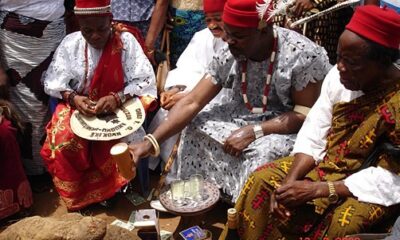
One of the first components of the cleansing ritual is divination (igba afa). Before any cleansing begins, a diviner or dibia afa is consulted to determine the exact nature of the abomination, the deity offended, and the kind of sacrifice required for atonement. Through the diviner’s spiritual insight, the community gains clarity on what went wrong and what must be done to restore balance. This stage establishes the foundation for all other ritual actions.
The next stage often involves confession and acknowledgment of wrongdoing. The offender, or sometimes a representative of the family or community openly admits the act that caused the defilement. Confession is essential because it signifies humility and the willingness to make peace.
The Igbo believe that no cleansing can be complete without truth and repentance. By admitting fault before elders, the gods, and the community, the offender symbolically lifts the veil of secrecy that gives spiritual impurity its power.
Following confession is the preparation and offering of sacrifices. Sacrifices are a central part of Ikpu Aru because they serve as the bridge between humans and the spiritual world. Depending on the gravity of the offense, the sacrifice could include animals such as goats, chickens, or rams; items like kola nuts, palm wine, and yam; or symbolic materials such as nzu, uhie, and ose oji.
These offerings are presented to Ala, to the ancestors, and to any deity believed to have been offended. The act of sacrifice is believed to transfer the impurity from the offender to the offering, which is then ritually disposed of to signify purification.
Another vital ritual element is libation. The priest or elder pours palm wine or water on the ground while invoking the names of deities and ancestors. Libation is both a form of prayer and a means of spiritual communication. It invites the presence of the ancestors to witness the cleansing and intercede for forgiveness. This act connects the living with the spiritual forces that maintain cosmic order.
In some communities, Ikpu Aru includes a symbolic washing or purification rite. This can take the form of washing the offender’s body, hands, or feet with consecrated water or herbal mixtures prepared by the priest. Sometimes, nzu is rubbed on the offender’s body as a symbol of purity and restoration.
In other cases, the person may be required to bathe in a flowing stream or river believed to possess cleansing power. Water in Igbo culture symbolizes renewal and the washing away of defilement.
Ritual pronouncements and blessings follow the cleansing acts. The priest or elder declares the offender or community purified using sacred words that affirm the end of spiritual pollution. These declarations are not mere words but are believed to carry spiritual force capable of sealing the reconciliation between the human and divine realms. The priest may bless the offender with kola nuts and palm wine, praying for renewed fortune, fertility and peace.
In more severe cases, Ikpu Aru extends beyond the individual to include community-wide cleansing ceremonies. This occurs when the abomination affects the land itself, such as when blood is unjustly shed, or a sacred grove is desecrated. During such events, the entire village may gather to perform collective rituals of sacrifice, prayers and fasting. Drums, songs and dances accompany the ceremonies, symbolizing the restoration of joy and unity.
An important aspect of the cleansing is the disposal of ritual remains. The items used in sacrifice or cleansing such as animal remains, ashes, or water are carefully taken to designated sacred places like a forest grove, river, or shrine. This act ensures that the impurity is completely removed from the community. It is believed that improper disposal could invite the return of the defilement.
Finally, the ritual concludes with thanksgiving and celebration. Once the cleansing is complete and peace restored, the participants often share a communal meal. This meal signifies unity, forgiveness and renewed harmony. It also reminds everyone that the purpose of Ikpu Aru is not punishment but reconciliation and spiritual healing.
Altogether, the ritual components of Ikpu Aru reveal the Igbo people’s deep understanding of balance between the physical and spiritual worlds. Every stage, from confession to sacrifice, washing and blessing represents an intentional movement from impurity to purity, from guilt to forgiveness, and from disorder to harmony.
Through these sacred acts, the community not only purifies itself but also reaffirms its collective commitment to the moral and spiritual principles that define Igbo existence.
Social Function of Ikpu Aru
Ikpu Aru serves an important social function in Igbo society in that it preserves moral order, promotes communal harmony and reinforces accountability. Beyond its religious aspect, it operates as a social mechanism that strengthens relationships and upholds collective responsibility.
When an abomination occurs, it is not treated as a private matter but as a community concern. The public nature of the ritual ensures transparency and restores trust among members. By witnessing the offender’s atonement, the community reaffirms shared values and the importance of truth, repentance and forgiveness. This process discourages moral decay and reminds everyone of the consequences of wrongdoing.
Ikpu Aru also plays a role in conflict resolution. It provides a culturally accepted way to heal divisions caused by offenses or taboos. Once the ritual is completed, both the offender and the community are expected to move forward without resentment, promoting peace and unity.
Additionally, the practice serves as a form of moral education. Younger generations learn from observing these rituals that actions have social and spiritual consequences. This helps to preserve discipline and continuity of cultural values within the community.
In essence, the social function of Ikpu Aru lies in its ability to restore not just spiritual purity but also social balance, reinforcing the interconnectedness of individuals within the moral fabric of Igbo life.
Symbolism of the Protocols in Ikpu Aru
Ikpu Aru is rich in symbolism, with every object and action carrying deep spiritual and cultural meaning. Each element of the ritual speaks to the Igbo understanding of purification, renewal and harmony between humans and the divine.
The use of nzu symbolizes purity, peace and a return to innocence after defilement. Water represents cleansing and spiritual renewal, washing away both physical and unseen impurities. Animal sacrifices symbolize substitution, that is, the transfer of guilt from the offender to the offering while libation connects the living with the ancestors, inviting their blessing and forgiveness.
The act of confession is symbolic of truth and humility, a public admission that opens the door to healing. Sacrificial blood represents life and reconciliation believed to seal the restored bond between humans and the gods. Feasting after the ritual symbolizes communal joy, peace and the reaffirmation of unity.
Overall, the symbols in Ikpu Aru express the deeper truth that cleansing is not only physical but spiritual, and that renewal of the soul requires both action and intention. Through these symbols, Igbo people affirm their belief in restoration, balance and the sacredness of life.
Modern Interpretation and Relevance of Ikpu Aru
Ikpu Aru persists in many places, though practices have changed. Christianity and Islam influence how people understand cleansing rituals. Some Christians interpret Ikpu Aru as cultural tradition similar to confession and repentance.
Others avoid it because of religious conflict over offerings and shrine acts. In some areas, the ritual continues privately or in modified form. In other areas, elders or cultural groups perform Ikpu Aru as part of heritage preservation.
Anthropologists and local scholars emphasize that Ikpu Aru is a social tool that can be adapted. As communities change, the forms of cleansing shift while the core idea remains. The core idea is that actions that harm the social or spiritual order must be repaired. That principle continues to guide how people address certain moral breaches.
Modern applications also show up in community dispute resolution where elders use ritual language and symbolic acts to settle problems, even if no explicit shrine offerings are made. In other cases, Ikpu Aru is reinterpreted in human rights and legal frames. For example, some behaviour once seen as Aru may now be treated as a criminal matter.
Ikpu Aru in Contemporary Practice
Although traditional rituals have evolved over time, Ikpu Aru continues to exist in various forms across Igboland, especially in rural and culturally conservative communities. While many of the elaborate sacrifices of the past have been reduced or replaced with symbolic acts, the essence of cleansing, confession and reconciliation remains intact.
In some towns of Anambra, Enugu and Imo States, for instance, when a serious taboo such as incest or desecration of a shrine occurs, the elders still convene to consult a diviner to determine the nature of the offense and prescribe the appropriate cleansing ritual. The diviner may recommend sacrifices such as a goat, fowl, or items like kola nuts and palm wine, depending on the gravity of the defilement.
The ritual usually begins with confession by the offender, either in private before the elders or publicly, depending on the offense. This is followed by symbolic washing or sprinkling of consecrated water, a practice meant to cleanse the body and soul of impurity.
Sacrifices are then made to Ala, and sometimes, to the ancestors, after which libation is poured as a prayer for forgiveness and restoration. Once the ritual is completed, the priest or elder declares the land and people clean again, signifying the end of spiritual pollution.
In many modern settings, especially among educated and Christian Igbo families, the traditional Ikpu Aru has taken on a more moral or spiritual form rather than ritualistic. Offenses are resolved through confession, apology, prayers and symbolic acts of reconciliation rather than animal sacrifices. Churches and community leaders often adopt the principle of cleansing through repentance and forgiveness, reflecting a continuity of the ancient idea in a new context.
This shows that while the form of Ikpu Aru may have changed, its purpose remains the same – to restore peace, purify the spirit and heal the relationship between the individual, the community and the moral order that sustains them all.
In Conclusion…
Ikpu Aru remains one of the most profound expressions of the Igbo understanding of morality, spirituality and community. It embodies the belief that every action has both physical and spiritual consequences and that peace can only be sustained through balance, truth and restoration. Though its outward forms have evolved with time and the influence of modern religion, the essence of Ikpu Aru continues to guide the moral compass of Igbo society.
At its core, the ritual teaches that wrongdoing is not the end of a person or community, but a call to renewal. Through confession, cleansing and reconciliation, the ritual restores harmony between humans and the divine, between individuals and their community, and between people and the land itself. It affirms the timeless truth that purification is not only a spiritual necessity but also a social one. A reminder that collective well-being depends on the moral integrity of all.
In a world where ethical boundaries are often blurred, the philosophy behind Ikpu Aru remains strikingly relevant. It invites modern society to reflect on responsibility, forgiveness and the need for genuine atonement.
Whether practiced through traditional rituals or expressed through modern forms of reconciliation, the culture of Ikpu Aru endures, calling humanity to live in harmony with truth, justice and the sacred laws that bind all creation together.
References
- https://www.researchgate.net/publication/354364186_Imperatives_and_significance_of_Igbo_traditional_practices_of_ancient_Bende_indigenes_of_Abia_State_south-east
- https://en.wikipedia.org/wiki/Ala_%28odinani%29
- https://www.odinanimysteryschool.com/odinani-mystery-school-events-trainings/ikpu-aru-online-training
- Ajakor, E. “The Ritual of Cleansing Abomination in Igboland.” ACJOL. 2024
- “An evaluation of ikpu alu in Igboland in the light of the Old.” Pre-ORCJAH. 2019.
You might want to check this out…