





Heritage
The Role of Sira: First Daughters in Ogoni Marriage Tradition

Ogoni people
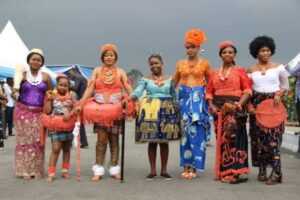
Among the Ogoni people of Rivers State, Nigeria, family and marriage are not only personal milestones but also cultural statements. Every union is tied to ancestry, heritage, and the hope of future generations. Within this context, the figure of the first daughter, known as Sira or sometimes Biakē in different dialects, carries a unique weight in Ogoni society. Her place in family and marriage traditions reflects the deep concern of the Ogoni for identity, continuity, and the survival of their lineage.
Who is the Sira?

Sira tradition, Ogoni
The word Sira translates simply as “first daughter,” but in Ogoni thought it carries far more than a biological description. Like the Igbo concept of Ada, the Sira is considered a custodian of family honor. She is often looked up to as a guide to her younger siblings and a bridge between her parents and the wider kindred.
In many families, the Sira is entrusted with responsibilities of care, mediation, and leadership. She represents stability, and her actions can reflect positively or negatively on the entire household. Because of this special position, her marriage and personal life have historically attracted close attention from her family and community.
The Biakē or Sira Custom
One of the most distinct practices tied to first daughters in Ogoni is the Biakē custom. This tradition emerged out of concerns about family continuity in cases where a man did not have male children. In traditional Ogoni society, sons were regarded as heirs who would inherit property, keep the family name alive, and perform ancestral rites. The absence of a male child often raised fears that a lineage might disappear.
To address this, some families turned to the first daughter. Instead of marrying out, the Sira could remain in her father’s compound and bear children who would continue the family name. These children, though biologically hers, were counted as belonging to her father’s lineage. In this way, the Biakē system ensured that even without sons, the family line would not be considered broken.
It is important to stress that this custom did not apply universally across Ogoni land. Some communities practiced it strictly, while others observed it loosely or not at all. Even within the same village, families could make different decisions depending on their circumstances.
Variations Across Ogoni Land
The Ogoni are made up of several clans like Khana, Gokana, Tai, Eleme, and Oyigbo, each with its own dialect and subtle cultural differences. Practices concerning the Sira also varied among these clans.
In some places, the Biakē arrangement was a matter of family honor and was strongly enforced. In others, it was more symbolic, serving as a reminder of the first daughter’s importance without necessarily limiting her choice of marriage. There are also cases where families allowed the Sira to marry but still maintained that her children carried part of her father’s heritage.
This diversity shows that while the concept of the Sira was widely recognized, its practical application was far from uniform.
Marriage Choices and Cultural Expectations
Because of her symbolic importance, the marriage of a Sira was sometimes surrounded by caution. Families preferred that she marry within the community or within Ogoni land, so that she would remain close to her roots. This made it easier for her to fulfill her family responsibilities and ensured that cultural ties were preserved.
However, many first daughters did marry outside their immediate communities, and in modern times, this has become very common. The idea that first daughters were forbidden from marriage is a misunderstanding. What actually happened was that in families without male children, a daughter, often the first female child was chosen to remain and carry on the family line. Where male children existed, the Sira usually had the freedom to marry like her sisters.
Read More:The Ogoni People || Culture, Traditions, and Heritage of a Proud Niger Delta Tribe
Symbolic Power of the Sira
Beyond marriage and lineage, the Sira holds symbolic power within the family. She is often expected to act as a second mother to her siblings, guiding them in both moral and practical matters. At family gatherings, she commands respect and can play a role in conflict resolution.
In ritual life, the presence of the first daughter can also carry weight. Her blessings are sometimes sought during traditional ceremonies, and her role in burial rites or inheritance discussions may be greater than that of younger siblings. All of these underscore the cultural belief that the first daughter carries a portion of her parents’ spirit and must safeguard it.
Similarities with the Igbo Ǹnè̩té Practice
The Biakē custom in Ogoni land is not unique. A very similar practice exists among the Igbo people, especially in parts of Anambra, Imo, and Enugu States. Among the Igbo, this is known as Ǹnè̩té or Igbu Ǹnè̩té.
Just like Biakē, the Ǹnè̩té custom arises when there is no male child in a family. To preserve the lineage, a daughter, sometimes the first daughter is chosen to remain in her father’s house. In some cases, she may symbolically “marry a wife” in her father’s name. Any children born through this arrangement are considered heirs of her father’s lineage, not of an outside husband.
The main difference is in the form it takes:
- In Ogoni (Biakē), the responsibility is placed directly on the first daughter (Sira) to remain and bear children in her father’s house.
- In Igbo (Ǹnè̩té), the daughter could “marry a wife” for her father’s lineage, and the children of that union belong to her father’s house.
Despite the differences, the underlying cultural logic is the same, lineage must not die because there are no sons. Both Ogoni and Igbo societies saw daughters as capable of carrying on the family line, but they structured the customs differently.
This comparison shows how African communities developed creative solutions to the same challenge, adapting them to their unique cultural frameworks.
The Impact of Christianity and Modern Life
With the spread of Christianity, Western education, and urban living, both the Biakē and Ǹnè̩té systems began to weaken. Churches discouraged practices that seemed to restrict marriage or tie women to compulsory arrangements. Younger generations, exposed to broader ideas of freedom and gender equality, began to challenge customs that limited choice.
Today, most Ogoni and Igbo families no longer enforce these traditions. While elders may still recall them, they survive more as oral history than active practice. First daughters now have complete freedom to marry as they choose, but they still carry symbolic respect as leaders and unifiers within their families.
Cultural Debates Around the Sira and Ǹnè̩té
Even in decline, these customs spark debate. Critics describe them as outdated systems that placed burdens on women, limiting their independence. Supporters, however, see them as practical and culturally sound solutions to the challenge of lineage continuity.
The truth lies somewhere in between. These customs remind us of how much importance African societies placed on family identity, while also raising questions about gender roles in traditional settings. They show how women were seen not only as nurturers but also as vital carriers of family heritage.
The Sira Today
In present-day Ogoni communities, the Sira continues to be respected as the first child of her family, carrying honor and responsibility. She is still looked upon as a stabilizer, a unifier, and often a role model for her siblings. Her marriage is celebrated like that of any other daughter, with no binding restrictions.
Among the Igbo, the Ada continues to hold similar symbolic importance, even as the Ǹnè̩té practice has declined. The continuity between these two cultures highlights a shared African wisdom: that daughters, like sons, are essential to the survival of family and heritage.
Conclusion
The place of the first daughter in Ogoni culture is a fascinating example of how African traditions weave together family, identity, and survival. The Biakē or Sira custom, though sometimes misunderstood, was historically a way to ensure lineage continuity in families without sons. Its close parallel with the Igbo Ǹnè̩té practice shows that across different cultures, the same problem inspired similar solutions.
Today, these customs may have largely faded, but the symbolic respect for the first daughter remains strong. She continues to embody responsibility, unity, and pride, showing that while practices may change, values endure. In celebrating the Sira, and in remembering customs like Biakē and Ǹnè̩té, we celebrate not only daughters but also the resilience of African heritage in a changing world.