

African Culture and Traditions
PIN CASTING (IGHA NTUTU): AN IGBO MYSTERY

Pin casting! The first Christmas I spent in my husband’s hometown, Awgbu in Orumba North Local Government Area of Anambra State, left an unforgettable impression. It wasn’t the food, the masquerades. Those weren’t new to me. It wasn’t even the family reunion. It was something far more mysterious and strange.
After the festivities were over and we were preparing to return to our base, my father-in-law (of blessed memory) called us aside and said, “Before you leave, make sure you go and check yourselves for pin.”
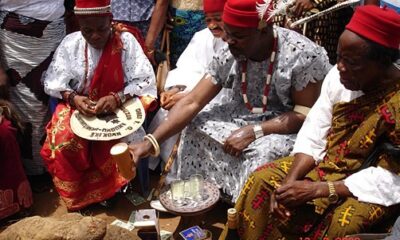
That sentence puzzled me. Check for pin kwa? What pin? I had never heard of such a thing in my life. But it was not something out of place for my husband and his brother. They knew what he was talking about. We obliged, anyways. My husband, my brother-in-law, and I went to the native place where such checks were done. We were told to drop a small fee, a form of offering, and then the process began.
The man in charge, who actually didn’t look anything unusual, began tapping different parts of our bodies. Each time he did that, we were told that if there were pins lodged anywhere inside us, they would fall out, right before our eyes.
He began with my husband. To my amazement, tiny metal pins started dropping on the floor as he tapped him. Then, it was my brother-in-law’s turn. The same thing happened. Finally, it was my turn. I was skeptical, yet curious. But as he tapped my shoulders, thighs, and back, I watched in disbelief as a few small pins fell to the ground.
I was shocked. Speechless. My mind wrestled between curiosity, fear, and the urge to explain what I was witnessing. Was this real? Could it be a trick? Was there a spiritual explanation I didn’t understand?
That particular experience opened my eyes to one of the most fascinating and controversial aspects of Igbo traditional spirituality – Pin Casting, known locally as Igha Ntutu or Igba Pin.
This article explores the mystery of Pin Casting – what it means in, how it is believed to work, the rituals around it, the psychology and spirituality behind it, and how modern medicine and traditional religion view the practice today.
Whether you see it as superstition, spirituality, or cultural science, one thing is clear, Pin Casting holds a deep and enduring place in the Igbo imagination.


THE MEANING OF PIN CASTING (IGHA NTUTU)
Pin casting, popularly known as Igba Ntutu or igba pin in local speech is a form of belief and practice found in parts of Igboland in southeastern Nigeria. At its simplest, pin casting is the idea that a person can be harmed by another who “sends” or “casts” tiny objects (described as pins, needles, or small rods) into a victim’s body or life through secret, supernatural means. The belief can sit somewhere between witchcraft, traditional healing/curse systems, and popular medical superstition
When Igbo people talk about pin casting, they usually mean one of two but related things:
- A spiritual technique. Someone with supposed wicked power (a witch, wizard, or malevolent spiritual agent) directs harm toward another person by casting small symbolic objects in form of pins, nails, thorns through ritual projections. These objects are not always taken literally but are signs that the person has been targeted. Victims believe that the lodged object causes pain, illness, bad luck, paralysis, or in more serious occasions, death.
- A physical claim. People, sometimes, report finding tiny pins or needles in their skin or in the environment, or claim to feel pains as if something is lodged inside them. These reports are often interpreted locally as evidence of pin-casting. Medical investigations sometimes find no foreign object, which leads to debates between healers and clinicians.
In both meanings, pin casting functions as a way for communities to name misfortune, like sudden illness, chronic pain, relationship breakdowns, or unexplained bad luck and point to an external, human source of harm.
HISTORICAL AND CULTURAL PERSPECTIVE
To understand pin-casting, you may need a little background on Igbo spiritual life. Traditional Igbo religion, a.k.a Odinani, includes the idea that the visible world is closely connected to spiritual forces, ancestors, and personal guardian spirits (chi). Specialists – diviners, healers, or ritual experts, when working with the divination oracle, mediate between the seen and unseen. In the wider system, many kinds of misfortune are explained by spiritual attack, broken taboos, or ancestral displeasure.
Pin-casting should be viewed against this background. It is one technique among many by which people believe spiritual specialists or malevolent agents can interfere in another person’s life. Like other practices such as the throwing of afa (divination seeds), the reading of objects, or ritual poisoning, pin casting is embedded in a larger cosmology where words, symbols, and material objects can carry force.
HOW PIN CASTING IS DESCRIBED
Ethnographic work and local studies e.g. the research carried out in Agulu, Anambra State and neighbouring communities record detailed local accounts of the practice. Some common themes are as follows:
- The alleged senders are called witches, sorcerers, or persons who have been initiated into the secret arts. They may be strangers, neighbours, or even relatives. The power may be exercised at a distance. A person can be harmed even though the sender and victim never come in physical contact.
- Accounts vary as to the method of the transmission. Some say a ritual is performed with pins, charms, or effigies. Others describe an act of sending through words, charms, or a symbolic pin planted in a shrine. In the narratives from Agulu, the term Igha Ntutu has been used to tie pin casting to ritual acts intended to ruin someone’s life.
- On the effects, victims often report severe, unexplained body pains, a sense of obstruction, sudden paralysis, joint pains, or persistent coughs and fatigue. Community diagnosis may point to pin casting when biomedical tests do not explain the condition.
- As to the evidence and removal, traditional healers sometimes claim they can detect and extract the pins through divination and ritual cleansing. At the same time, modern medical practitioners warn against dangerous removal practices and call for careful clinical assessment.
These descriptions show why pin casting is both feared and controversial. It operates in the space where community belief, ritual action, and bodily experience overlap.
SOCIAL, PSYCHOLOGICAL, AND CULTURAL REASONS BEHIND THE PERSISTENCE OF PIN-CASTING
There are several reasons the idea of pin casting remains powerful, despite everything:
As a way to explain misfortune. Human beings naturally look for causes. When someone falls ill suddenly, experiences repeated misfortune, or suffers an inexplicable accident, the idea that an enemy has willed it makes social and moral sense. It identifies a culprit and suggests a way to respond. In cultures where spiritual causation is accepted, pin casting fits naturally as an explanation.
Community memory and reports. Stories pass between families and generations. When people report that a neighbour found pins in their skin, the story reinforces belief and spreads fear. Social contagion of such stories fuel continued attention. \
The role of ritual specialists. Dibias and other traditional specialists have recognized authority. If a diviner pronounces that the cause is pin casting and offers a ritual cure, many clients will try it. The ritual process validates the belief.
Medical uncertainty and gaps in care. Where access to quality healthcare is limited, people often combine biomedical care with traditional approaches. Some symptoms – chronic pain, neuropathy, psychosomatic distress are not easily solved by brief clinic visits. This uncertainty creates room for alternative explanations like pin casting.
MEDICAL AND PUBLIC-HEALTH PERSPECTIVES
Public-health professionals and medical writers have called attention to pin-casting as a medical superstition that can harm people in two ways:
Delayed or inappropriate treatment. If someone believes their illness is caused by spiritual pin-casting, they may skip medical tests or delay treatment for serious conditions like infections, diabetes, or neurological disease. This delay can worsen outcomes.
Exploitative “removals.” Scammers or unqualified healers sometimes charge money to “remove” pins or perform risky extraction rituals. These interventions can be harmful, both financially and physically. Health writers in Nigeria have urged authorities to educate the public and regulate harmful practices.
At the same time, health experts recognize the social reality’ Beliefs are real influences on behaviour. Efforts to change harmful practice must therefore respect local culture and involve trusted community leaders, including traditional healers, rather than only criminalizing belief.

CASE STUDIES AND ACADEMIC WORK ON PIN CASTING
Scholarly and fieldwork sources provide the most detailed, verifiable accounts of how pin casting is talked about locally. For example, a study focused on the Agulu people discusses Pin Casting (Igha Ntutu) as a locally important practice used to settle disputes, punish enemies, and express social anxieties. The paper explores how pin casting is woven into larger systems of witchcraft belief and ritual action.
Journalistic pieces and editorials e.g. pieces in ThisDay and other Nigerian media outlets have pointed out the public-health problem that arises when the belief turns into a business of “pin removal” or into excuses to avoid clinical care. These pieces argue for health education campaigns and community engagement.
These sources help us separate folklore and lived experience from properly documented phenomena, while showing the social consequences of the belief.
HOW COMMUNITIES TRY TO PREVENT OR CURE PIN CASTING
Responses in local communities vary widely. Common responses include:
Consulting a dibia or diviner. The most common route is to visit a trusted diviner or healer who performs detection and removal rituals. Such rituals may include herbal baths, sacrifices, and symbolic extraction of pins.
Religious solutions. Christian and Muslim communities often handle such cases through prayer, deliverance sessions, or pastoral counselling. Some believers see pin casting as demonic activity, treated by prayer rather than traditional medicine.
Medical check-up. In areas with good access to healthcare, clinicians will rule out physical causes and may treat pain and underlying disease. Public-health outreach encourages people to use clinics for unexplained symptoms.
Community sanctions. Sometimes, communities identify a suspected sender and use social pressure, reconciliation, or ritual expiation to resolve conflict. This shows that pin casting is not only about health, but also part of social control and moral order.
Effective prevention often combines education so that people know when to seek clinical care, engagement with local leaders, including dibias, and legal measures against fraudulent or abusive “removal” practices.
WHY RESEARCHERS SAY PIN CASTING SHOULD BE STUDIED MORE CAREFULLY
Pin casting sits at the intersection of anthropology, public health, and sociology. Researchers point to several reasons for careful study:
- It is a window into moral economies and social conflict. Claims of pin casting often arise in situations of jealousy, competition, or local tensions. Studying the practice reveals how communities manage suspicion.
- It affects health-seeking behaviour. Understanding local explanations for illness is crucial for designing effective health campaigns and interventions.
- It may be exploited. Where belief exists, unscrupulous actors may take advantage of vulnerable people. Research can guide policy to protect citizens.
- It connects to larger traditions. Pin casting is linked to broader Igbo ideas about divination, witchcraft, and the role of the dibia. So, it matters for the study of Odinani and West African ritual life.
Researchers are advocating for mixed methods, which include combining interviews, participant observation, public-health data, and clinical study in order to understand both the meaning and effect.
PRACTICAL ADVICE
In the event where one is worried about pin casting, these practical steps that combine respect for local belief with good health practice may suffice:
Get a medical check-up first. Pains and other unexplained symptoms can have treatable biological causes. Begin with a clinical assessment. If the clinic finds a medical condition, follow medical advice.
If the clinical tests are inconclusive, consider both routes. Many people choose to combine biomedical care with consultation of trusted community healers or religious leaders. That combined approach can respect belief while not refusing clinical oversight.
Avoid dangerous extraction procedures. Do not allow anyone to perform risky physical “removals” or charge excessively for “cures.” Report abusive practitioners to local authorities or health agencies.
Seek community support. Trusted family members, clergy, or community leaders can help separate rumour from fact and reduce stigma. Many cases of suspected pin casting are tied to interpersonal conflict. A calm, community-led review can help.
If you’re a health worker, approach concerns respectfully. Dismissive statements about belief often drive people away. Education campaigns that respect local culture while explaining medical models work best.
IN CONCLUSION…
Pin casting , or Igba Ntutu is more than a single ritual. It is a set of beliefs and practices that satisfy social, emotional, and moral needs in many Igbo communities. The idea that tiny pins can be “sent” to harm someone helps people explain suffering, name an enemy, and call for justice. At the same time, the belief can become harmful when it prevents timely medical care or fosters exploitative “cures.” For those reasons, pin casting deserves careful, respectful attention from researchers, health workers, and policy makers.
The key takeaway is, if you encounter the claim of pin casting, treat the person’s distress as real, begin with proper medical evaluation, and then work sensitively and respectfully to integrate community resources (healers, religious leaders) where appropriate. That combined approach protects health, reduces exploitation, and honours cultural meaning at the same time.
REFERENCES
- https://rsisinternational.org/journals/ijriss/Digital-Library/volume-4-issue-2/315-324.pdf
- https://www.thisdaylive.com/2023/11/04/igba-pin-and-other-medical-superstitions
- https://www.modernghana.com/news/1268765/igba-pin-and-other-medical-superstitions-in-nige.html
- https://www.semanticscholar.org/paper/Pin-Casting-%28Igba-Ntutu%29-and-Piosoning-an-Art-of-in-Chuks/89b5cadb69036334044e3a4818cd551f1b322f86
- https://en.wikipedia.org/wiki/Odinani
You can check this out…
https://nnewicity.com/ogbanje-in-igbo-tradition-what-it-was-then-and-how-it-is-today/