





Igbo Practices
Why People Pour Drink on the Ground: The Meaning of Libation in Igbo Culture

The Concept of Pouring Drink on the Ground in Igbo Culture

Across many communities in Nigeria and Africa, there is a familiar act that people perform almost without thinking: before they start drinking, they open the bottle, shake the drink gently, and pour a small portion on the ground. Some do it quietly without saying anything, while others accompany it with short sentences like “for the land,” “for the ancestors,” or “for those before us.” It is an act that many young people have seen growing up but never fully understood. Some believe it is just a harmless cultural habit, while others think it is spiritually deep or even dangerous. Yet, behind this simple motion of pouring a drink on the earth lies a long history, a cultural meaning, and a worldview that connects people to the land, to their heritage, and to the unseen world around them.
The practice is known across Africa as libation, but among the Igbo it is usually called ita mmanya n’ala or itu mmanya n’ani, meaning “pouring drink on the land.” The idea seems simple: before you take something for yourself, you acknowledge that you are not the only one present in the environment. You honour the land that carries you, and you remember the people who lived before you. This very ordinary act is rooted in the belief that life is not only physical. Africans traditionally understand the world as having both visible and invisible layers, and the ground beneath our feet represents more than soil. It represents the resting place of ancestors, the home of spiritual forces, and the foundation of all blessings. So, pouring drink on the ground becomes a way of showing respect, acknowledging presence, inviting blessings, or even asking for protection.

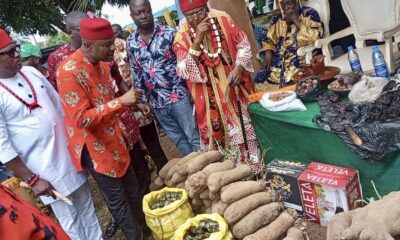
A chief pouring drink on the ground
In many traditional communities, people do not just drink impulsively. In olden times, when elders opened a pot of palm wine, they first poured a little on the ground and called the names of their forefathers. It was a moment of connection. The ancestors were believed to still watch over the living, guiding them, protecting them, and ensuring that the lineage continued in peace and prosperity. When someone poured drink and said something like, “May our ancestors bless this gathering,” it was not idol worship in the way some people see it today. Instead, it was a cultural prayer, similar to saying grace before a meal. The belief behind it was simple, it showed that the living and the dead share a bond, and remembering the dead is a way to keep the family united across generations.
The ground, or Ala, is also very important in Igbo spirituality. She is more than earth, she is the Earth Mother, the custodian of morality, fertility, and order. In many communities, everything returns to the earth, so the earth is treated with respect. When people pour drink on the ground, they are acknowledging the presence of this spiritual force. They are saying, “May this land not turn against us,” or “We are grateful to the land that feeds us,” even if they do not say it out loud. It is believed that blessings and curses alike are tied to the land, and that the earth hears, witnesses, and responds. So, pouring drink becomes a symbol of humility. It shows that humans recognise they are not above the earth but part of it.
In many Igbo communities, the act of pouring drink on the ground is also connected to traditional prayers and other symbolic gestures. Sometimes an elder begins the process by breaking a kola nut, calling on the ancestors, and speaking blessings for peace, unity, and protection. As the kola is broken, shared, and blessed, a little drink may be poured on the earth to invite the ancestors to witness the moment. In some communities, the elder also makes small white marks on the ground with nzu (white chalk), which represents purity, truth, and a clean heart. These gestures are not harmful rituals; they are cultural ways of showing respect to the land, acknowledging ancestral presence, and grounding the prayer in tradition. The drink, the kola nut, the spoken words, and the chalk marks all come together to form a complete cultural expression of gratitude, remembrance, and blessing.
Another important meaning behind the act is permission. In the traditional mindset, it is not proper to just start consuming something, especially alcohol, without acknowledging the spiritual world. The act of pouring a small portion on the ground first is like saying, “May this drink not harm me. May it be a drink of joy and not of trouble.” In many communities, when a group of men is gathered and someone brings a bottle, the elderly person present often performs this act first. It is a way of opening the drinking session, almost like a cultural blessing for the group to enjoy without any negative spiritual consequences.
There is also a deeper layer related to truthfulness and accountability. When people in the past settled disputes or made strong declarations, they sometimes poured drink on the ground to seal their words. The belief was that the earth does not lie. If you poured drink and made a promise or statement, and it was false, the earth would bear witness and could punish the liar. This turned the simple act into a covenant symbol. People feared to lie when drink had been poured because it meant calling spiritual witnesses to the conversation. It also helped maintain honesty in the community. The presence of the earth goddess or the ancestors in that symbolic act encouraged people to speak truthfully or face consequences.
With modernization, migration, and the spread of Christianity and Islam, many people began to see the act differently. Some started to believe it was evil or demonic, especially because of the spiritual language associated with it. Others feared it because certain people began to use drinks in harmful rituals. It became easy for society to confuse the normal cultural practice with negative spiritual activities. However, the original act itself was never created for harm. It was meant for respect, remembrance, prayer, and blessings.
This is where the difference lies, the traditional form of libation is usually simple, harmless, and open. A person pours a little drink, says a few words, and everyone present understands that it is a cultural greeting to the land or a short ancestral prayer. Nothing secretive is involved. But harmful rituals that involve drinks, charms, blood, or strange objects are very different. Those are deliberate spiritual practices designed to cause harm or manipulate outcomes. They are usually done at night or in secrecy and involve ingredients that go far beyond ordinary drink. Understanding this difference helps people see that not everything that involves pouring drink on the ground is negative.
Interestingly, even people who do not think deeply about culture still pour drink casually. Some young men in bars or hangouts do it jokingly. They call it “for the boys on the other side” or “for those who came before us,” even if they do not fully believe in it. Some people do it as a form of respect for departed friends. Others do it as a harmless tradition they grew up watching uncles perform. In those cases, the act has shifted from spiritual to almost symbolic or cultural. It represents connection to roots, to brotherhood, or to memory.
Click herehere to watch a video of Kanayo.O. Kanayo performing libation
Many Nigerian communities share this tradition beyond the Igbo. Yoruba people practice tẹbọ, where they pour gin or palm wine to call the ancestors. Edo people also pour drink to honour their lineage and the deities that protect the land. Urhobo, Isoko, Efik, and Benin communities all have similar customs. Even outside Africa, ancient Egyptians offered wine to the gods, and ancient Greeks poured drink on the ground as an offering to Zeus or the dead. This shows that libation is not unique to one culture. It is a universal human expression of honouring higher forces, acknowledging the unseen, and showing gratitude.
In today’s world, the meaning of the act continues to evolve. Some people see it purely as culture, others view it as spirituality, and many see it as a mixture of both. Some Christians who still participate in traditional customs interpret it as simply remembering ancestors or showing respect to the land that God created. Others avoid it entirely because they believe it contradicts their faith. Both perspectives exist side by side, and they reflect the diversity of modern African beliefs.
What remains true is that the act is deeply rooted in history. It is a reminder that before modern religion, before Western education, and before social changes, African communities had their own ways of acknowledging the sacred. They understood life as a cycle where the living, the dead, and the land interact constantly. To pour drink was to say, “I am part of something bigger. I recognise those who came before me. I acknowledge the forces that surround me.” In this way, the act becomes not only a tradition but also a philosophy, a way of seeing life.

nze njemanze pouring the festival libation[Photo Source: Google]
Conclusion
In the end, pouring drink on the ground is a small act with a long history. It is one of those cultural habits that holds multiple meanings at once — respect, memory, blessing, permission, truth, and connection. It shows how deeply Africans value the relationship between the living and the unseen. Whether someone sees it as a prayer, a greeting, a remembrance, or a cultural habit, the act remains an important part of the African story. And like many traditions, it carries a message: before you enjoy anything in this world, remember where you stand, remember who stood before you, and remember the land that holds everything together.
Read about:10 Popular Igbo Cultural Festivals and Traditions You Should Know